Jahr: 2021

  • Online workshop: The Role of Social Protection in Cushioning the Effects of Pandemics: First empirical evidence (and lessons) from COVID-19, January 29 2021

    Logo: PEGNet
    ©PEGNet

    The COVID-19 pandemic puts enormous pressure on economies and societies worldwide. This is particularly true for low and middle income countries, where many people are engaged in low-wage informal employment. The online event took place on 29 January  2021 and was jointly organised by the German Development Institute / Deutsches Institut für Entwicklungspolitik (DIE) and PEGNet.
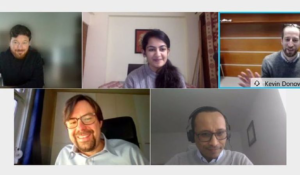


    Screenshot: Pegnet online event
    ©DIE

    Four distinguished speakers from leading universities presented their latest empirical studies on the role of social protection in cushioning the effects of the COVID-19 pandemic. Garima Sharma (Massachusetts Institute of Technology) started and presented latest evidence on the impacts of a pension scheme in India. She was followed by Christian Oldiges (University of Oxford), who showed how the employment guarantee programme (MGNREGA) support beneficiaries in dealing with the COVID-19 lockdowns in India. Kevin Donovan (Yale University) presented evidence that cash transfers have positive economic impacts on microenterprises in Kenya during the COVID-19 lockdowns. At last, Kibrom Tafere (World Bank) discussed the protective impacts of the Productive Safety Net Programme (PSNP) during the COVID-19 pandemic in Ethiopia. After the presentations, the moderator, Christoph Strupat (DIE), discussed with the speakers and the audience what kind of social protection policies have been most effective in cushioning the effects of the pandemic and which ones could improve the resilience of people in low and middle income countries in the future.

    You can re-watch the event here
  • Research phase in the Postgraduate Training Programme: team UNDS reform reports

    We are constantly in a process of development – the world keeps turning every day, everyone is always taking a step forward. We work in development projects and develop individually, for example through the postgraduate training programme. It is a process that never stands still, even if we tend to be habitual. These habitual structures sometimes need to be adapted, to the new, over which we often have no control.

    How the United Nations (UN) organises these adaptation processes within its development system (UNDS) is what we are currently investigating in our research. During these last months, we have been influenced by the second wave of the pandemic that has been stronger than previously expected. For our research, this means a lot of change and above all: digitalisation. Our project on the UNDS reform, once planned with a stay of several months in South Africa, is now being conducted from Germany but, thanks to the digital possibilities, worldwide after all.

    The supposed loss turned out to be a gain in our particular case in the last few weeks. While no longer having to be physically present in the field, we can collect data worldwide and investigate our research questions in Côte d’Ivoire, Georgia and Uganda.

    As a research team studying changes across a system, we realise that sometimes we too have to change our usual/familiar structures in order to move forward. We have the rare chance to do a new kind of research and to reach out to actors in a way that would not have been possible through travelling in such a short period of time. Isn’t it disappointing that we cannot gain intercultural experience on the ground? Of course it is. And we also assume that by working digitally, we will have less access to stakeholders – especially beyond the UN system – in the countries.

    But for our study, it seems to us, the advantages of digital research outweigh the disadvantages. We are very aware that we are in a privileged position. And so we hope to develop ourselves in this process to such an extent that in the future we can better assess for which projects we can use the opportunities of digital research as a sensible alternative to field research involving climate-damaging travel – and for which projects digital approaches are less suitable. As a team, we have the rare opportunity to conduct a valuable digital study of a global system and are very grateful to be able to take such big steps forward during this difficult time.

  • PGK-Forschungsphase: Team UNDS-Reform berichtet

    Wir befinden uns ständig in einem Prozess der Entwicklung – die Welt dreht sich jeden Tag weiter, alle gehen immer einen Schritt nach vorn. Wir arbeiten in Entwicklungsprojekten und entwickeln uns individuell weiter, zum Beispiel durch das Postgraduierten-Programm. Es ist also ein Prozess, der niemals stillsteht, auch wenn wir zu Gewohnheiten neigen. Diese gewohnten Strukturen müssen manchmal angepasst werden, an das Neue, auf das wir oft keinen Einfluss haben.

    Wie die Vereinten Nationen (UN) diese Anpassungsprozesse innerhalb ihres Entwicklungssystems (UNDS) organisiert, untersuchen wir momentan in unserer Forschung. Während der letzten Monate sind wir dabei unerwartet stark von der zweiten Welle der Pandemie beeinflusst worden. Für unsere Forschung bedeutet das viel Wandel und vor allem: Digitalisierung. Unser Projekt über die UNDS-Reform, einst mit einem mehrmonatigen Aufenthalt in Südafrika geplant, findet nun von Deutschland aus, aber dank der digitalen Möglichkeiten, doch weltweit statt.

    Der vermeintliche Verlust entpuppte sich in den letzten Wochen in unserem besonderen Fall als Gewinn. Dadurch, dass wir nicht mehr vor Ort sein müssen, können wir weltweit Daten erheben und unsere Forschungsfragen nun in Côte d’Ivoire, Georgien und Uganda untersuchen. Wir merken als Forschungsteam, das den Wandel eines gesamten Systems untersucht, dass auch wir unsere gewohnten Strukturen manchmal ändern müssen, um voran zu kommen. Wir haben die seltene Chance, eine für uns neue Art der Forschung zu betreiben und Akteur*innen zu erreichen, wie es durch Reisen in so kurzer Zeit nicht möglich gewesen wäre. Ob es nicht enttäuschend ist, dass wir nicht vor Ort interkulturelle Erfahrung sammeln können? Natürlich. Und wir gehen auch davon aus, dass wir durch die digitale Arbeitsweise einen geringeren Zugang zu Stakeholdern – vor allem jenseits des UN-Systems – in den Ländern haben werden.

    Doch für unsere Studie, so scheint es uns, überwiegen die Vorteile der digitalen Forschung. Wir sind uns sehr bewusst, dass wir damit in einer privilegierten Position sind. Und so hoffen wir, dass wir uns selbst in diesem Prozess so weit entwickeln, dass wir in Zukunft besser einschätzen können, für welche Vorhaben wir die Chancen der digitalen Forschung als sinnvolle Alternative zu mit klimaschädlichen Reisen verbundener Feldforschung nutzen können – und für welche Vorhaben digitale Herangehensweisen weniger gut geeignet sind. Wir haben als Team die seltene Chance, eine wertvolle digitale Untersuchung zu einem weltweiten System durchzuführen und sind sehr dankbar, während dieser schweren Zeit solche großen Schritte nach vorne machen zu können.

  • Online event series by MGG Network, PRODIGEES and CIFE continued

    Screenshot: Presentation Dr. Dominguez
    ©Juan Carlos Dominguez

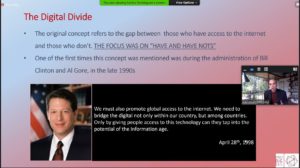
    The Managing Global Governance (MGG) Network and its EU-funded research initiative on digitalisation and sustainable development PRODIGEES continued its collaboration with the Centre international de formation européenne (CIFE) in February with a presentation “Digital but still Unequal: Challenges of Smart Technologies from a Comparative Perspective” by Dr. Juan Carlos Dominguez of Instituto Mora in Mexico City. Dr. Dominguez, an alumnus of the MGG Academy and key partner for both PRODIGEES and the MGG Network, encouraged participants to reflect on the degree to which the international development agenda lags behind technological advancement. At the same time, he advocated for caution, claiming that science and technology are not the “magical bullets” to solve all global problems.

    Dr. Dominguez’ presentation continues a PRODIGEES-CIFE online event series which began with Instituto Mora’s Dr. Simone Lucatello in a discussion about the intersection between digitalisation and climate change.

    More information about the series, including recordings of past presentations, can be found on CIFE’s Executive Trainings web page.

    For more information about the PRODIGEES project, please consult our website at www.prodigees.info.

  • Online Veranstaltungsreihe des MGG-Netzwerk, PRODIGEES und CIFE weitergeführt

    Screenshot: Presentation Dr. Dominguez
    ©Juan Carlos Dominguez

    Das Managing Global Governance (MGG)-Netzwerk und seine EU-geförderte Forschungsinitiative zu Digitalisierung und nachhaltiger Entwicklung PRODIGEES setzten die Zusammenarbeit mit dem Centre international de formation européenne (CIFE) im Februar mit einem Vortrag „Digital but still Unequal: Challenges of Smart Technologies from a Comparative Perspective“ von Dr. Juan Carlos Dominguez vom Instituto Mora in Mexiko-Stadt, fort. Dr. Dominguez, ein Alumnus der MGG Academy und wichtiger Partner sowohl für PRODIGEES als auch für das MGG-Netzwerk, forderte die Teilnehmer*innen auf, darüber nachzudenken, inwieweit die internationale Entwicklungsagenda dem technologischen Fortschritt hinterherhinke. Gleichzeitig mahnte er zur Vorsicht und betonte, dass Wissenschaft und Technologie keine „Geheimwaffen“ zur Lösung aller globalen Probleme seien.

    Die Präsentation von Dr. Dominguez setzte eine Online Veranstaltungsreihe von PRODIGEES und CIFE fort, die mit Dr. Simone Lucatello vom Instituto Mora in einer Diskussion über die Schnittmenge zwischen Digitalisierung und Klimawandel begonnen hatte.

    Weitere Informationen über die Reihe, einschließlich Aufzeichnungen vergangener Präsentationen, finden Sie auf der CIFE-Webseite Executive Trainings.

    Weitere Informationen über das PRODIGEES-Projekt finden Sie auf unserer Website www.prodigees.info.