Jahr: 2021

  • Bis uns die Schulden auseinanderreißen? Internationale Zusammenarbeit und sozio-ökonomische Gerechtigkeit in einer Post-Covid19-MENA-Region

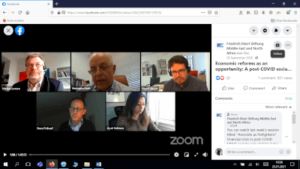
    Screenshot: Event series Until debt tear us apart? , facebook-session with Markus Loewe, Mustapha Nabli, Henrik Mayer, Hans Frühauf and Ayat Solman
    ©DIE

    Das Deutsche Institut für Entwicklungspolitik (DIE) und die Friedrich-Ebert-Stiftung (FES) hatten im im Herbst 2020 eine Reihe von Online-Debatten organisiert. Die Debatten bauten auf den Forschungs- und Politikaktivitäten der Teams für den Nahen Osten und Nordafrika (MENA) in beiden Organisationen auf und konzentrierten sich auf die Frage, wie internationale Akteure ihre Unterstützung für sozioökonomische Gerechtigkeit erneuern könnten, während sich die Region dem zehnten Jahrestag der Aufstände des „Arabischen Frühlings“ im Jahr 2011 nähert.

    Fünf Online-Debatten fanden zwischen September und Dezember 2020 statt. Die ersten vier waren für die Öffentlichkeit zugänglich, die fünfte war eine geschlossene Sitzung für politische Entscheidungsträger*innen der Europäischen Union (EU) und Deutschlands. Expert*innen und Entscheidungsträger*innen aus den MENA-Ländern, Europa und Nordamerika nahmen an den Debatten teil, die sich jeweils auf ein bestimmtes Thema konzentrierten. Weit über 100 Teilnehmer*innen verfolgten jede der vier öffentlichen Debatten, die auch live auf Facebook gestreamt wurden.

    Die erste Debatte konzentrierte sich auf die Finanzkrisen, die durch die Covid-19-Pandemie verschärft wurden, und die Rolle der internationalen Finanzinstitutionen in der Region. Die zweite diskutierte die internationale Unterstützung für Wirtschaftsreformen und mögliche „Post-Covid“-Sozialverträge in den MENA-Ländern. Die dritte Debatte befasste sich mit den Volksprotesten und der sogenannten „zweiten Welle“ des Arabischen Frühlings. Die vierte Debatte konzentrierte sich auf die Europäische Union als Entwicklungsakteur und Unterstützer des Wandels, insbesondere in Palästina und im Libanon. Die fünfte Debatte für politische Entscheidungsträger*innen beleuchtete die sozialen und wirtschaftlichen Auswirkungen der Covid-19-Krise und wie internationale Geber, insbesondere die Europäische Union und Deutschland, Unterstützung mobilisieren können, um die Schocks der Pandemie in der Region zu lindern.

    Die MENA-Forschungs- und Politik-Teams des DIE und der FES waren mit den Reaktionen auf die Debatten sehr zufrieden. Das Online-Format war zunächst lediglich als Mittel gewählt worden, um die Diskussionen während der Pandemie fortzusetzen, aber es ermöglichte eine breite Beteiligung und einen regen Austausch unter Kolleg*innen aus der ganzen Welt. Das DIE und die FES erwägen, später im Jahr 2021 weitere Debatten in diesem Format zu organisieren.
  • Until debt tear us apart? International cooperation and socio-economic justice in a post-Covid19 MENA region

    Screenshot: Event series Until debt tear us apart? , facebook-session with Markus Loewe, Mustapha Nabli, Henrik Mayer, Hans Frühauf and Ayat Solman
    ©DIE

    The German Development Institute / Deutsches Institut für Entwicklungspolitik (DIE) and the Friedrich Ebert Foundation (FES) organised a series of online debates in the autumn of 2020. The debates built on the research and policy activities of the Middle East and North Africa (MENA) teams in both organisations, and focussed on how international actors could renew their support for socio-economic justice as the region approached the 10th anniversary of the ‘Arab Spring’ uprisings in 2011.

    Five online debates took place between September and December 2020. The first four were open to public participation and the fifth was a closed session for EU and German policymakers. Experts and decision makers from MENA countries, Europe and North America joined the debates, each focussing on a specific topic. Well over 100 participants tuned in to each of the four public debates, which were also streamed live on Facebook.

    The first debate centred on the financial crises that have been exacerbated by the Covid-19 pandemic, and the role of international financial institutions in the region. The second discussed international support for economic reform and potential ‘post-Covid’ social contracts in MENA countries. The third debate raised the issue of popular protests and the so-called ‘second wave’ of the Arab Spring. The fourth focussed on the European Union as a development actor and supporter of change, especially in Palestine and Lebanon. The fifth debate for policymakers highlighted the social and economic fallout of the Covid-19 crisis and how international donors, especially the European Union and Germany, can mobilise support to alleviate shocks from the pandemic in the region.

    The MENA research and policy teams at DIE and FES were very pleased with the responses to the debates. The online format was only chosen as a practical means of continuing discussions during the pandemic, but it enabled a broad participation and lively exchanges among colleagues from all over the world. The DIE and the FES are considering organising more debates in this format later in 2021.

  • Political transition in the US – a tidal change for the Future of Globalisation? A collection of experts’ opinions

    Photo: The White House in Washington

    Globalisation in the sense of increasing global connectedness has seen difficult times over the last years. The global financial crisis showed the vulnerability of our economic systems and middle classes. Multilateralism was challenged by “my country first” movements, not least so from the US, one of the godmother nations to the post-WWII world order. The other godmother, the UK, turned its back to the EU’s integration project. Furthermore, trade wars increased trade barriers and changed the setting for global production chains. And certainly in 2020, a global pandemic was (and is) most effectively curbed by the limitation of individual movements, often reducing cross-border linkages.

    (mehr …)