The consideration of the relevance of human health, animal health and environmental health as well as biodiversity is called the „One Health“ approach. It envisages the promotion and maintenance of health in all these areas through preventive measures. The Federal Ministry for Economic Cooperation and Development (BMZ) in Germany is strengthening its commitment in the context of the One Health approach. Anna-Katharina Hornidge, Director of the German Development Institute / Deutsches Institut für Entwicklungspolitik (DIE) is one of nine scientists appointed to the ministry’s One Health advisory board. This interdisciplinary body will provide comprehensive and independent advice to BMZ on its priorities in the above-mentioned areas.
Der „One Health“-Ansatz betrachtet die Relevanz von menschlicher Gesundheit, Tiergesundheit sowie Umweltgesundheit und Biodiversität. Er sieht vor, Gesundheit in allen genannten Bereichen durch präventive Maßnahmen zu fördern und zu erhalten. Das Bundesministerium für wirtschaftliche Zusammenarbeit und Entwicklung (BMZ) verstärkt sein Engagement im Kontext des One-Health-Ansatzes. Als eine von neun Wissenschaftler*innen wurde DIE-Direktorin Anna-Katharina Hornidge in den Beirat One Health des Ministeriums berufen. Das interdisziplinär besetzte Gremium wird das BMZ hinsichtlich seiner Schwerpunktsetzung in den genannten Themenbereichen umfassend und unabhängig beraten.
In the context of this year’s High-Level Political Forum (HLPF), Imme Scholz, Deputy Director at the German Development Institute / Deutsches Institut für Entwicklungspolitik (DIE) took part in the panel „Protecting and advancing human wellbeing and ending poverty“. This year’s HLPF took place in New York from 7 to 16 July 2020. Due to the Covid-19 pandemic, most of the events were held online. In her contribution to the virtual panel, Imme Scholz explained the connection between human development as defined by the Human Development Index and the consumption of natural resources associated with this value. As a rule, high levels of human development go along with large ecological footprints. A deeper analysis of changes between 2000 and 2015 in 53 developing countries elaborated by Francesco Burchi and Daniele Malerba (both DIE) showed that 70% of countries improved their levels of employment, health and education, but at the same time increased their CO2 emissions. Still, there were 11 countries that managed to keep this increase below 2 t CO2 per person. The best performers were Uruguay and Costa Rica: small countries with solid democracies, low levels of economic and social inequality, whose health and education systems perform better (often much better) than Latin America as a region and better than upper middle-income countries. Both have high public investment in quality education in schools and universities, and they have universal health coverage systems since decades. And they have invested massively in renewable energy technologies in recent years.
In the context of the Covid-19 crisis this means that in the 21st century, human well-being will be much more related to resilient public infrastructures than to ever rising household incomes.
Im Rahmen des diesjährigen High-Level Political Forum (HLPF) nahm Imme Scholz, stellvertretende Direktorin des Deutschen Instituts für Entwicklungspolitik (DIE) an dem Panel “Protecting and advancing human wellbeing and ending poverty” teil. Das HLPF fand vom 07.-16. Juli 2020 in New York statt.
Auf Grund der Covid-19-Pandemie wurde ein Großteil der Veranstaltungen online abgehalten. In ihrem Beitrag zu dem virtuellen Panel erläuterte Imme Scholz den Zusammenhang zwischen menschlicher Entwicklung im Sinne des Human Development Index, und dem mit diesem Wert einhergehenden Verbrauch natürlicher Ressourcen. Aktuell geht ein hoher Stand menschlicher Entwicklung ausnahmslos mit einer Überbeanspruchung natürlicher Ressourcen einher, während ein ökologisch nachhaltiger Ressourcenverbrauch zumeist bedeutet, dass die entsprechenden Länder niedrige Werte des Human Development Index aufweisen. Vertiefte Analysen von Francesco Burchi und Daniele Malerba vom DIE zu Veränderungen in 53 Entwicklungsländern zwischen 2000 und 2015 zeigen, dass 70 Prozent der Länder ihre Werte bei Beschäftigung, Gesundheit und Bildung verbessern konnten und dass dabei auch ihre CO2-Emissionen stiegen. Es gibt aber auch elf Länder, denen es gelungen ist, den Anstieg dabei sehr gering zu halten (unterhalb von zwei Tonnen CO2 pro Kopf). Uruguay und Costa Rica gehen hier allen voran: kleine Länder mit soliden Demokratien und einem niedrigen Niveau an sozialer und wirtschaftlicher Ungleichheit, deren Gesundheits- und Bildungssysteme leistungsfähiger als die Lateinamerikas insgesamt und auch als die vieler anderer Länder mit mittlerem Einkommen sind. Beide Länder investieren hohe öffentliche Mittel in Schulen und Universitäten und sie verfügen seit Jahrzehnten über eine universelle Krankenversicherung. Und sie haben in den letzten Jahren die erneuerbaren Energien enorm ausgebaut.
Auch aus der Sicht der Covid-19-Krise bedeutet dies, dass menschliches Wohlergehen zukünftig weltweit stärker von leistungsfähigen und resilienten Versorgungsinfrastrukturen abhängen wird als von stetig wachsenden Haushaltseinkommen, so Imme Scholz.
Sustainability and digitalisation are two of the most impactful discussions in today’s landscape. Each of them individually has generated a massive amount of research about how they can change essential practices, and mostly, governance, businesses, and society. However, the confluence of both of these trends largely remains uncharted. Many research activities on the concepts like digitalisation, digital transformation, industry 4.0 applications, etc. exist, but not all relevant dimensions have been well investigated. Although the attention is paid to these two swings individually, less attention is directed to understand how these developments can combine to reimagine a sustainable system. The potential offered by digitalisation and artificial intelligence (D&AI) — big data, deep learning, the internet of things, virtual reality, and more — is often designated with growth. A similar build-up can also be seen around sustainable transformation. The conjunction of D&AI and sustainability offers both opportunities and challenges. On the one hand new technologies can fuel sustainable innovation and on the other hand they can craft problems like the digital gap, cyber-crime, and privacy concerns. It is crucial to distinctly identify the gains and trade-offs for developing an inclusive, safe, and healthy system for improved quality of life for all.
Given the existing gap in knowledge, the project “Digitainable” of the Bonn Alliance for Sustainability Research / Innovation Campus Bonn (ICB) aims to investigate how, why and where D&AI contribute in the expansion of existing arrangement in-place for the achievement of the Sustainable Development Goals (SDGs). The influences of D&AI on indicators of the SDGs considering their interlinkages are the main focus of the project. The interdisciplinary research group approaches these issues from a technological as well as from a social perspective. The methods used within the group are further harmonised by transdisciplinary approaches involving various stakeholders from the domain. In addition to scientific contributions, the team organised events to engage with broad expertise essential for a better understanding of the conjunction of D&AI and sustainable development.
D&AI capabilities for SDGs
The project of the Bonn Alliance for Sustainability Research defined digitalisation (D) as ‚the social transformation triggered by the mass adoption of digital technologies that generate, process, and transfer information‘ (Katz and Koutroumpis 2013) and artificial intelligence (AI) as the use of science and engineering (software or hardware) to create intelligent machines that can make and/or act on decisions that usually require organic intelligence or as Max Tegmark said, „Intelligence that is not biological.“ The team has recognised eight D&AI capabilities that could benefit the SDGs. These eight capabilities are further grouped into three major categories: Data-Driven, Analytics-Driven, and Design Driven. The image below reflects the classification of capabilities we have considered in our research. The project team is aware that some of these capabilities may have an overlap; however, for the sake of simplicity in exploring the on-ground purpose of capabilities for SDG indicators and interlinkages, we established this classification.
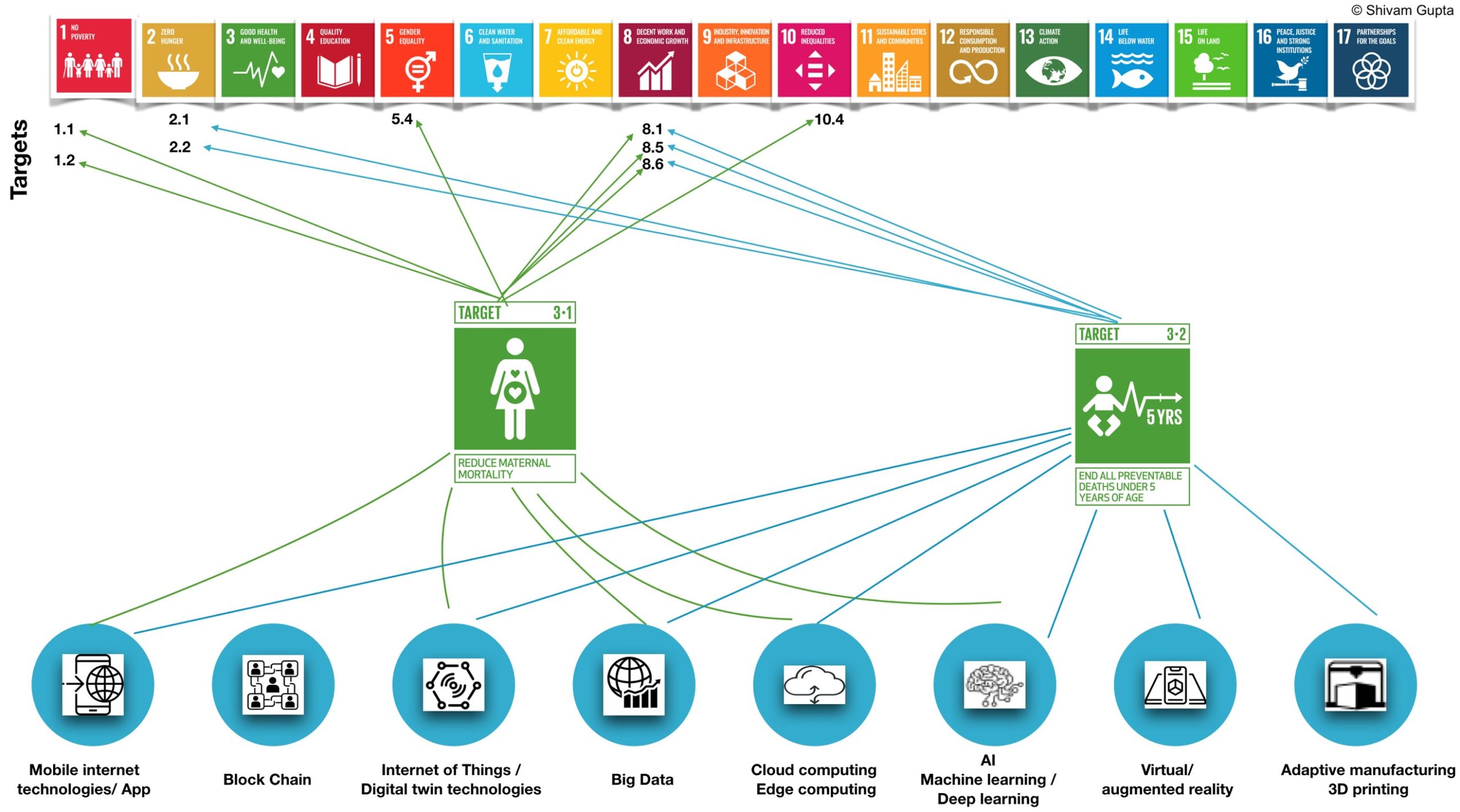
To map the influence of D&AI capabilities for the SDGs at the indicator level, the project team first analysed the raw data from organisations such as the World Bank and from United Nations SDG databases for evidence generation. Afterwards, we explored the use cases to understand the significance of capabilities for the specific indicator. The use cases highlight the meaningful context of the indicator’s official definition that can be tackled by using one or more D&AI capability. Using the initial Theory of Change (ToC) as a purposeful model to examine the technology usage backed with pieces of evidence, we establish the usefulness of different D&AI capabilities for indicators. The results of D&AI capabilities for SDG indicators are not exhaustive yet and continue to evolve with time. We are developing the framework to compute the impact of D&AI capabilities for SDG targets and their respective indicators. The figure below represents a brief overview of the research work the team is doing for SDG 3 (Health and Wellbeing). Furthermore, the project team is conducting similar work on other goals and their respective indicators. If you would like to know more details or collaborate, please feel free to contact the staff.
Stakeholders‘ needs and expectations are vital in designing and realising technical solutions to support existing processes. New technologies often present new modes of accomplishing the task at hand. For this, digital technologies need, however, to be made useful for as many people as possible. Especially in low income and lower-middle-income countries (LMICs) inclusiveness, equity and literacy are often challenges. Data related debates need to be discussed with regard to anonymity, data privacy and usage, and data rights.
Interlinkages and interpretations
Furthermore, care is also needed while exploring the interlinkages and integration of SDG indicators. There is limited existing knowledge of the interlinkages and interactions between SDG indicators, especially in LMICs. The nature of interlinkages and integrations is very much geography dependent, for example, in the case of landlocked and water locked geographies, which also change the choices and adaptation of the SDGs. Thus, the generalisation of interlinkages will not be an efficient way of exploring the coherence in an action plan. Alongside, the SDG indicators take the country and the regional context into consideration. Holistic and integrated approaches are beneficial for analysing and interpreting the usefulness of D&AI and interlinkages of SDG indicators.
Energy Demand
Concerns are also raised about increases in electricity usage by D&AI infrastructure, electronic devices, information technologies, data centres, and to a certain extent, on internet distribution networks. The increasing use of D&AI services is predicted to increase the load on energy demand, which we need to consider carefully for a realistic troubleshooting of the implementation challenges.
All this requires collaboration among industry, academia, governments, citizens, and NGOs to periodically discuss the effort on the availability, accessibility, and connectivity issues. The close association between different key stakeholders is essential to help mitigate risks and facilitate even distribution of infrastructure and resources for concealing the broader aim of „leaving no one behind.“ Collaboration and period review of strategies adopted are desired for developing a clear action plan to utilize resourcefully D&AI for Sustainable development.
In April 2020, the Bonn Alliance for Sustainability Research organised such an event called “Digitainable Thinkathon”. It brought together people from research, the private sector, civil society, and public administration in an online format to discuss the usefulness of those eight digital capabilities mentioned above for the indicators of SDG 4 and 13. Participants remain in touch for further collaboration and to bring forth the discussion of the topic of D&AI for the SDGs at the indicator level. Future research work will significantly advance by getting support from researchers within and outside the Bonn Alliance for Sustainability Research. If you are interested in working on some aspect of D&AI for SDGs, please contact: