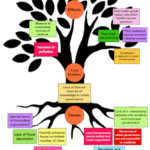
As households move out of poverty, their spending patterns change. From a human development perspective, this is good and important, but changing consumer behaviour may result in significantly more CO2 emissions. The lifestyles of growing global middle classes decide whether this happens.
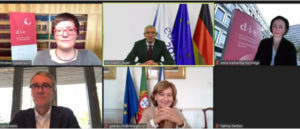
At the end of the German Council Presidency, a public, high-level online panel discussion took place on 14 December 2020 on the subject of „The German Council Presidency and the future of European development policy„. State Secretary Martin Jäger (Federal Ministry for Economic Cooperation and Development, BMZ), Koen Doens (General Director of DG DEVCO), Teresa Ribeiro (State Secretary for Foreign Affairs and Cooperation, Portugal) and Dr. Fatima Denton (Director, UNU Institute for Natural Resources, Ghana) had a lively discussion moderated by Dr. Christine Hackenesch of DIE. Prof. Dr. Anna-Katharina Hornidge (Director DIE) opened the event.
The focus of the discussion was on the successes and challenges of the Council Presidency to find an appropriate global EU response to the Covid-19 pandemic and to ensure coordinated European action. It became clear that the “Team Europe” approach is central to the effective coordination of European development policy in the context of the pandemic. During the upcoming Portuguese presidency, the topics of health, education, green transformation, “working better together” and cooperation with middle-income countries will be important priorities.
Panellists also discussed about the future orientation of European development policy. It became clear that in an increasingly multipolar world order characterized by geopolitical rivalries, international partnerships must be strengthened. For the implementation of the 2030 Agenda and the global sustainability transformation, co-creation of knowledge and policy solutions with partners from the Global South is central. European development policy will thereby need to put more emphasis on future topics such as climate change, digitization and increasing inequality.
Zum Ende der deutschen Ratspräsidentschaft fand am 14.12.2020 eine öffentliche, hochrangige online Podiumsdiskussion zum Thema „Die deutsche Ratspräsidentschaft und die Zukunft der europäischen Entwicklungspolitik“ statt. Mit dabei waren Staatssekretär Martin Jäger (Bundesministerium für wirtschaftliche Zusammenarbeit und Entwicklung, BMZ), Koen Doens (Generaldirektor der GD DEVCO), Teresa Ribeiro (Staatssekretärin für auswärtige Angelegenheiten und Zusammenarbeit, Portugal) und Dr. Fatima Denton (Direktorin, UNU Institute for Natural Resources, Ghana). Prof. Dr. Anna-Katharina Hornidge (Direktorin, DIE) eröffnete die Veranstaltung. Dr. Christine Hackenesch (Programmleitung, DIE) moderierte die Veranstaltung.
Im Zentrum der Diskussion standen die Erfolge und Herausforderungen der Ratspräsidentschaft eine angemessene globale Antwort der EU auf die Covid-19 Pandemie zu finden, und hierbei ein abgestimmtes europäisches Handeln sicherzustellen. Es wurde deutlich, dass der „Team-Europe“-Ansatz zentral ist für eine effektive Koordinierung europäischer Entwicklungspolitik im Kontext der Pandemie. Während der portugiesischen Präsidentschaft werden die Weiterentwicklung des Team-Europe-Ansatzes, die Themen Gesundheit, Bildung, grüne Transformation und Kooperation mit Mitteleinkommensländern im Fokus stehen.
Die Panellist*innen diskutierten auch über die langfristige Gestaltung und inhaltliche Ausrichtung der europäischen Entwicklungspolitik. Die Panellist*innen argumentierten, dass in einer zunehmend multipolaren und von geopolitischen Rivalitäten geprägten Weltordnung internationale Partnerschaften gestärkt werden müssen. Für die Umsetzung der Agenda 2030 und der globalen Nachhaltigkeitstransformation ist insbesondere die gemeinsame Ausarbeitung von Lösungsansätzen mit Partnerländern („co-creation“) zentral. Europäische Entwicklungspolitik sollte die entscheidenden Zukunftsthemen Klimawandel, Digitalisierung und die wachsende Ungleichheit stärker in den Blick nehmen.
Corona has evidentially changed the world as we know it and pushed us out of our comfort zone to develop new solutions to tackle new challenges. This also included the MGG Academy, which usually takes place as a four-month dialogue and trainings programme at the German Development Institute / Deutsches Institut für Entwicklungspolitik (DIE) in Bonn.
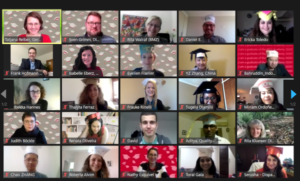
Instead of traveling to Bonn, 24 young professionals from China, India, Indonesia, South Africa, Brazil, Mexico and Europe embarked on 17 August 2020 on a digital learning journey into the world of international cooperation and sustainable development. While the switch to digital collaboration in itself is already a challenge and meant experiencing an unknown world of MS Teams, Zoom, Mural and many other digital tools, the Academy team had to develop innovative solutions to overcome additional structural burdens, which were caused by the need to incorporate 8 different time zones. This meant that the synchronous working-time, when all participants could come together simultaneously, was very limited and thus, resulted in a part-time programme with asynchronous and self-organized smaller learning-units.
Despite these structural and general challenges, the Academy was able to find innovative ways to connect, work, co-create and enjoy the MGG culture with the participants. The digital space offered the opportunity to include a plethora of different voices and diverse perspectives from all over the world (39 speakers in total), which would not have been possible in a physical format. Additionally, the participants connected over sharing their country specific contexts and realities, as everyone continued their “normal” life next to the Academy amidst a global pandemic. These shared experiences resulted in a momentum and were an “unexpected gift”. It allowed us to achieve something big, while we were finding new ways of connecting with each other. We started passion projects and impact networks that now, for the first time, were created in a digital rather than a physical space, which means it is far more likely that we will be able to continue working together well after the academy has concluded” (Serusha Govender, participant of the MGG Academy 2020).
The desire to meet face-to-face one day was persistent throughout the Academy and we are convinced that physical programmes will not and cannot be replaced entirely through digital alternatives. Nevertheless, the participant’s concluded at the end of their digital MGG journey in December, that “to us, having participated in the Academy means, we are prepared for the future of global collaboration in the virtual space. The Academy helped us to become change makers who are aware of the challenges and opportunities of working together digitally” (Frauke Rinelli, participant of the MGG Academy 2020).
Corona hat die Welt verändert und uns alle gezwungen, unsere Komfort-Zone zu verlassen. Wir mussten lernen, Lösungen für neuartige Herausforderungen zu entwickeln. Das gilt auch für die MGG Academy, die normalerweise als ein viermonatiges Dialog- und Fortbildungsprogramm am Deutschen Institut für Entwicklungspolitik in Bonn stattfindet.
In diesem Jahr sind die Teilnehmer*innen – 24 ausgewählte Nachwuchsführungskräfte aus Brasilien, China, Europa, Indien, Indonesien, Mexiko und Südafrika – nicht nach Bonn gereist, sondern haben stattdessen am 17. August 2020 ihre digitale Lernreise in die Welt der internationalen Kooperation und nachhaltigen Entwicklung angetreten. Dafür musste nicht nur überlegt werden, wie die digitale Zusammenarbeit mit Werkzeugen wie MS Teams, Zoom und Mural gestaltet werden kann. Viel herausfordernder war die Überwindung struktureller Probleme, die sich aus der Verteilung der Teilnehmenden über acht Zeitzonen ergeben. Weil die Zeitfenster für das gemeinsame Arbeiten der Teilnehmenden sehr knapp und kostbar waren, wurde ein Teilzeitprogramm mit vielen asynchronen und eigenständig organisierten Lerneinheiten entwickelt.
Nach Abschluss der Academy Anfang Dezember lässt sich sagen, dass es trotz dieser strukturellen Herausforderungen gelungen ist, Räume zu schaffen, in denen die Teilnehmenden kreativ miteinander arbeiteten, sich einander verbunden fühlten, und durch Co-Creation die sogenannte MGG Kultur erlebten. Das digitale Format ermöglichte es außerdem, eine Vielzahl von Stimmen und Perspektiven aus aller Welt einzubinden (insgesamt 39 Referent*innen), was in einem Präsenzprogramm in diesem Umfang nicht möglich gewesen wäre. Da alle während der Academy noch ihrem “normalen” Leben im eigenen Land während einer globalen Pandemie nachgingen, konnten die Teilnehmenden die länderspezifischen Kontexte der anderen direkter miterleben. Die so geteilten Erfahrungen schufen ein Momentum, welches ein “unerwartetes Geschenk” war: “It allowed us to achieve something big, while we were finding new ways of connecting with each other. We started passion projects and impact networks that now for the first time were created in a digital rather than a physical space which means it is far more likely that we will able to continue working together well after the academy has concluded” (Serusha Govender, Teilnehmende der MGG Academy 2020).
Natürlich war der Wunsch, sich persönlich zu treffen, während der gesamten Academy präsent. Präsenzprogramme können auch in Zukunft nicht gänzlich durch digitale Alternativen ersetzt werden. Doch die Teilnahme an der digitalen Academy hat auch Vorteile, wie eine Teilnehmerin in der Abschlussrede zusammenfasste: “to us, having participated in the Academy means, we are prepared for the future of global collaboration in the virtual space. The Academy helped us to become change makers who are aware of the challenges and opportunities of working together digitally” (Frauke Rinelli, participant of the MGG Academy 2020).
Diese Website benutzt Cookies. Wenn du die Website weiter nutzt, gehen wir von deinem Einverständnis aus.