Jahr: 2020

  • Panel discussion on the topic “Why Internationalisation? Old and new rationales in diverse higher education systems”

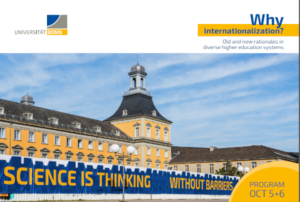
    Cover: Why internationalization??
    © Universität Bonn

    Under the heading “Internationalisation of Higher Education and Research with and after Corona”, representatives of the German Academic Exchange Service (DAAD),  the management of the University of Bonn, science and technology research, as well as development research and policy advice addressed the question to what extent the current corona-induced digitalisation of research and teaching is changing internationalisation processes within science qualitatively and permanently. Do they possibly even contribute to a decolonisation of Western science? Anna-Katharina Hornidge emphasised their potential in the panel discussion, but at the same time warned against too much euphoria. A decolonisation of science means a radical rethinking of, among other things, performance criteria, publication systems, academic languages, and appointment procedures. It thus goes far beyond corona-induced digitization of research and teaching, with all its positive effects on the internationalisation of discussion and learning rounds. At the same time, the creation of digital infrastructures and embedding their use in the everyday practices of science is a fertile basis for many further steps in international scientific cooperation.

    Find more information here
  • Podiumsdiskussion zum Thema „Why Internationalisation? Old and new rationales in diverse higher education systems“

    Cover: Why internationalization??
    © Universität Bonn

    Unter der Überschrift „Internationalisation of Higher Education and Research with and after Corona” widmeten sich Vertreter*innen des Deutschen Akademischen Austauschdienstes (DAAD), der Leitung der Universität Bonn, der Wissenschafts- und Technikforschung sowie der Entwicklungsforschung und Politikberatung der Frage, inwiefern die momentane Corona-bedingte Digitalisierung von Forschung und Lehre Internationalisierungsprozesse innerhalb der Wissenschaft qualitativ und dauerhaft verändern. Tragen sie möglicherweise sogar zu einer Dekolonialisierung der westlichen Wissenschaft bei? Anna-Katharina Hornidge unterstrich in der Podiumsdiskussion die Potentiale, warnte aber gleichzeitig vor zu großer Euphorie. Eine Dekolonialisierung der Wissenschaft bedeute ein radikales Überdenken von, u.a. Leistungskriterien, von Publikationssystemen, von Wissenschaftssprachen und Berufungspraktiken. Sie gehe somit weit über Corona-bedingte Digitalisierung von Forschung und Lehre hinaus, mit all seinen positiven Auswirkungen auf die Internationalisierung von Diskussions- und Lernrunden. Gleichzeitig sei die Schaffung der digitalen Infrastrukturen und Einbettung ihres Gebrauchs in die Alltagspraktiken der Wissenschaft eine fruchtbare Grundlage für viele weitere Schritte internationaler Wissenschaftskooperation.

    Weitere Informationen finden Sie hier.

  • Talk Plural Hannover, „Krisenmanagement – das Verhältnis von Wissenschaft und Politik“

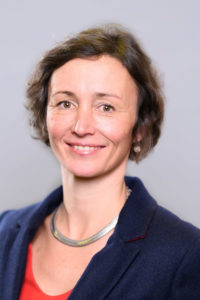
    Photo: Anna-Katharina Hornidge
    Anna-Katharina Hornidge, ©DIE

    In einem Online-Gespräch am 2. Oktober 2020, veranstaltet durch Plurale Ökonomik Hannover und Partnern, widmete sich Anna-Katharina Hornidge im Austausch mit Nicole Wilke, Referatsleiterin für internationalen Klimaschutz im Bundesumweltministerium (BMU) und Chefverhandlerin Deutschlands auf internationalen Klimakonferenzen, Fragen zur Rolle von Wissenschaft und Plattformen wissenschaftlicher Politikberatung in internationalen Verhandlungskontexten. Sowohl die Erfahrungen aus Klimawissenschaft und Klimapolitik als auch die jüngsten Beobachtungen im Umgang mit Covid-19 boten zahlreiche Anstöße, um gemeinsam über die Potentiale, aber auch Limitierungen von wissenschaftlicher Politikberatung im internationalen Kontext nachzudenken.

  • Talk Plural Hannover: „Crisis management – the relationship between research and politics”

    Photo: Anna-Katharina Hornidge
    Anna-Katharina Hornidge, ©DIE

    In an online discussion on 2 October 2020, organised by Plurale Ökonomik Hannover and partners, Anna-Katharina Hornidge, in exchange with Nicole Wilke, Head of Division for International Climate Protection at the German Federal Ministry for the Environment (BMU) and chief negotiator for Germany at international climate conferences, addressed questions about the role of research and platforms for scientific policy advice in international negotiation contexts. Both the experiences from climate science/ climate policy and the latest observations in dealing with Covid-19 offered numerous impulses to jointly reflect on the potentials as well as the limitations of scientific policy advice in an international context.

  • DIE-Director Anna-Katharina Hornidge appointed to the German Advisory Council on Global Change (WBGU)

    Logo WBGU
    © WBGU

    DIE-Director  Anna-Katharina Hornidge has been appointed as a new member of the German Advisory Council on Global Change (WBGU). The Council (founded 1992) is concerned with the implementation of the Sustainable Development Goals (SDGs) as part of the United Nations‘ 2030 Agenda. Its focus lies on global transformation towards sustainability in order to further evolve existing development paths in terms of strategy and content. Among other things, the altogether nine Council members analyse global environment and development problems, evaluate global sustainability policy implementation, give recommendations for action, and provide impulses for possible research steps in science.

    Find more information here