
Jahr: 2020

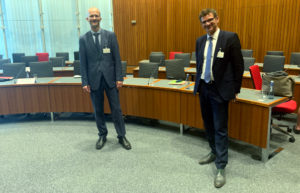
  • Jörn Grävingholt at the hearing in the NRW Science Committee on Peace and Conflict Research

    Photo: Jörn Grävingholt & Conrad Schetter
    Jörn Grävingholt & Conrad Schetter, ©JRF

    On 17 June 2020, at the request of the ALLIANCE 90 / THE GREENS parliamentary group, the science committee of the North Rhine-Westphalian state parliament discussed the topic “Strengthening peace and conflict research” in a public meeting.

    Representatives of various institutes for peace and conflict research in North Rhine-Westphalia discussed with the science committee about the future direction of this research field.

    The two Bonn member institutes of the Johannes Rau Research Society and the Bonn Alliance for Sustainability Research, the German Development Institute / Deutsches Institut für Entwicklungspolitik  (DIE) and the BICC (Bonn International Conversion Center) were also invited.

    Jörn Grävingholt spoke for DIE and explained that the institutions involved in peace and conflict research in NRW cooperate in many different ways and thus bring their different strengths to bear in joint research and policy advice. He argued to strengthen the institutional funding of this branch of research in order to ensure the recognized high quality work in the long term.

    The hearing made it clear that all political groups in the state parliament attach great importance to peace and conflict research. The committee minutes for consultation will shortly be available on the Science Committee website:.

    The application of the ALLIANCE 90 / THE GREENS parliamentary group „Strengthening peace and conflict research“ (German only) can be found at: https://www.landtag.nrw.de/portal/WWW/dokumentenarchiv/Dokument/MMD17-7752.pdf
  • Jörn Grävingholt bei Anhörung im Wissenschaftsausschuss NRW zu Friedens- und Konfliktforschung

    Photo: Jörn Grävingholt & Conrad Schetter
    Jörn Grävingholt & Conrad Schetter, ©JRF

    Am 17. Juni 2020 erörterte der Wissenschaftsausschuss des nordrhein-westfälischen Landtages auf Antrag der Fraktion BÜNDNIS 90 / DIE GRÜNEN in einer öffentlichen Sitzung das Thema „Die Friedens- und Konfliktforschung stärken“.
    Vertreter*innen verschiedener Institute der Friedens- und Konfliktforschung in Nordrhein-Westfalen diskutierten mit dem Wissenschaftsausschuss über die zukünftige Ausrichtung dieses Forschungsfeldes. Eingeladen waren auch die beiden Bonner Mitgliedsinstitute der Johannes-Rau-Forschungsgemeinschaft und der Bonner Allianz für Nachhaltigkeitsforschung, das Deutsche Institut für Entwicklungspolitik (DIE) sowie das BICC (Internationales Konversionszentrum Bonn).

    Für das DIE sprach Jörn Grävingholt und erläuterte, dass die Einrichtungen, die in NRW in der Friedens- und Konfliktforschung engagiert sind, in vielfältiger Weise kooperieren und damit ihre unterschiedlichen Stärken in gemeinsame Forschung und Politikberatung einbringen. Er warb dafür, die institutionelle Finanzierung dieses Forschungszweigs zu stärken, um die anerkannt hochwertige Arbeit auf Dauer sicherstellen zu können.

    In der Anhörung wurde deutlich, dass alle Fraktionen des Landtags der Friedens- und Konfliktforschung einen hohen Stellenwert beimessen. Das Ausschussprotokoll zur Anhörung steht in Kürze auf der Seite des Wissenschaftsausschusses.

    Der Antrag der Fraktion BÜNDNIS 90 / DIE GRÜNEN: „Die Friedens- und Konfliktforschung stärken“ (Drucksache 17/7752)

  • Global Landscapes Forum (GLF) Bonn Digital Conference 2020

    Mariya Aleksandrovo and Michael Brüntrup from the German Development Institute / Deutsches Institut für Entwicklungspolitik (DIE) organised an afternoon within the virtual Global Landscape Forum (GLF) 2020. Together with the Deutsche Gesellschaft für Internationale Zusammenarbeit (GIZ) and partners from the University of Bonn, the United Nation Convention to Combat Desertification (UNCCD) and the Rangeland Initiative of the International Livestock Research Institute (ILRI), they designed three interlinked sessions on the nexus “drought risk management, natural resource management and social protection”. The new German focal point in the Federal Ministry for Economic Cooperation and Development (BMZ) for the UNCCD, Mrs Christa Franke, could be won over for a greeting address.

    DIE’s contribution consisted of three panel discussions and a complex mix of 23 video clips, mostly produced specifically for this event. A moderator guided through each session. A preliminary recording of the entire session can be found here. An unusual highlight was certainly the address of the ESA astronaut Samantha Cristoforetti who brought in the ”orbital perspective (…) onto the amazing work you all are doing to preserve our climate, our biosphere, our landscapes, and especially our agricultural and food security” and some of the services that aerospace can contribute to this. In the last session, some short clips from climate activists in Uganda made it very clear how drastically the Corona crisis just as drought challenges affect poor people in poor countries. Social protection, resource and climate protection as well as agriculture must go together to meet this challenge. DIE’s Christoph Strupat could clearly substantiate some of these linkages with the help of results from intervention experiments in Malawi.

    The GLF 2020 had been planned long before the Corona pandemic as a virtual event, to provide a sign that large conferences and global dialogue are possible and meaningful without resource-intensive travelling. With the outbreak of the Corona crisis the event got further dynamic and meaning, which has also been considered in its subtitle „Food in the time of crises“. With almost 5000 (a fee of 10 US dollar) paying participants from 146 countries and all segments of society this has been achieved in an impressive way. Participants were free to roam between sessions and to exchange with presenters and among themselves; in addition, social media were served busily, its outreach indicated with 50 million.

    In summary, the conference showed many new options for global interactions but it also became clear that this requires substantial efforts and that it cannot completely replace physical meetings

  • Global Landscapes Forum (GLF) Bonn Digital Conference 2020

    Mariya Aleksandrova und Michael Brüntrup vom Deutschen Institut für Entwicklungspolitik (DIE) gestalteten einen Dialog-orientierten Nachmittag im virtuellen Global Landscape Forum (GLF) 2020. Gemeinsam mit der Deutschen Gesellschaft für Internationale Zusammenarbeit (GIZ) und Partnern der Universität Bonn, der United Nations Convention to Combat Desertification (UNCCD) und der Rangeland Initiative des International Livestock Research Institute (ILRI),  organisierten sie drei zusammenhängende Sessions zum Nexus „Dürrerisikomanagement, Management natürlicher Ressourcen und Soziale Sicherung“. Aus dem Bundesministerium für wirtschaftliche Zusammenarbeit und Entwicklung (BMZ) konnte der neue deutsche „Focal Point“ für die UNCCD, Frau Christa Franke, für eine Grußbotschaft gewonnen werden.

    Eine abwechslungsreiche Mischung von drei Paneldiskussionen und 23 Videoclips als thematische Inputs – fast alle eigens für diese Veranstaltung durch das DIE produziert, bildeten den DIE-Beitrag.

    Ein ungewöhnliches Highlight war die Ansprache von ESA-Astronautin Samantha Cristoforetti, die die „orbitale Perspektive (…) auf die Aktivitäten zur Erhaltung des Klimas, der Biosphäre, der Landschaft und besonders der Landwirtschaft und Ernährungssicherheit” einbrachte und einige der Dienstleistungen aufführte, die die Raumfahrt dazu beitragen kann. In der letzten Session wurde unter anderem anhand von kurzen Ansprachen von Klima-Aktivist*innen aus Uganda sehr drastisch verdeutlicht, wie sehr die Corona-Krise und auch Dürren arme Menschen in armen Ländern beeinträchtigen. Akteure im Bereich Soziale Sicherung, Ressourcen- und Klimaschutz sowie Landwirtschaft sind gemeinsam gefordert, sich dem entgegenzustemmen. Christoph Strupat, DIE, konnte einige dieser Zusammenhänge anhand von Ergebnissen aus Interventions-Experimenten in Malawi eindeutig belegen.

    Ein (vorläufiger) Gesamtmitschnitt ist hier zu finden.

    Das GLF 2020 war schon lange vor der COVID-Pandemie als virtuelle Veranstaltung geplant gewesen, um ein Zeichen zu setzen, dass große Konferenzen und globaler Dialog auch ohne ressourcen-intensive Reisebewegungen  möglich und sinnvoll sind. Mit dem Ausbruch der Corona-Krise bekam dies nochmal eine besondere Dynamik und Bedeutung. Dem trug auch das Motto „Food in the time of crises“ Rechnung. Mit fast 5000 (einen Obolus von 10 US-Dollar) zahlenden Teilnehmer*innen aus 146 Ländern und allen gesellschaftlichen Bereichen ist dies eindrucksvoll gelungen. Die Teilnehmer*innen konnten frei zwischen den Sessions wechseln und sich mit den Vortragenden und untereinander austauschen; außerdem wurden die sozialen Medien intensiv bedient, die dort erzielte Reichweite beläuft sich auf  ca. 50 Millionen Kontakte.

    Insgesamt zeigte diese Konferenz viele neue Möglichkeiten für globale Interaktionen auf. Gleichzeitig wurde deutlich, dass auch digitale Formate von allen einer intensiven Vorbereitung bedürfen und sie gleichzeitig physische Treffen nicht völlig ersetzen können.

  • Covid-19, Development Policy and Science

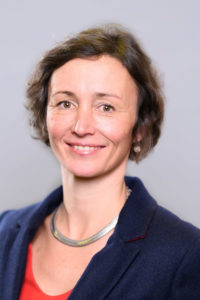
    Photo: Anna-Katharina Hornidge neue Direktorin des DIE, Photo: Benjamin Westhoff, ©DIE
    Anna-Katharina Hornidge, ©DIE

    On 23 June, Anna-Katharina Hornidge, Director of the German Development Institute / Deutsches Institut für Entwicklungspolitik (DIE), addressed the General Assembly of the Working Group on Global Responsibility, the umbrella organisation of development and humanitarian organisations in Austria. The event focused on the impact of the COVID-19 pandemic on the future of development policy.

    In her statement, Anna-Katharina Hornidge referred to a proposal made by Horst Köhler, former President of Germany, in 2017 to understand development policy as interdependence policy. What does close, mutual interdependence mean under the current conditions? What does it mean for a policy that is neither based on fear of the neighbour nor on the conviction that we want to help our neighbour as a much stronger partner – but for a policy that is to be understood as a structural policy for international cooperation that makes the global common good possible?

    Such a development policy, according to Hornidge, should focus on three areas in particular: (a) the cultivation and expansion of transregional and global levels of understanding, including the active containment of nationalisms in dealing with the pandemic in the short and medium term, (b) the reduction of social inequalities, the expansion of health and education systems in the medium-term promotion of social crisis resilience, as well as (c) the consistent pursuit of the transformation of our production systems and consumption patterns towards a sustainable use of the resources of our planet, and as a precautionary measure with regard to future crises, which, similar to the current one, stem from the imbalance between man and nature.

    On 24 June, Anna-Katharina-Hornidge gave an input to an online workshop on “COVID 19 and the development policy work of NRW actors”, jointly organized by the One World Network NRW and the State Chancellery of North Rhine-Westphalia. The workshop focused on the question of the extent to which the scientific landscape of North Rhine-Westphalia can contribute to the development policy measures of the state and in cooperation with civil society actors, with a special focus on the partner country Ghana. This was discussed by Ms Hornidge along the development policy guidelines of the State of North Rhine-Westphalia. She referred to DIE’s work at the interface between science and politics, also in the support of South-South cooperation in the context of Think Tanks 20 (T20), a network of research institutes and think tanks from the G20 countries, as well as in the context of the Bonn Alliance for Sustainability Research.