Jahr: 2021

  • Postgraduate Course – Research Team Phase: Team Nepal reports!

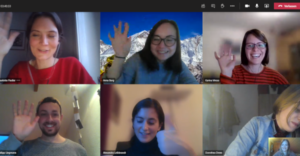
    Foto: Web-Konferenz Gruppenbild
    ©DIE

    If it was a normal year, in a few weeks time we would be boarding a plane to Nepal to conduct fieldwork for our research project. Around this time, we would be busy with travel preparations, visa applications and vaccinations, looking for accommodation and full of expectations. Instead: Online meetings, digitally conducted interviews, online team building. All very different from a normal postgraduate course year, right? Then again… Maybe not quite? Because what is „normal“ anyway?

    For us as Team Nepal (Social cohesion, Peace and Local Elections in Nepal), the digital work and research life is starting to feel a bit familiar already. We try not to think of it as „abnormal“, as a worse alternative to actual fieldwork, or a consolation prize. Instead, we are currently experiencing a perhaps different, but nevertheless enriching, exciting and educational research phase. The “new normal” will not take away our motivation or enthusiaism for our research: We adjust, accomodate and simply look for new ways to find out how local elections influence peace and social cohesion in Nepal – even from afar. To this end, we have come up with different methods to diversify skills to work in the digital space: We kick-start the week with check-in call on Mondays and discuss current news from Nepal. There, the panoramic video background of snowtopped Himalayan mountains provides an almost realistic „on-site“ feeling. For content sessions, we use “Miro Board”, a digital pinboard with colourful post-its to share and structure our ideas. And of course we are especially grateful to our Nepalese partners who bring us a little closer to Nepal during our regular meetings. In a way, we have created our own little digital work bubble somewhere between Germany and Nepal. Our research team phase is therefore certainly different from the years before, but we think: Being different is exciting!

  • Forschungsteamphase des Postgraduierten-Programms am DIE: Team Nepal berichtet

    Foto: Web-Konferenz Gruppenbild
    ©DIE

    Wäre es ein normales Jahr, würden wir in ein paar Wochen in einen Flieger gen Nepal steigen, um dort unsere Forschung im Rahmen des Postgraduierten-Programms durchzuführen. Dann wären wir wahrscheinlich gerade mit Visumsanträgen und Impfungen, mit der Wohnungssuche und anderen Reisevorbereitungen beschäftigt. Stattdessen: Online-Meetings, digital durchgeführte Interviews, Online-Teambuilding. Alles ganz anders als in einem normalen PGK-Jahr, oder? Vielleicht nicht so ganz, denn was ist schon „normal“?

    Für uns als Team Nepal („Gesellschaftlicher Frieden und lokale Wahlen in Nepal“) fühlt sich das digitale Arbeits- und Forschungsleben schon ein Stück weit vertraut an. Wir versuchen, es nicht als „unnormal“, als schlechtere Alternative zur tatsächlichen Feldforschung oder als Trostpflaster aufzufassen. Vielmehr erleben wir zurzeit eine vielleicht andere, aber trotzdem gewinnbringende, spannende und lehrreiche Forschungsphase. Wir lassen uns unsere Motivation und unseren Forscher*innenwillen nicht nehmen, sondern suchen uns neue Wege um herauszufinden, wie lokale Wahlen Frieden und gesellschaftlichen Zusammenhalt in Nepal beeinflussen. Dazu nutzen wir verschiedene Methoden, um unser digitales Arbeiten abwechslungsreich zu gestalten: Wir treffen uns jeden Montag für einen Check-In in die Woche und besprechen dabei aktuelle Nachrichten aus Nepal. Dabei sorgt der Videohintergrund mit Himalaya-Panorama sogar für ein fast realistisches „Vor-Ort“-Setting. Für inhaltliche Sessions machen wir uns das Miro-Board zu eigen, eine Art digitale Pinnwand, auf welcher farbenfrohe Notizzettel angebracht werden können. Besonders dankbar sind wir unseren nepalesischen Partner*innen, die uns in regelmäßigen Meetings Nepal ein Stück näherbringen. Auf diese Weise arbeiten wir in einer kleinen, digitalen Blase zwischen Deutschland und Nepal. Unsere Forschungsteamphase ist daher sicherlich anders als die Jahre davor, aber muss anders immer schlechter sein? Wir finden: Anders sein ist spannend!

  • Conference: “The World Economy in Times of COVID-19: Effects on Development Policy”

    Bild eines Virus
    ©PIRO4D, Pixabay

    In December 2020, a conference was held as part of the “Fair Globalisation” project financed by the Federal Ministry for Economic Cooperation and Development (BMZ) on the subject of “The World Economy in Times of COVID-19: Effects on Development Policy”. International experts and political decision-makers discussed the question of how the global economic order can contribute to achieving the goals of the 2030 Agenda for Sustainable Development and thus guarantee a fairer and more inclusive globalisation, also against the background of the COVID-19 pandemic.

    International trade plays a very important role in shaping globalization fairly and overcoming the corona crisis. Participants of the conference discussed, among other things, how the potential of the African Continental Free Trade Agreement (AfCFTA) can be exploited, what role environmental clauses can play in trade agreements and what economic advantages would result from an Investment Facilitation Agreement.

    Participants of the conference stressed that developing countries do not have enough financial resources to cope with the crisis. The “global financial safety net” should thus be strengthened for example by capital increases of the multilateral development banks. The current international tax system offers multinational corporations and rich individuals many loopholes for tax avoidance. Increased international tax cooperation is needed which involves all countries in the negotiations. To prevent a renewed debt crisis in developing countries, for example the debt restructuring within the new “Common Framework for Debt Treatments beyond the Debt Service Suspension Initiative” initiated by the G20 and the Paris Club should be implemented quickly and tied to sustainability criteria.

    How the global economic order can contribute to the implementation of the SDGs and thus ensure a “better recovery” from the COVID-19 crisis is the focus of the continuation of the BMZ financed project “Fair Globalisation.”

  • Konferenz: „Die Weltwirtschaft in Zeiten von COVID-19: Auswirkungen auf die Entwicklungspolitik“

    Bild eines Virus
    ©PIRO4D, Pixabay

    Im Dezember 2020 fand eine Konferenz im Rahmen des vom Bundesministerium für wirtschaftliche Zusammenarbeit und Entwicklung (BMZ) finanzierten Projektes „Gerechte Globalisierung“  statt. Sie thematisierte „Die Weltwirtschaft in Zeiten von COVID-19: Auswirkungen auf die Entwicklungspolitik“. Internationale Expert*innen und politische Entscheidungstragende diskutierten die Frage, wie die Weltwirtschaftsordnung zur Erreichung der Ziele der Agenda 2030 für nachhaltige Entwicklung beitragen und damit eine gerechtere und inklusivere Globalisierung auch vor dem Hintergrund der COVID-19-Pandemie gewährleisten kann.

    Der internationale Handel spielt eine sehr wichtige Rolle für die gerechte Gestaltung der Globalisierung und für Bewältigung der Corona-Krise. Die Teilnehmer*innen der Konferenz diskutierten u.a. wie das Potenzial des African Continental Free Trade Agreement (AfCFTA) ausgeschöpft werden kann, welche Rolle Umweltklauseln in Handelsabkommen spielen können und welche ökonomischen Vorteile sich durch ein Investment Facilitation Agreement ergeben würden.

    Die Teilnehmer*innen besprachen auch die Rolle internationaler Finanzfragen im Zuge der Corona-Krise. Sie betonten, dass die Entwicklungsländer nicht über genügend Finanzmittel verfügen, um die Krise zu bewältigen. Daher sollte das „global financial safety net“ beispielsweise durch Kapitalerhöhungen der multilateralen Entwicklungsbanken gestärkt werden. Da das derzeitige internationale Steuersystem multinationalen Unternehmen und vermögenden Privatpersonen viele Lücken zur Steuervermeidung bietet, ist eine verstärkte internationale steuerliche Zusammenarbeit und die Einbeziehung aller Länder in die Verhandlungen erforderlich. Zur Verhinderung einer erneuten Verschuldungskrise in Entwicklungsländern sollte beispielsweise das von der G20 und dem Pariser Club initiierte neue Rahmenwerk – „Common Framework for Debt Treatments beyond the Debt Service Suspension Initiative“ – schnell umgesetzt und an Nachhaltigkeitskriterien gebunden werden.

    Wie die Weltwirtschaftsordnung zur Umsetzung der Sustainable Development Goals (SDGs) beitragen und damit eine schnellere Erholung von der Covid-19-Krise sicherstellen kann, steht im Fokus der Fortführung des BMZ-finanzierten Projektes „Gerechte Globalisierung.”

  • Foresight: US climate policy under President Joe Biden

    Photo: The White House in WashingtonThe US administration under President Joe Biden will be much more outward facing and stand for a return to multilateralism says Charles Martin-Shields of the German Development Institute / Deutsches Institut für Entwicklungspolitik (DIE). The First appointments reflects this, such as the appointment of the former ambassador to the United Nations, Samantha Power, to head of USAID.

    In climate policy, too, it can be assumed that Biden will correct the American course under Trump. For example, Biden early announced his plan to return to the responsibilities and commitments of the Paris Climate Agreement. According to Martin-Shields, several appointments are further strong signals to national and international climate policy. For example the appointment of John Kerry, long-time senator and former Secretary of State, to Climate Envoy. Furthermore, Climate Envoy Kerry is given a seat on the National Security Council. Thus, a deserving and committed representative of climate protection will be present when central issues of national security and foreign policy are negotiated. Martin-Shields believes that Kerry has the political capital to coordinate effectively with different US cabinet-level agencies on issues of climate change.


    Have a look at this short social video or read more on his perception.

    https://twitter.com/DIE_GDI/status/1351896029449351168?s=20


    Well-known climate representatives appointed

    Biden also filled key domestic policy positions with personalities known in climate policy. For example, Brian Deese will take over the lead of the White House Economic Council. Deese represented the White House during the Paris Climate Agreement negotiations under Obama in 2015.

    Michael Regan will take over as head of the Environmental Protection Agency (EPA), which rolled-back numerous environmental rules under Trump. Regan knows EPA from his work during the administration of Bill Clinton. At the North Carolina Department of Environmental Quality, he established the first environmental-justice advisory board.

    Signs outwards and inwards

    Besides the signalling power of appointments and the announced return to the Paris Climate Agreement, there are also concrete actions by the Biden administration that give hope. For example, on its first day President Biden stopped the approval of the construction of Keystone XL, a pipeline that was to transport oil from Canada’s tar sand fields to the USA. He did so despite the tension the decision is likely to cause with the important neighbouring country Canada.

    Charles Martin-Shields expects to see actual coordination across the State Department, USAID and EPA, with possibility for legislative support from Democratic House and Senate. So changes and policies could be put into law, making them harder to change on short notice by later presidents.


    On 21 January 2021, Charles Martin-Shields also shared his assessments of the expected climate policy under US President Joe Biden with the Bonn Climate Change Group.

    The Bonn Climate Change Group is an open network of organisations and institutions based in Bonn, mostly working in the fields of environmental change and development. It has been jointly initiated by the NDC-Partnership and the City of Bonn in 2019 to foster dialogue on climate change and sustainable development, and to open a space for mutual support towards ambitious climate action. DIE has been represented in the network from the early beginning, especially with by the Klimalog project. The network meets three to five times a year under Chatham House Rule, meetings are held in English and hosted in turns.

    Read more contributions by our experts or in partnership on the political change in den US:

    How to repair the damage? Undoing “America First” at the UN

    Political transition in the US – a tidal change for the Future of Globalisation? A collection of experts’ opinions