 In the Special Issue, After one decade of G20 summitry, edited by Axel Berger, Sven Grimm at the DIE and myself, I argued that the G20 had morphed from a crisis committee or steering group to being a hybrid focal point. In other words, the G20 could no longer be judged simply by its instrumental delivery. As a crisis committee, the G20 concentred its collective efforts on managing the aftermath of the 2008 Global Financial Crisis (GFC), but gradually ran out of momentum. Alternatively, as a possible steering group, the G20 has not been able to embrace the mandate of working together beyond the core financial agenda whether on climate change, migration, or other compelling issue areas.
Jahr: 2020
-
Recalibrating The G20 in the Aftermath of Saudi Arabia’s Summit: Testing a Secretariat!
-
Save the date: Hochrangige Podiumsdiskussion zum Ende der deutschen EU-Ratspräsidentschaft und zur Zukunft der europäischen Entwicklungspolitik
In dieser öffentlichen Online-Podiumsdiskussion werden die wichtigsten Lehren aus der Covid-19-Pandemie für die Zukunft der EU-Entwicklungspolitik der deutschen Präsidentschaft erörtert. Die deutsche Präsidentschaft wurde weitgehend von der akuten Krisensituation in Europa und in Partnerländern dominiert. Unsere Diskussionsteilnehmer*innen, darunter Staatssekretär Martin Jäger (Bundesministerium für wirtschaftliche Zusammenarbeit und Entwicklung, BMZ), Koen Doens (Generaldirektor der GD DEVCO), Teresa Ribeiro (Staatssekretärin für auswärtige Angelegenheiten und Zusammenarbeit, Portugal, tbc) und Vera Songwe (Exekutivsekretärin der UN-Wirtschaftskommission für Afrika, tbc) werden die Herausforderungen und Erfolge Deutschlands bei der Suche nach einer angemessenen globalen Antwort der EU auf die Pandemie erörtern. Die Diskussion wird sich insbesondere auf „Team Europe“ konzentrieren – ein Versuch, die Bemühungen der EU-Institutionen und der Mitgliedstaaten zur Bewältigung der Folgen der Pandemie besser zu koordinieren. Darüber hinaus wird die Veranstaltung die Zukunft der europäischen Entwicklungspolitik angesichts der bevorstehenden Herausforderungen reflektieren und diskutieren. Während 2020 von Debatten über kurzfristige Reaktionen auf Covid-19 dominiert wurde, muss die langfristige Erholung von der Covid-19-Pandemie die nachhaltige Entwicklung – in der EU und in den Partnerländern – in den Mittelpunkt stellen. Die Agenda 2030 für nachhaltige Entwicklung zusammen mit dem Europäischen Green Deal verlangen von der EU, – national und global – Transformationsprozesse in Schlüsselbereichen der nachhaltigen Entwicklung voranzutreiben. Der Zeitraum bis 2030 bietet der EU ein Jahrzehnt, um sich von der Covid-19-Pandemie zu erholen und langfristige Auswirkungen auf wichtige Nachhaltigkeitstransformationen zu erzielen, erfordert jedoch auch entschlossenes Handeln und eine Neuausrichtung der Entwicklungspolitik. Während der Veranstaltung wird daher diskutiert, wie die EU die Agenda 2030 erfolgreich umsetzen und damit verbundene Nachhaltigkeitstransformationen in ihrer Entwicklungspolitik vor dem Hintergrund der anhaltenden Covid-19-Pandemie und der erforderlichen kurzfristigen Maßnahmen fördern kann.
-
Save the date: High-level panel debate on Germany’s Presidency of the EU Council and the Future of European Development Policy
This high-level public online debate will discuss the key lessons learnt of the German Presidency of the EU Council from the Covid-19 pandemic for the future of EU development policy. As Germany’s Presidency has largely been dominated by fostering solutions to acute crisis situations in Europe and in partner countries, our panellists, including State Secretary Martin Jäger (Federal Ministry for Economic Cooperation and Development, BMZ), Koen Doens (Director General DG DEVCO), Teresa Ribeiro (Secretary of State for Foreign Affairs and Cooperation, Portugal, tbc) and Vera Songwe (Executive Secretary UN Economic Commission for Africa, tbc) will discuss Germany’s challenges and successes in finding an adequate global response to the pandemic for the EU. In particular, the discussion will focus on the launch of ‚Team Europe‘ – an attempt to better coordinate EU institutions and member states’ efforts to address the consequences of the pandemic. In addition, the event will also reflect and discuss the future of European development policy in light of key challenges ahead. While 2020 has been dominated by debates on short-term responses to Covid-19, long-term recovery from the Covid-19 pandemic needs to put sustainable development – in the EU and in partner countries – centre stage. The 2030 Agenda for Sustainable Development together with the European Green Deal, require the EU – domestically and globally – to drive transformation processes forward in key areas of sustainable development. The period up to 2030 offers the EU a decade to recover from the Covid-19 pandemic and to create long-lasting impact on key sustainability transformations, but also requires decisive action and readjustment of development policy. The event will thus discuss how the EU can successfully implement the 2030 Agenda and promote related sustainability transformations in its development policy against the background of the ongoing Covid-19 pandemic and required short-term measures.
-
Erste internationale Social Cohesion Week am DIE
Logo of the Social Cohesion Hub ©DIE Das Thema „gesellschaftlicher Zusammenhalt” hat jüngst viel Aufmerksamkeit gewonnen. Soziale Kohäsion ist nicht nur für die Bewältigung von Krisen sondern auch langfristiger für nachhaltige Entwicklung relevant. Soziale Kohäsion steht sowohl in Gesellschaften im globalen Norden als auch Süden vor Herausforderungen. Wissensaustausch und gemeinsames Lernen sind notwendig, um diese Herausforderungen zu meistern. Die „Social Cohesion Week” und der Social Cohesion Hub machen erste Schritte in diese Richtung.
Die Social Cohesion Week (#SoCoWeek) am DIE hat Wissenschaftler*innen und Praktiker*innen vom 9. bis 12. November zusammengebracht, um zu diskutieren wie soziale Kohäsion entsteht und was sie bewirkt. 378 Teilnehmer*innen konnten 52 Redner*innen zu einer Bandbreite an Themen in elf Veranstaltungen hören und sich mit ihnen und untereinander austauschen. Das Eröffnungspanel diskutierte den aktuellen Wissensstand und Forschungslücken zu sozialer Kohäsion, während der Beitrag internationaler Entwicklungspolitik zu sozialer Kohäsion Gegenstand eines Dialogpanels aus der praktischen Politik war. Weitere Workshops haben sich mit Entstehungsbedingungen von sozialer Kohäsion auseinandergesetzt – die Themen reichten von Flucht, ökonomischen Faktoren, soziale Sicherungssystemen, Steuerpolitik, „transitional justice” in Postkonfliktgesellschaften über Peacebuilding, geteilten Wertevorstellungen bis zu den Folgen von Covid-19. Die am DIE entwickelte Konzeptualisierung und Messung von sozialer Kohäsion wurde in einem gesonderten Workshop diskutiert und kritisch reflektiert.
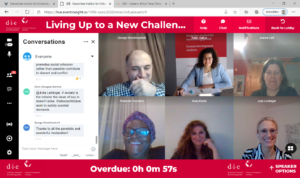
©DIE Highlight der Woche war der Launch des Social Cohesion Hub. Die vom DIE bereitgestellte kollaborative Webplattform soll online einen Raum schaffen, um Informationen über soziale Kohäsion zu teilen und zu finden, Austausch über Konzepte, Daten und Literatur fördern sowie den Dialog zwischen Entwicklungsprojekten zu sozialer Kohäsion fördern. Vertreter*innen der Weltbank, UNDP und der GIZ hoben den Bedarf für den #SoCoHub hervor und diskutierten die Potenziale und Herausforderungen für eine erfolgrieche Zukunft des Hubs. Interessiert am Thema? Verfolgen Sie den Hashtag #SoCoResearch auf Twitter.
-
First international Social Cohesion Week at DIE
Logo of the Social Cohesion Hub ©DIE Social cohesion has gained a lot of attention recently. It is not only important to tackle crises but also for global development in the long run. Societies both in the global North and South are facing challenges of their social cohesion which to overcome necessitates knowledge exchange and joint learning. The Social Cohesion Week and the launched Social Cohesion Hub aspire to help making one of the first steps in this endeavour.
DIE’s Social Cohesion Week (#SoCoWeek) brought together researchers and policy practitioners to exchange and discuss the making, drivers and consequences of social cohesion from 9 to 12 November. The 378 participants were lucky to count on the contribution of 52 speakers in 11 sessions on a variety of topics. An opening panel discussion focused on where research on social cohesion stands today, while the contributions of international cooperation to improving social cohesion was the focus of a practitioners’ panel. Further workshop sessions focused on different drivers of social cohesion, ranging from forced displacement through economic driving forces, social protection schemes, taxation, post-conflict transitional justice, peacebuilding, shared value orientations and consequences of Covid-19. A special workshop session presented and discussed the conceptualisation and measurement of social cohesion of the research team at DIE.
©DIE The launch of the Social Cohesion Hub was the highlight of the week. The collaborative knowledge web platform set up by DIE this year offers an online space to find information and foster exchange about concepts, data, literature, and development cooperation projects on social cohesion. Representatives of the World Bank, UNDP and GIZ highlighted the relevance of the #SoCoHub and discussed how to form a community of action between researchers and policy practitioners working on social cohesion. They also discussed potentials and challenges of a successful future of the #SoCoHub. Interested in the topic? Follow the hashtag #SoCoResearch on Twitter.