

Jahr: 2020

  • New Book: Taming the Big Green Elephant. Setting in Motion the Transformation Towards Sustainability

    Cover: Taming the big green elephant. Setting the motion for transformation towards sustainability, Ariel Macaspac HernandezAriel Macaspac Hernandez, economist at the German Development Institute / Deutsches Institute für Entwicklungspolitik (DIE) has published a book with the title “Taming the big green elephant. Setting In motion the transformation towards sustainability” (Open Access) with the publisher Springer. With the use of analytical methods from the negotiation studies, economics and social science, he shows how policy goals and development trajectories are interdependent.

    In addition to theoretical models (ideal types) to understand the political and institutional conditions in different development trajectories, he presents through country case studies (China, Jamaica, Mexico, Philippines and the United States) the diverse entry points of countries to transformation to sustainability. He argues that sustainable low carbon development is a transformative process that constitutes the shifting from the initially chosen or taken pathway to another pathway as goals have been re-visited and revised to enable the system to adapt to changes. However, shifting towards low carbon trajectories entails transition costs that are accrued through the effects of lock-ins that have framed decisions and collective actions.

    The uncertainty about these costs can be overwhelming or even disruptive. The book discusses the concept of knowledge diplomacy, which is built upon negotiative perspectives to help define, design, and facilitate collective actions in order to execute the principles of sustainability. The eBook can be downloaded freely through the following link: https://link.springer.com/book/10.1007/978-3-658-31821-5
  • Neues Buch: Taming the Big Green Elephant. Setting in Motion the Transformation Towards Sustainability

    Cover: Taming the big green elephant. Setting the motion for transformation towards sustainability, Ariel Macaspac HernandezAriel Macaspac Hernandez, wissenschaftlicher Mitarbeiter am Deutschen Institut für Entwicklungspolitik (DIE), hat unter dem Titel “Taming the big green elephant. Setting In motion the transformation towards sustainability” eine Buchmonographie (Open Access) im Wissenschaftsverlag Springer veröffentlicht. In seiner umfassenden verhandlungs-, wirtschafts- und sozialwissenschaftlichen Analyse zeigt er, wie Politikziele und Entwicklungspfade sich wechselseitig bedingen.

    Neben den vorgestellten theoretischen Modellen (Idealtypen) zum integrativen Verständnis der politischen und institutionellen Bedingungen in unterschiedlichen Transformationspfaden zeigen die Fallbeispiele (China, Jamaika, Mexiko, Philippinen und USA) die diversen möglichen Zugänge von Ländern zur Transformation zur Nachhaltigkeit. Hinsichtlich einer systemischen Transformation zu nachhaltiger Dekarbonisierung betont Hernandez insbesondere die Wahrnehmung und Diskussion von Transitionskosten, wie sie etwa aus technologischen und infrastrukturellen „Lock-Ins“ erwachsen, als Faktor der politischen Entscheidungsfindung.

    Vor diesem empirisch unterfütterten Hintergrund argumentiert er, dass das Umsteuern auf kohlenstoffarme Entwicklungspfade maßgeblich davon abhängt, wie unter Bedingungen von Unsicherheit Transitionskosten gemessen, bewertet und interpretiert werden. Darüber hinaus entwickelt er das auf Verhandlungsperspektive basierte Konzept der Wissensdiplomatie (knowledge diplomacy) weiter, um gesellschaftliche Aushandlungsprozesse entsprechend gestalten und Transformationshindernisse überwinden zu können. Das eBook ist kostenfrei unter diesem Link erhältlich: https://link.springer.com/book/10.1007/978-3-658-31821-5

  • Development cooperation in times of global megatrends

    Our world in 2050 is decided today. Global megatrends and how we deal with them define the conditions of tomorrow. Megatrends are observed everywhere. They affect society, economy, politics and the environment. Megatrends reinforce each other through their interlinkages. While all countries are affected by global megatrends, their ability to address them is not the same. This has consequences for development policy.

    The Report of the UN Economist Network for the UN 75th Anniversary “Shaping the Trends of Our Time”, which was published in September 2020, examines five megatrends: climate change; demographic shifts, particularly population ageing; urbanization; the emergence of digital technologies; and inequalities –that are affecting economic, social and environmental outcomes. The report underlines that all trends are the result of human activity, and as such, they can be shaped by human decisions and policy choices.

    The United Nations System Staff College (UNSSC) and the German Development Institute / Deutsches Institut für Entwicklungspolitik (DIE) have embarked on a variety of collaborations in order to examine the concepts underpinning  the 2030 Agenda and to underline the consequences of global megatrends in light of national policy choices, development policy, as well as civil servant capacity development.

    A short joint video emphasizes the importance for development policy to recognise the universal relevance of global megatrends and calls on governments to approach the challenges of our time through joint efforts, seeking innovative solutions, away from past recipes, which have led to high human development to the detriment of environmental sustainability. As in climate policy and in the covid-19 crisis, rich and poor countries have to learn to truly collaborate, share knowledge, foster systemic change and generate positive effects across various fields, at home, as much as elsewhere.

  • Entwicklungszusammenarbeit in Zeiten globaler Megatrends

    Unsere Welt im Jahr 2050 wird heute entschieden. Globale Megatrends und unser Umgang mit ihnen definieren die Bedingungen von morgen. Megatrends sind überall zu beobachten. Sie wirken sich auf Gesellschaft, Wirtschaft, Politik und Umwelt aus. Megatrends verstärken sich gegenseitig durch ihre Verflechtungen. Alle Länder sind von den globalen Megatrends betroffen, aber nicht in gleichem Maße in der Lage, mit ihnen umzugehen. Das hat Konsequenzen für die Entwicklungspolitik.

    Der Bericht des UN Economist Network zum 75-jährigen Jubiläum der UN: „Shaping the Trends of Our Time“, der im September 2020 veröffentlicht wurde, untersucht fünf Megatrends: Klimawandel, demografische Verschiebungen, insbesondere das Altern der Bevölkerung, Urbanisierung, das Aufkommen digitaler Technologien und Ungleichheiten, die sich auf wirtschaftliche, soziale und ökologische Ergebnisse auswirken. Der Bericht unterstreicht, dass alle Trends das Ergebnis menschlichen Handelns sind und als solche durch menschliche Entscheidungen und politische Weichenstellungen gestaltet werden können.

    Das United Nations System Staff College (UNSSC) und das Deutsche Institut für Entwicklungspolitik (DIE) haben eine Reihe von Kooperationen begonnen, um die Konzepte zu untersuchen, die der Agenda 2030 zugrunde liegen, und um die Konsequenzen der globalen Megatrends im Hinblick auf nationale politische Entscheidungen, Entwicklungspolitik sowie die Entwicklung von Beamtenkapazitäten zu unterstreichen.

    Ein kurzes gemeinsames Video betont, wie wichtig es für die Entwicklungspolitik ist, die universelle Relevanz globaler Megatrends anzuerkennen. Es fordert Regierungen weltweit auf, die Herausforderungen unserer Zeit durch gemeinsame Anstrengungen anzugehen und nach innovativen Lösungen zu suchen, weg von den Rezepten der Vergangenheit, die zu einer hohen menschlichen Entwicklung auf Kosten der ökologischen Nachhaltigkeit geführt haben. Wie in der Klimapolitik und in der Covid-19-Krise müssen reiche und arme Länder lernen, wirklich zusammenzuarbeiten, Wissen zu teilen, systemische Veränderungen zu fördern und positive Effekte in verschiedenen Bereichen zu erzeugen, zu Hause genauso wie anderswo.

  • New research on policy coherence for peace in Germany’s Africa policies

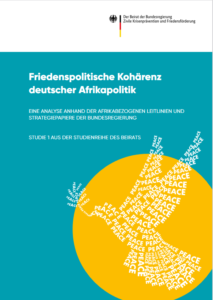
    Cover: Friedenspolitische Kohärenz deutscher Afrikapolitik. Eine Analyse anhand der afrikabezogenen Leitlinien und Strategiepapiere der Bundesregierung Julian Bergmann, Ina Friesen, Christine Hackenesch, Julia Leininger Beirat der Bundesregierung Zivile Krisenprävention und Friedensförderung Studienreihe des Beirats (Studie 1)
    ©PeaceLab

    On behalf of the Advisory Board to the German Government for Civilian Crisis Prevention and Peacebuilding, a new study authored by researchers of the German Development Institute / Deutsches Institut für Entwicklungspolitik (DIE) assesses the policy coherence for peace in the German Africa policies. In their report Julian Bergmann, Ina Friesen, Christine Hackenesch and Julia Leininger analyse whether and how policy coherence for peace is reflected in the German political strategies for cooperation with Africa. The study defines policy coherence for peace as the interaction between policies with regard to the overarching objective of fostering sustainable peace, as set out in the German Government’s guidelines on crisis prevention, conflict management and peacebuilding.

    The study finds that the strategy papers display a high degree of substantive coherence in terms of the challenges identified in Africa, the German Government’s policy objectives and the instruments to achieve them. However, they only reflect selectively the key elements of the German Government’s vision statement on peacebuilding. The authors recommend that the German Government initiates a consultation process to determine how to implement the vision statement on peacebuilding at the strategic level and in governmental practice and what principles would need to be further fleshed out to this end. In particular, they ask the German Government to develop a clearer understanding of what crisis prevention involves, what constitutes suitable means of prevention and how these means can strategically be deployed.

    The study (in German) is accessible via this link.

    A shorter blogpost on the study is accessible on the PeaceLab Blog website.