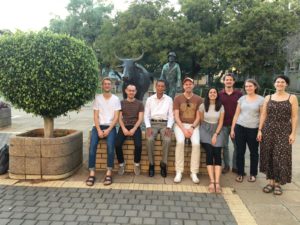
On 26 January 2020, together with our team leader Sebastian Ziaja, we took off on our research trip to Botswana to investigate e-government and democracy in Botswana. Faster than expected, the Corona developments caught up with us and brought us back to Germany from one day to the next only seven weeks later. However, even though our research stay was shortened by a few weeks, we were able to implement our plans and had a very exciting time in Gaborone.
Arriving in the capital of Botswana, we were welcomed by bright sunshine. On the same day, we had our first meeting with our project partner Professor David Sebudubudu, Dean of the Faculty of Social Sciences at the University of Botswana. In the following two weeks, further meetings with partners and relevant actors followed, such as Statistics Botswana, Afrobarometer and the Water Utilities Corporation. The goal for our research stay was to conduct an experiment on digital tax returns and a survey on e-government in Gaborone. After the questionnaire had been prepared and we had trained 27 research assistants, our survey was ready to start. In three intensive weeks, we were able to conduct more than 2,123 interviews. Before the survey, we had conducted an information campaign in cooperation with Botswana Unified Revenue Service in order to inform taxpayers in Gaborone about the option of e-filing (filing tax returns over the internet).
In the following week, events took a turn for the worse due to the worldwide corona pandemic. Our planned presentation of our preliminary research results at the University of Stellenbosch had to be cancelled. Likewise, the planned presentation of our final research results at University Botswana, as well as further background interviews should not take place. During the course of March, the decision was made to return to Germany early.
After an intensive time spent together, we are now working on our research report from our homes with regular video conferences. We are very very excited about the results of our analysis and would be happy if you continue to follow us on our Twitter channel: @EgovBotsTeam.
Best greetings and all the best for the time to come.
Hier ein Erlebnisbericht von den Mitgliedern des Forschungsteams Botswana:
Das ging schneller als gedacht: Am 26. Januar 2020 starteten wir gemeinsam mit unserem Teamleiter Sebastian Ziaja unsere Forschungsreise zum Thema e-Government und Demokratie in Botswana. Knappe sieben Wochen später sollten uns die Corona-Entwicklungen einholen und uns von einem auf den anderen Tag zurück nach Deutschland bringen. Doch auch wenn unser Forschungsaufenthalt verkürzt wurde, konnten wir unser Vorhaben umsetzen und hatten eine sehr spannende Zeit in Gaborone.
In der Hauptstadt Botswanas angekommen, empfing uns strahlender Sonnenschein. Noch am gleichen Tag hatten wir unser erstes Treffen mit unserem Projektpartner Professor David Sebudubudu, dem Dekan der Fakultät für Sozialwissenschaften an der Universität Botswana. In den kommenden zwei Wochen folgten weitere Treffen mit Partnern und relevanten Akteuren, wie Statistics Botswana, Afrobarometer und der Water Utilities Corporation. Das Ziel unseres Forschungsaufenthaltes war es, ein Experiment zur digitalen Steuererklärung sowie eine Umfrage zu e-Government in Gaborone durchzuführen. Nachdem der Fragebogen überarbeitet und wir 27 Forschungsassistent*innen geschult hatten, konnte unsere Umfrage losgehen. In drei intensiven Wochen führten wir mehr als 2.123 Interviews durch. Vorab organisierten wir in Kooperation mit dem Botswana Unified Revenue Service eine Informationskampagne, um Steuerzahler*innen in Gaborone über die Möglichkeit des e-Filings (elektronische Abgabe der Steuererklärung) zu informieren.
In der folgenden Woche überschlugen sich die Ereignisse aufgrund der weltweiten Corona-Pandemie. Die erste Vorstellung unserer Forschungsergebnisse an der Universität Stellenbosch musste abgesagt werden. Ebenso sollten die geplante Präsentation an der Universität Botswana sowie weitere Expert*innengespräche nicht mehr stattfinden. Im Laufe des März fiel schließlich die Entscheidung vorzeitig nach Deutschland zurückzukehren.
Nach einer intensiven gemeinsamen Zeit arbeiten wir nun mit regelmäßigen Videokonferenzen weiter an unserem Forschungsbericht. Wir sind gespannt, auf unsere Analyseergebnisse und freuen uns, wenn Sie uns weiterhin auf unserem Twitter-Kanal folgen: @EgovBotsTeam.
Beste Grüße und alles Liebe für die kommende Zeit.
Receiving letter from MGG team, I’d like share some lines from a movie named <the wandering Earth> and also some personal experience to help fighting with the corona-virus together.(mehr …)
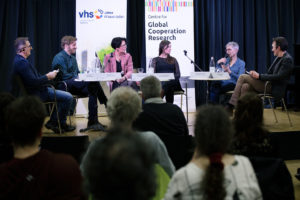
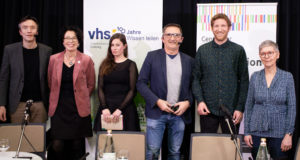
The 16th Käte Hamburger Dialogue took place as part of the Duisburger Akzente in cooperation with VHS Duisburg and Studio 47.
„There’s not much to happiness,“ is a common saying. But what about happiness at a time when sustainability guides our actions and implicitly calls us to renunciation and moderation? Is „having a lot“ then still possible at all? And in our growth-oriented society, in which, despite all the clichés to the contrary, a life of abundance is still regarded as the ultimate happiness, can satisfaction be achieved despite less consumption? These questions were debated by a round of speakers from the local science and sustainability sector as part of the 16th Käte Hamburger Dialogue at the Duisburg adult education centre. And right at the beginning a lively discussion relaxed about what kind of luxury it really is to be able to afford to do without.
As long as a sustainable lifestyle is reserved for the privileged sections of society, it is out of the question that it can be a recipe for „becoming happy“. There was agreement on the podium, however, that sustainability is not the same as renunciation. Rather, it means a rethinking of the value attributed to certain goods and behaviour. In this way, profits can be made and new products manufactured, also in the sense of a sustainable economy. One difference to conventional value creation, however, is that there is an awareness of the consequences of this action. If, therefore, we consume in the knowledge of our own effectiveness in such a way that we can exert a positive influence on other people and at the same time achieve desirable effects, this will, in doubt, even generate more happiness than if we only reward ourselves with a purchase.
Second annual conference of the Centre on communicative power postponed
Because of the Corona crisis and in accordance with the requirements of the North Rhine-Westphalian state government, the Centre has decided to postpone its 2nd annual conference, which was scheduled for 16 April 2020. A new date – probably in November 2020 – will be announced in time on the Centre’s website.
About: The annual conference will examine the functioning of communicative power as opposed to structural, material and positional power in creating opportunities and obstacles to transnational and global cooperation. A better understanding of the functioning of communicative power is of utmost importance in a context where global cooperation is increasingly controversial despite pressing problems of planetary scope such as climate change. Communicative power is of central importance for processes of criticism and justification of (global) public policy, all the more so in times of often conflicting ideas of world order.
The historian works on the topics of gender, anti-colonialism and anti-imperialism, humanitarian movements and their history, South Asia, food and hunger relief. After studies in Heidelberg, New Delhi, Groningen, Uppsala and a stopover at the Overseas Development Institute, she completed her doctorate at the Institute of Contemporary History at ETH Zurich. From March 2020 to February 2021, Dr Simonow will be a Postdoctoral Research Fellow in the research group ‚Pathways and Mechanisms of Global Cooperation‘. Her research project is entitled ‚The Private in the Political. Intimacy as a Pathway of Global Cooperation: Feminism, Anti-Imperialism and Indian Nationalism in Europe, North America and South Africa, c. 1900s-1960s‘ and aims to provide a feminist historical investigation of the role of (interethnic) love and sexual intimacy as paths of global cooperation of social and political movements in the first six decades of the twentieth century.
The legal philosopher Umberto Mario Sconfienza works on the environment and climate change from the perspective of political philosophy. He was Postdoctoral Research Fellow at the Cluster of Excellence ‚Normative Order‘ at the Goethe University Frankfurt and is a Postdoctoral Research Fellow at the Käte Hamburger Kolleg in the research group ‚Global Cooperation and Polycentric Governance‘ from January to December 2020. Dr. Sconfienza is developing a theory for the description and better understanding of global environmental policy under the title ‚The Post-Sustainability Trilemma‘.
Publications
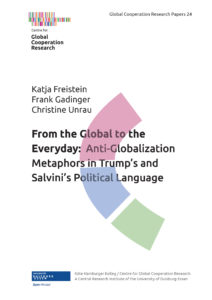
Katja Freistein, Frank Gadinger, Christine Unrau From the Global to the Everyday: Anti-Globalization Metaphors in Trump’s and Salvini’s Political Language (Global Cooperation Research Papers 24), Duisburg 2020
ISSN: 2198-1949 (Print)
ISSN: 2198-0411 (Online)
DOI: 10.14282/2198-0411-GCRP-24
https://www.gcr21.org/publications/gcr/research-papers/
In this paper, we ask how exactly right-wing populists make anti-globalization appealing. We follow the growing interest in the ambivalent features of populist language and performances by suggesting a methodological framework around narratives, metaphors, and emotions. We argue that right-wing populists skilfully present abstract phenomena of globalization and translate them to individual experiences of ‘ordinary people’. Metaphors play a crucial role in populist storytelling as they make sense of a complex reality through imagery. They mobilize collective emotions and reach a wider audience through a high degree of linguistic adaptability and normative ambiguity.
We demonstrate these narrative operations using two recent cases of ‘successful’ right-wing populist, anti-globalization storytelling, which build on strong metaphors. One is the metaphor of the ‘House’, used by former Italian Deputy Prime Minister and Interior Minister Matteo Salvini, and the other is U.S. President Donald Trump’s metaphor of ‘The Wall’. We argue that these metaphors are used to create an inside/outside distinction that externalizes threats which are possibly internal (e.g. drug consumption) to a polity (e.g. external drug abuse or organized crime) but can be blamed on globalization through the use of metaphors. What is more, metaphors can be utilized to construct a crisis, which in turn makes it possible for populists to adopt the savior-role of an energetic hero, who alone is able to resolve the supposed crisis.
Der 16. Käte Hamburger Dialogue fand im Rahmen der Duisburger Akzente, in Kooperation mit VHS Duisburg und Studio 47, statt.
„Es gehört nicht viel zum Glücklichsein“ – so lautet eine gängige Redensart. Wie verhält es sich aber mit dem Glück in einer Zeit, in der Nachhaltigkeit unsere Handlungen leitet und uns implizit zu Verzicht und Mäßigung auffordert? Ist „viel haben“ dann überhaupt noch möglich? Und kann sich in unserer auf Wachstum fixierten Gesellschaft, in der allen anderslautenden Floskeln zum Trotz ein Leben im Überfluss immer noch als das ultimative Glück gilt, Zufriedenheit trotz weniger Konsum einstellen? Über diese Fragen debattierte eine Runde von Referent*innen aus dem lokalen Wissenschafts- und Nachhaltigkeitsbereich im Rahmen des 16. Käte Hamburger Dialogues in der Duisburger VHS.
Gleich zu Beginn entsponn sich eine angeregte Diskussion darüber, was für ein Luxus es tatsächlich ist, sich einen Verzicht überhaupt leisten zu können. Solange nämlich eine nachhaltige Lebensweise nur den privilegierten Teilen der Gesellschaft vorbehalten bleibt, ist ohnehin ausgeschlossen, dass es als Rezept zum „Glücklich-Werden“ taugt. Einigkeit herrschte indes auf dem Podium darüber, dass Nachhaltigkeit nicht mit Verzicht gleichzusetzen ist. Vielmehr bedeute es, dass ein Umdenken darüber stattfindet, welchen Stellenwert bestimmte Güter und Verhaltensweisen zugeschrieben bekommen.
So können auch im Sinne einer nachhaltigen Konjunktur Gewinne erwirtschaftet und neue Produkte hergestellt werden. Ein Unterschied zur konventionellen Wertschöpfung liegt jedoch darin, dass ein Bewusstsein für die Konsequenzen dieses Handelns herrscht. Wenn wir demnach im Wissen unserer eigenen Wirkmächtigkeit so konsumieren, dass wir damit einen positiven Einfluss auf andere Menschen ausüben und gleichzeitig wünschenswerte Effekte erzielen können, erzeugt dies im Zweifel sogar mehr Glück, als wenn man mit einem Kauf nur sich selbst belohnt.
Zweite Jahreskonferenz des Kollegs zu kommunikativer Macht wird verschoben
Entsprechend den Vorgaben der nordrhein-westfälischen Landesregierung zur Corona-Krise hat das Kolleg beschlossen, seine zweite Jahreskonferenz, die für den 16. April 2020 geplant war, zu verschieben. Ein neuer Termin – voraussichtlich im November 2020 – wird rechtzeitig auf der Website des Kollegs bekannt gegeben.
Zum Thema: Die Jahreskonferenz will die Funktionsweise von kommunikativer Macht im Unterschied zu struktureller, materieller und positioneller Macht bei der Schaffung von Möglichkeiten und Hindernissen für transnationale und globale Zusammenarbeit untersuchen. Ein besseres Verständnis der Funktionsweise von kommunikativer Macht ist in einem Kontext, in dem globale Zusammenarbeit trotz drängender Probleme von planetarischer Tragweite wie dem Klimawandel zunehmend umstritten ist, von größter Bedeutung. Kommunikative Macht ist zentral für Prozesse der Kritik und Rechtfertigung (globaler) öffentlicher Politik, und dies umso mehr in Zeiten oft gegensätzlicher Weltordnungsvorstellungen.
Die Historikerin arbeitet zu den Themen Gender, Anti-Kolonialismus und Anti-Imperialismus, Humanitäre Bewegungen und ihre Geschichte, Südasien, Nahrung und Hungerhilfe. Nach Stationen in Heidelberg, New Delhi, Groningen, Uppsala und einer Zwischenstation am Overseas Development Institute promovierte sie am Institut für Zeitgeschichte der ETH Zürich. Dr Simonow forscht von März 2020 bis Februar 2021 als Postdoc Research Fellow in der Forschungsgruppe „Pfade und Mechanismen globaler Kooperation“. Ihr Forschungsprojekt unter dem Titel „The Private in the Political. Intimacy as a Pathway of Global Cooperation: Feminism, Anti-Imperialism and Indian Nationalism in Europe, North America and South Africa, c. 1900s-1960s“ will eine feministische historische Untersuchung der Rolle von (interethnischer) Liebe und sexueller Intimität als Wege der globalen Zusammenarbeit sozialer und politischer Bewegungen in den ersten sechs Jahrzehnten des zwanzigsten Jahrhunderts liefern.
Der Rechtsphilosoph Umberto Mario Sconfienza arbeitet zu den Themen Umwelt und Klimawandel aus der Perspektive der politischen Philosophie. Er war Postdoctoral Research Fellow am Exzellenzcluster „Normative Ordnung“ der Goethe-Universität Frankfurt und forscht von Januar bis Dezember 2020 als Postdoc Research Fellow am Käte Hamburger Kolleg in der Forschungsgruppe „Globale Kooperation und polyzentrische Governance“. Dr. Sconfienza entwickelt am Kolleg eine Theorie zur Beschreibung und für ein besseres Verständnis globaler Umweltpolitik unter dem Titel ‚The Post-Sustainability Trilemma‘.
Publikationen
Katja Freistein, Frank Gadinger, Christine Unrau From the Global to the Everyday: Anti-Globalization Metaphors in Trump’s and Salvini’s Political Language (Global Cooperation Research Papers 24), Duisburg 2020
ISSN: 2198-1949 (Print)
ISSN: 2198-0411 (Online)
DOI: 10.14282/2198-0411-GCRP-24
https://www.gcr21.org/publications/gcr/research-papers/
In this paper, we ask how exactly right-wing populists make anti-globalization appealing. We follow the growing interest in the ambivalent features of populist language and performances by suggesting a methodological framework around narratives, metaphors, and emotions. We argue that right-wing populists skilfully present abstract phenomena of globalization and translate them to individual experiences of ‘ordinary people’. Metaphors play a crucial role in populist storytelling as they make sense of a complex reality through imagery. They mobilize collective emotions and reach a wider audience through a high degree of linguistic adaptability and normative ambiguity.
We demonstrate these narrative operations using two recent cases of ‘successful’ right-wing populist, anti-globalization storytelling, which build on strong metaphors. One is the metaphor of the ‘House’, used by former Italian Deputy Prime Minister and Interior Minister Matteo Salvini, and the other is U.S. President Donald Trump’s metaphor of ‘The Wall’. We argue that these metaphors are used to create an inside/outside distinction that externalizes threats which are possibly internal (e.g. drug consumption) to a polity (e.g. external drug abuse or organized crime) but can be blamed on globalization through the use of metaphors. What is more, metaphors can be utilized to construct a crisis, which in turn makes it possible for populists to adopt the savior-role of an energetic hero, who alone is able to resolve the supposed crisis.
Diese Website benutzt Cookies. Wenn du die Website weiter nutzt, gehen wir von deinem Einverständnis aus.