Jahr: 2020

  • News from the Käte Hamburger Kolleg / Centre for Global Cooperation Research (KHK/GCR21)

    Research Fellowships 2021–2022: Open Call for Applications
    Logo: Call for Applications
    ©KHK/GCR21

    The Käte Hamburger Kolleg/Centre for Global Cooperation Research (KHK/GCR21) invites applications for Research Fellowships with a duration of 12 months starting between February and September 2021. Proposals are especially welcome regarding: (1) critique, justification and legitimacy in global cooperation; and (2) global cooperation and competing conceptions of world order. In addition, preference will be given to applications with an empirical focus on the governance of climate change, the internet, migration, and peacebuilding. The fully funded fellowships are available to both senior and postdoctoral researchers across the humanities and social sciences (including also psychology, law and economics). We particularly encourage female researchers and scholars from the Global South to apply. Applications from scholars at risk are welcome. Deadline for applications is 1st June 2020. Apply here: https://www.gcr21.org/fellowship-application-2021

    We are aware that this call comes at a time of high uncertainty around COVID-19. We are monitoring the evolving situation closely and hope that circumstances will allow the advertised fellowships to start as planned from February 2021 onwards. We therefore urge you to apply if you are interested but still uncertain about the practicability of the fellowship!

    Global Cooperation Research – A Quarterly Magazine
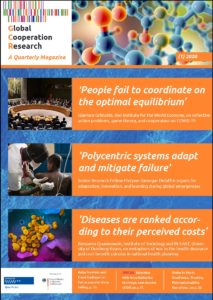
    Cover: 1 / 2020 Global Emergency and Communication
    ©KHK/GCR21

    1 / 2020 Global Emergency and Communication

    This issue scrutinizes global cooperation in light of the current COVID-19 global emergency. Articles range from reflections on modelling interpersonal and international coordination games at the time of the pandemic (Grimalda), applying polycentric governance analysis to global health challenges (Deloffre) to analysing the role of metaphors (Quasinowski, Gadinger/Freistein), normative claims (Groth) and narratives (Sconfienza) in technical discourses and political communication. Mouli Banerjee talks with Anna-Katharina Hornidge, new director of the German Development Institute / Deutsches Institut für Entwicklungspolitik (DIE), about “Knowledge Regimes, Development, Cooperation, and the Current Corona Crisis”.

    Prof. Wouter G. Werner new member to the Centre’s Scientific Advisory Board
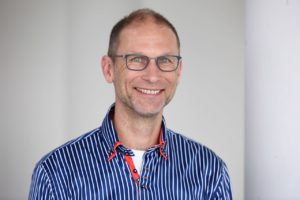
    Photo: Wouter G. Werner was appointed as a new member to the Centre’s Scientific Advisory Board
    Wouter G. Werner, ©KHK/GCR21

    Prof. Dr Wouter G. Werner was appointed as a new member to the Centre’s Scientific Advisory Board from 1 February 2020. Wouter Werner is a professor of international law at the Centre for the Politics of Transnational Law, Vrije Unversiteit Amsterdam. He joined the Centre in 2018 as a Senior Research Fellow with his project on ‘Restatements, Narration and Collective Sense Making in International Law’. Werner is the author of ‘Godot was Always There. Repetition and the Formation of Customary International Law’ in the Centre’s Research Paper Series (No. 22). His re-cent publications deal with topics such as documentary film and international criminal law, social acceleration and international law and the formation of customary law through restatements by expert committees.

    New Fellow: Dr Maren Hofius

    Photo: Dr Maren Hofius focuses on regional governance from a critical border studies perspective.
    Maren Hofius, ©KHK/GCR21

    International Relations scholar Dr Maren Hofius focuses on regional governance from a critical border studies perspective. Having been a lecturer and researcher at the Chair of Political Science, esp. Global Governance at the University of Hamburg, she joins the research group ‚Pathways and Mechanisms of Global Cooperation‘ as a Senior Research Fellow from April 2020 to March 2021 with her project “From Arctic Exceptionalism to Global Arctic: Exploring Pathways of Cooperation in Circumpolar Arctic Governance”. This project proposes to understand the Arctic Council as a ‘boundary organisation’ and examines the extent to which the ‘boundary work’ practiced by its multiple epistemic communities contributes to a climate of cooperation rather than conflict. Studying the Arctic Council’s boundary work promises to provide new insights into how global governance institutions can develop sustainable pathways of global cooperation in the face of increasingly pluralistic policy settings.
  • News from SDSN Germany

    Logo SDSN Germany
    ©SDSN Germany

    The coronavirus and the Covid-19 pandemic are currently determining our lives and thus also our work: not only in terms of organisation, but also in terms of content. While the current focus is of course on crisis management, some members and partners of SDSN Germany have reflected potential consequences of the corona crisis for German, European and global sustainability and climate policy as well as for international cooperation. Together with the Co-Chair of the network, Professor Anna-Katharina Hornidge, the secretariat of SDSN Germany initiated a mutual exchange in order to assess the situation and develop joint positions in the network. Therefore, the secretariat invited representatives of the member and partner organisations as well as the members of the Extended Leadership Council of SDSN Germany to a virtual meeting on 3 April. It remains to be seen how the pandemic will lead to changes in the framework conditions for sustainable development. More than 35 participants from politics/federal and state ministries, the municipal sector, science, economy and civil society met in this virtual discourse space for a common exchange and reflection on these challenges. Please find the report on the virtual meeting here.

  • Neues von SDSN Germany

    Logo SDSN Germany
    ©SDSN Germany

    Das Coronavirus und die Covid-19-Pandemie bestimmen derzeit unser Leben und damit auch unsere Arbeit: nicht nur organisatorisch, sondern auch inhaltlich. Während aktuell natürlich die Krisenbewältigung im Vordergrund steht, haben einige Mitglieder und Partner von SDSN Germany sich nun auch mit den Konsequenzen der Corona-Krise für deutsche, europäische und globale Nachhaltigkeits- und Klimapolitik sowie für die internationale Zusammenarbeit befasst. Gemeinsam mit der Ko-Vorsitzenden des Netzwerks Prof. Anna-Katharina Hornidge hat die Geschäftsstelle von SDSN Germany ein virtuelles Meeting zum Austausch und zur Entwicklung gemeinsamer Einschätzungen und Positionierungen im Netzwerk initiiert. Teil nahmen Vertreter*innen der Mitglieder- und Partnerorganisationen sowie Mitglieder des Erweiterten Lenkungsausschusses von SDSN Germany. Infolge der Pandemie ist mit möglicherweise erheblichen Veränderungen der Rahmenbedingungen für nachhaltige Entwicklung zu rechnen. Über 35 Teilnehmer*innen aus Politik/Bundes- und Landesministerien, dem kommunalen Bereich, Wissenschaft, Wirtschaft und Zivilgesellschaft trafen sich in diesem virtuellem Diskursraum am 3. April für den gemeinsamen Austausch und zur Reflexion dieser Herausforderungen. Den Bericht des virtuellen Meetings finden Sie hier.

  • Auftakttreffen zum neuen EU Horizon2020 Projekt

    Logo: Promoting Research on Digitalisation in Emerging Powers and Europe Towards Sustainable Development (PRODIGEES)
    Logo: PRODIGEES, ©DIE

    Das neue EU Horizon 2020-Projekt PRODIGEES (Promoting Research on Digitalisation in Emerging Powers and Europe Towards Sustainable Development) zur Erforschung der Verbindung von Digitalisierung und nachhaltiger Entwicklung hat mit dem offiziellen Auftakttreffen seine Aktivitäten aufgenommen. Aufgrund der Pandemie fand das Treffen nicht wie ursprünglich geplant in Berlin statt, sondern als eine Reihe von Online-Treffen, um die verschiedenen Zeitzonen der teilnehmenden Institutionen abzudecken. Das Treffen brachte das Deutsche Institut für Entwicklungspolitik (DIE) zusammen mit Vertretern des Centre for Strategic and International Studies (CSIS, Indonesien), Fundação Getúlio Vargas (FGV, Brasilien), Instituto Mora (Mexiko), Istituto Affari Internazionali (IAI, Italien), Research and Information System for Developing Countries (RIS, Indien), Stellenbosch University (Südafrika) und der Universität Hamburg.

    Das Auftakttreffen bot auch die Gelegenheit, den Lenkungsausschuss des Konsortiums zusammenzubringen, dem Vertreter aller Partner angehören. Das Komitee beaufsichtigt die Projektumsetzung in den nächsten vier Jahren (2020-2023). Der Kern der Diskussion war die Anpassung und der Zeitplan des geplanten Personalaustausches angesichts der Covid-19-Pandemie, sowie der Projektplan, Kommunikations- und Verbreitungsmaßnahmen. Trotz der derzeitigen Unsicherheiten blickt die Gruppe optimistisch auf die für die zweite Hälfte des Jahres 2020 geplanten Aktivitäten. Das Gremium begrüßte auch den Abschluss des ersten erfolgreichen Austausches im Rahmen von PRODIGEES von Deutschland nach Mexiko Anfang des Jahres.

  • Kick-off meeting for the new EU Horizon2020 project PRODIGEES

    Logo: Promoting Research on Digitalisation in Emerging Powers and Europe Towards Sustainable Development (PRODIGEES)
    Logo: PRODIGEES, ©DIE

    The new EU Horizon 2020 research and network project, PRODIGEES, which analyses digitalisation towards sustainable development, held its official kick-off meeting on March 30, 2020. Due to the global pandemic, the meeting was not held in Berlin, as originally planned, but as a series of online meetings to cover the different time zones of participating institutions. As project coordinator, the German Development Institute / Deutsches Institut für Entwicklungspolitik (DIE) brought together representatives from Centre for Strategic and International Studies (CSIS, Indonesia), Fundação Getúlio Vargas (FGV, Brazil), Instituto Mora (Mexico), Istituto Affari Internazionali (IAI, Italy), Research and Information System for Developing Countries (RIS, India), Stellenbosch University (SU, South Africa) and the University of Hamburg (UHAM, Germany).

    The kick-off meeting also served as an opportunity to bring together the Steering Committee of the consortium, comprising representatives from all partners. The committee oversees the project implementation throughout PRODIGEES’ lifetime (2020-2023). The core of the discussion revolved around the adjustment and the timeline for planned staff exchange in the face of the Covid-19 pandemic, the project plan, as well as communication and dissemination measures. Despite current uncertainties, the group is optimistic for the implementation of activities planned for the latter half of 2020, and praised the completion of the first successful secondment under the PRODIGEES framework from Germany to Mexico from earlier this year.