Jahr: 2021

  • Three new associate reseachers at DIE

    Christoph Anton, Erin McCandless and Sander Chan are now Associate Researchers at DIE.

    • Prof. Dr. Christoph Anton is Professor of Law at the Macquarie Law School of the Macquarie University in Sydney, Australia. His research encompasses the relationship of intellectual property and other laws to different knowledge systems, the role of law in ethnic classification and stratification and law and development policy.
    • Dr. Erin McCandless is an Associate Professor in the School of Governance at Witwatersrand University in South Africa. Her current research is focused on forging resilient social contracts, and the role of social cohesion, in countries affected by conflict, fragility and fraught transition, building upon a multi-country research and policy dialogue project that she directed from 2015-2018.  Professor McCandless is author of more than 100 publications, including several influential, policy-shifting United Nations reports, and she is founder and former Chief Editor of the Journal of Peacebuilding and Development.
    • Dr Sander Chan leads research on non-state climate action, particularly focusing on the role of such action in increasing adaptive capacities and resilience to the climate change impacts at the Global Center on Adaptation’s (GCA) Knowledge and Research Hub in Groningen. He is also affiliated with the Copernicus Institute of Sustainable Development at Utrecht University as adjunct assistant professor. Until September 2020, he was a Senior Researcher at DIE.
     

  • Drei neue assoziierte Wissenschaftler*innen am DIE

    Prof. Dr. Christoph Anton, Dr. Erin McCandless und Dr. Sander Chan sind neue assoziierte Wissenschaftler*innen am DIE.

    Christoph Anton ist Professor für Recht an der Macquarie Law School der Macquarie University in Sydney, Australien. Seine Forschungsgebiete umfassen das Verhältnis von geistigen Eigentumsrechten und anderen Rechtsgebieten zu unterschiedlichen Wissenssystemen, die Rolle des Rechts in ethnischer Klassifizierung und Stratifizierung sowie Recht und Entwicklungspolitik.

    Erin McCandless ist Associate Professor an der School of Governance der Witwatersrand University in Südafrika. Ihre aktuelle Forschung konzentriert sich auf das Schmieden belastbarer sozialer Verträge und die Rolle von sozialem Zusammenhalt in Ländern, die von Konflikten, Fragilität und schwierigem Übergang betroffen sind, aufbauend auf einem länderübergreifenden Forschungs- und Politikdialogprojekt, das sie von 2015-2018 leitete. Professor McCandless ist Autorin von mehr als 100 Publikationen, darunter mehrere einflussreiche, politikverändernde Berichte der Vereinten Nationen, und sie ist Gründerin und ehemalige Chefredakteurin des Journal of Peacebuilding and Development.

    Sander Chan leitet die Forschung am Wissens- und Forschungszentrum des Global Center on Adaptation (GCA) in Groningen, Niederlande. Er arbeitet insbesondere zu nichtstaatlichen Klimaschutzmaßnahmen und konzentriert sich dabei insbesondere auf die Rolle solcher Maßnahmen bei der Steigerung der Anpassungsfähigkeit und Widerstandsfähigkeit gegenüber den Auswirkungen des Klimawandels. Er ist zudem außerordentlicher Assistenzprofessor am Kopernikus-Institut für nachhaltige Entwicklung an der Universität Utrecht. Bis September 2020 war er Wissenschaftlicher Mitarbeiter am DIE.

  • Online Event: The United Nations and South-South Cooperation

    Cover: Online Event: Die Vereinten Nationen und Süd-Süd-Kooperation Zusammen mit dem indischen Think Tank Research and Information System for Developing

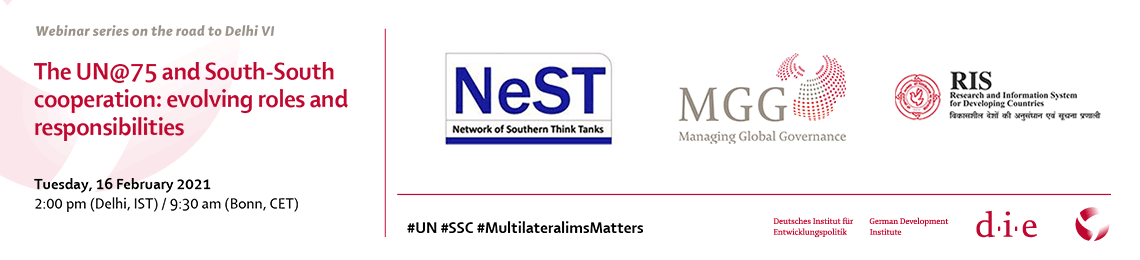
    In cooperation with the Indian think tank Research and Information System for Developing Countries (RIS), the German Development Institute / Deutsches Institut für Entwicklungspolitik (DIE) co-hosted the webinar The UN@75 and South-South cooperation: evolving roles and responsibilities on 16 February 2021. Attended by more than 250 participants, it brought together researchers as well as representatives from the United Nations (UN) to focus on the relationship between the UN, on the one hand, and cooperation among member states in the Global South, on the other.

    In his opening remarks, Dr. Sven Grimm underlined the importance of multilateralism for the global common good. Together with the RIS Director General, Prof. Dr. Sachin Chaturvedi, he stressed the relevance of partnerships – such as the one between RIS and DIE – for enabling a global debate about international cooperation among a broad range of stakeholders.

    Former UN Secretary-General Ban Ki-moon, in turn, pleaded for the strengthening of Southern UN member states, particularly in the context of the COVID-19 pandemic. He emphasised that increasing levels of cooperation among developing countries did not erase the responsibility of rich member states from the Global North to provide support.

    As part of the panel on the UN development system, Sebastian Haug presented ongoing research on how UN funds, programmes and specialised agencies have integrated South-South and triangular cooperation in their institutional procedures. He highlighted both the heterogeneity of UN efforts as well as geopolitical dynamics that have conditioned the support for South-South processes.

    Dr. Silke Weinlich chaired that panel and underlined that strengthening South-South cooperation was not only relevant for Southern member states but also provided a key contribution to implementing the Sustainable Development Goals (SDGs). She urged that all available cooperation formats needed to be part of concerted efforts towards reaching the SDGs, also and particularly in the context of the Covid pandemic.

    The online event was organised in cooperation with the Network of Southern Think Tanks (NeST) and the Managing Global Governance (MGG) network. Against the backdrop of the 75th anniversary of the United Nations, it offered panellists and participants the opportunity to take stock and, at the same time, was part of a series of events preparing an international conference on South-South cooperation that is set to take place in Delhi later this year.

    A complete recording of the event is available here:

  • Online round-table: “COVID-19 and its impact on the informal economy in Sub-Saharan Africa: Results from national representative surveys in 6 African countries”, 10.02.2021

    It is still difficult to assess the impact of the Covid-19 pandemic in several dimensions. This is particularly the case for the informal economies in developing countries. The German Development Institute/ Deutsches Institut für Entwicklungspolitik (DIE), the Friedrich-Ebert-Foundation (FES) and the International Labour Organization (ILO) held an online roundtable on 10 February 2021 that presented first empirical results from six national representative surveys in the informal economy. The surveys were conducted in Senegal, Ethiopia, Cote d’Ivoire, Benin, Zambia and Kenya. In the first part of the roundtable, Florence Bonnet (ILO) presented findings on access to health and health insurance coverage in the informal sector. Afterwards, Christoph Strupat (DIE) showed evidence on the economic effects of the COVID-19 pandemic. The event was moderated by Manfred Öhm (Head of Africa Department, FES) and Julia Leininger (DIE). The results provided a better understanding of the negative impacts of the COVID-19 pandemic in the informal economy and were a basis for a lively discussion after the presentations.

  • Online round-table zum Thema “COVID-19 and its impact on the informal economy in Sub-Saharan Africa: Results from national representative surveys in 6 African countries”, 10. Februar 2021

    Es ist immer noch schwierig, die wirtschaftlichen und sozialen Auswirkungen der COVID-19-Pandemie abzuschätzen. Dies gilt insbesondere für den informellen Sektor in Entwicklungsländern. Das Deutsche Institut für Entwicklungspolitik (DIE), die Friedrich-Ebert-Stiftung (FES) und die Internationale Arbeitsorganisation (ILO) veranstalteten am 10. Februar 2021 einen Online-Roundtable, der erste empirische Ergebnisse aus sechs nationalen repräsentativen Haushaltsbefragungen im informellen Sektor präsentiert. Die Befragungen wurden im Senegal, in Äthiopien, in der Elfenbeinküste, in Benin, Sambia und Kenia durchgeführt. Im ersten Teil der Veranstaltung präsentierte Florence Bonnet (ILO) Ergebnisse zum Zugang zu Gesundheitsdienstleistungen und Krankenversicherung im informellen Sektor. Anschließend zeigte Christoph Strupat (DIE) erste Ergebnisse zu den wirtschaftlichen Auswirkungen der COVID-19 Pandemie im informellen Sektor. Die Veranstaltung wurde von Manfred Öhm (Leiter der Afrika-Abteilung, FES) und Julia Leininger (DIE) moderiert. Die präsentierten Ergebnisse sorgten für ein besseres Verständnis zu den wirtschaftlichen und sozialen Auswirkungen der COVID-19-Pandemie in Entwicklungsländern und waren Grundlage für eine lebhafte Diskussion im Anschluss an die Vorträge.