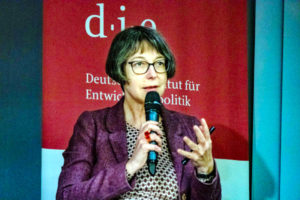
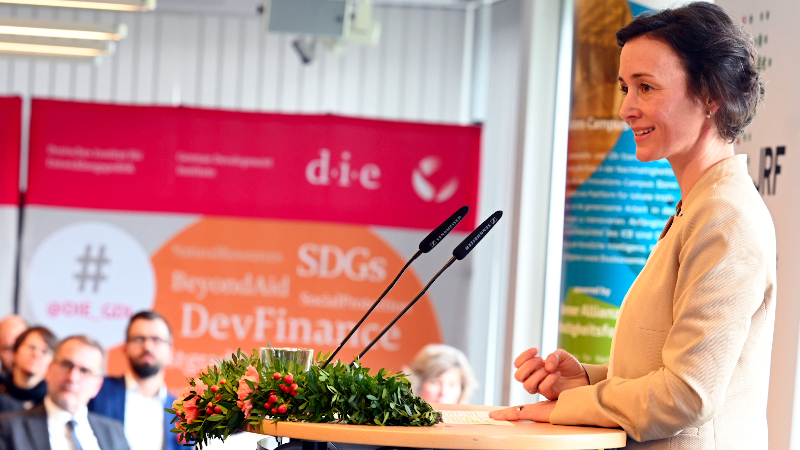
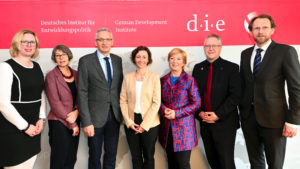
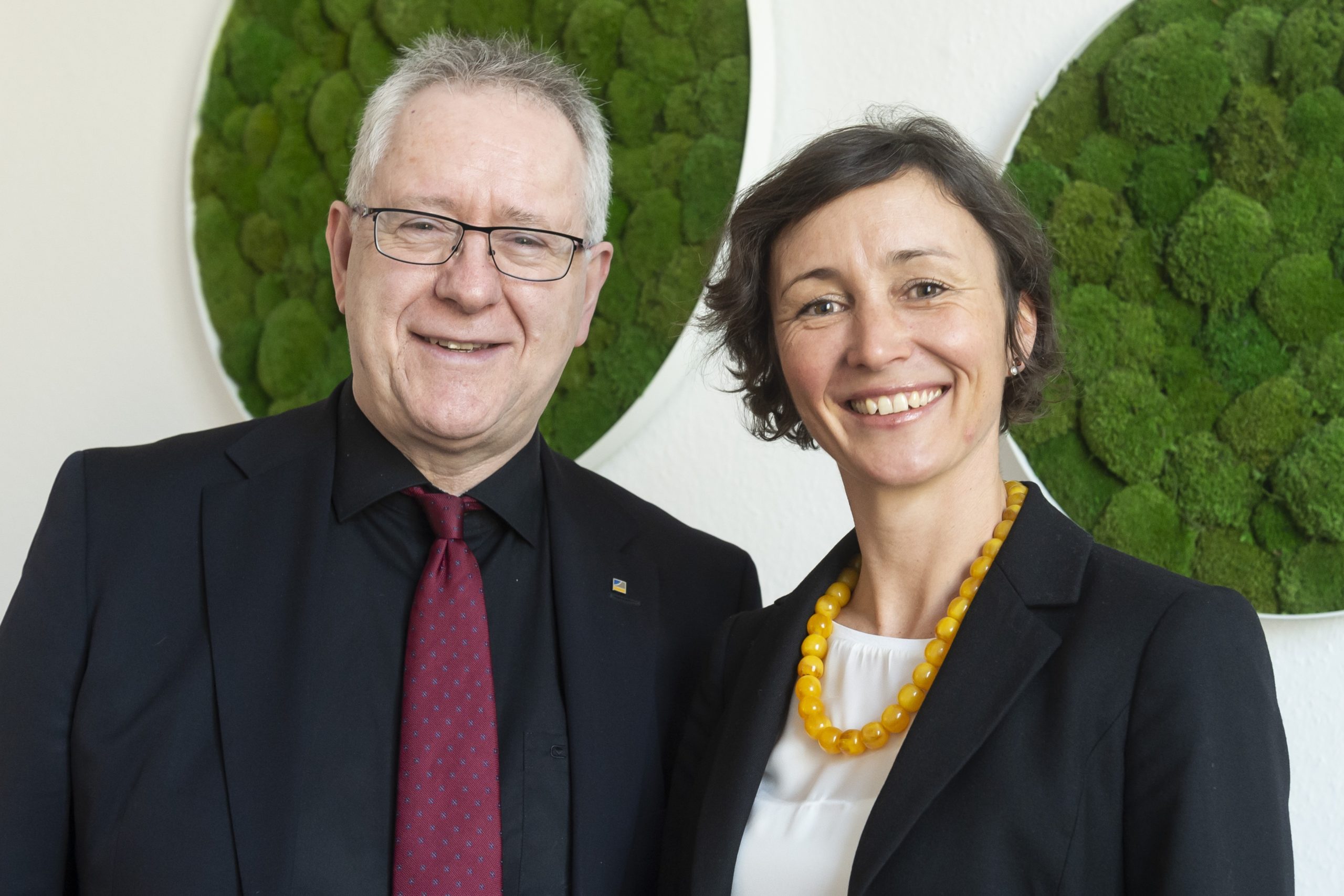
Mit über 100 geladenen Gästen feierte das Deutsche Institut für Entwicklungspolitik heute den Amtsantritt seiner neuen Direktorin, Anna-Katharina Hornidge. Als hochrangigste Repräsentant*innen der Gesellschafter des DIE sprachen Staatssekretär Martin Jäger (Bundesministerium für Wirtschaftliche Zusammenarbeit und Entwicklung) sowie Staatssekretärin Annette Storsberg (Ministerium für Kultur und Wissenschaft des Landes Nordrhein-Westfalen) Frau Hornidge ihre Glückwünsche aus. Rektor Hoch hieß Frau Hornidge an der Universität Bonn willkommen. Durch die Besetzung der Direktorinnenposition des DIE im Rahmen eines gemeinsamen Berufungsverfahrens mit der Universität Bonn unterstreichen die Gesellschafter die wissenschaftliche Unabhängigkeit des DIE sowie die Bedeutung der Zusammenarbeit zwischen dem DIE und der Universität Bonn im Kontext der Bonner Allianz für Nachhaltigkeitsforschung.
Imme Scholz, die das Institut seit dem Weggang von Dirk Messner im Oktober 2018 kommissarisch geleitet hat, freut sich auf die Zusammenarbeit mit Anna-Katharina Hornidge in der Leitung des Hauses und bei der strategischen Weiterentwicklung der Arbeit des DIE in Forschung, Beratung und Ausbildung. Axel Berger, Vorsitzender des Betriebsrats, und Andrea Cordes, Gleichstellungsbeauftragte, dankten Frau Scholz für die kommissarische Leitung des DIE und freuen sich auf die Zusammenarbeit mit Frau Hornidge in ihrem neuen Amt.
Vor ihrer Bestellung zur Direktorin des DIE und dem Ruf an die Universität Bonn war Anna-Katharina Hornidge Professorin für Sozialwissenschaften in den marinen Tropen an der Universität Bremen sowie Leiterin der Abteilung Sozialwissenschaften am Leibniz-Zentrum für Marine Tropenforschung. Dort leitete sie zudem die Arbeitsgruppe Entwicklungs- und Wissenssoziologie.
Die Pressemitteilung zur Berufung von Anna-Katharina-Hornidge an die Universität Bonn und zur Bestellung als Direktorin an das DIE finden Sie hier.
Die Verwendung dieser Bilder im Zusammenhang mit der Pressemitteilung ist kostenlos, dabei sind die angegebenen Bildquellen zu nennen. / The use of these images in connection with the press release is free of charge, the specified image source must be named.
New project “digitainable” at the Innovation-Campus Bonn (ICB)
Digitalization is an important driver for change in many areas of our lives and there is intense debate about whether it has a positive or negative impact on sustainable development. Often such considerations remain general. The main objective of the project digitainable is to go beyond this and to examine in detail the impact of digitalization on sustainable development.
The most comprehensive formulation of our current understanding of sustainability is the 2030 Agenda, which was adopted by the UN Member States in September 2015. With its 17 Sustainable Development Goals (SDGs), specified by 169 targets and more than 200 indicators, it comprehensively captures the sustainability landscape, including different areas such as improving health, eradicating poverty, gender equality and climate change. To come close to achieving these goals within the planned timeframe, a breakthrough in terms of speed and degree of progress is necessary. It is often assumed that digitalization and artificial intelligence (D&AI) can be used to significantly increase progress towards the SDGs. However, it is still unclear where and how D&AI can help to control and monitor the complex interrelationships of the broadly defined SDGs and their indicators, and where it could even hamper progress, for example through the high consumption of energy if it is generated from fossil sources. Digitainable aims to uncover the complex relationships between the indicators of SDGs and to understand the impact of D&AI on the progress towards the SDGs, both from a technical-scientific and a social-scientific perspective.
Methodological approach of the project
In the project, the influence of D&AI on the Agenda 2030 indicators is examined individually. A particular challenge is that D&AI are not explicitly addressed either in the SDGs themselves or in the targets and indicators. Therefore, the interrelationships are mostly indirect. The project is therefore divided into the following two phases:
Phase 1: The project will identify the impact of D&AI at the indicator level, both at the level of individual indicators and their linkages. It will attempt to describe a Theory of Change for each indicator.
Phase 2: It is known that there are numerous synergies and tradeoffs between the different indicators. The project will examine possible effects of D&AI on these relationships and will try to identify options where D&AI can enhance synergies and mitigate tradeoffs. In particular, it will also examine how to incorporate the issue of D&AI into a future („post-2030“) agenda.
The project will rely on cooperation with partners within and outside the Bonn Alliance for Sustainability Research for a wide range of issues.
Community Building – digitainable Thinkathon
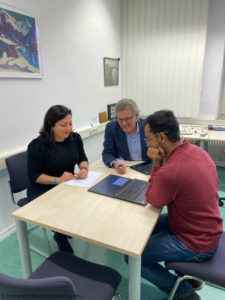
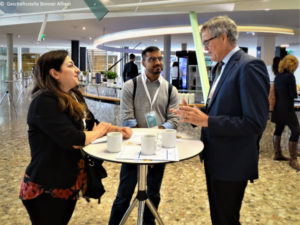
Mahsa Motlagh, Jakob Rhyner , Shivam Gupta
We want to bring together people who deal with these important tasks and issues! On 28April 2020, we will host a digitainable Thinkathon in Bonn (in English). The online application process opens on 29 January 2020.
The regional research network aims to further strengthen research in the field of sustainable development and global change. It helps to interlink and expand the interdisciplinary competence in this field in Bonn. Furthermore, the Bonn Alliance aims at jointly establishing the Innovation Campus Bonn (ICB).
Pilotprojekt zu Digitalisierung und künstlicher Intelligenz am ICB: “Digitalization and Sustainability – digitainable”
Die Digitalisierung ist ein wichtiger Motor für Veränderungen in vielen Bereichen unseres Lebens. Es wird intensiv darüber diskutiert, ob sie sich positiv oder negativ auf die nachhaltige Entwicklung auswirkt. Oft bleiben solche Betrachtungen allgemein. Hauptziel des Projekts digitainable des Innovations-Campus Bonn (ICB) ist es, darüber hinauszugehen, und den Einfluss der Digitalisierung auf nachhaltige Entwicklung im Detail zu untersuchen.
Die umfassendste Formulierung unseres heutigen Verständnisses von Nachhaltigkeit liefert die UN-Agenda 2030, die im September 2015 von den UN-Mitgliedsstaaten verabschiedet wurde. Mit ihren 17 Nachhaltigkeitszielen (Sustainable Development Goals, SDGs), die durch 169 Ziele und mehr als 200 Indikatoren spezifiziert sind, wird die Nachhaltigkeitslandschaft umfassend erfasst, einschließlich unterschiedlicher Bereiche wie Verbesserung der Gesundheit, Beseitigung der Armut, Gleichstellung der Geschlechter oder Klimawandel. Um diese Ziele in der geplanten Zeit auch nur annähernd zu erreichen, ist ein Durchbruch in Bezug auf Geschwindigkeit und Grad der Fortschritte erforderlich. Oft wird davon ausgegangen, dass mit Hilfe von Digitalisierung und künstlicher Intelligenz (D&KI) die Fortschritte, die zum Erreichen der SDGs notwendig sind, deutlich gesteigert werden können. Es ist jedoch unklar, wo und wie gut D&KI dazu beitragen, die komplexen Zusammenhänge der breit definierten SDGs und ihrer Indikatoren zu steuern und zu überwachen. Auch ist unklar, in welchen Bereichen sie den Fortschritt sogar hemmen könnten, zum Beispiel durch den hohen Verbrauch an Energie, so lange diese aus fossilen Quellen erzeugt wird. Digitainable zielt darauf ab, diese komplexen Beziehungen zwischen den Indikatoren der SDGs aufzudecken und den Einfluss von D&KI auf den Fortschritt hin zu den SDGs zu verstehen, sowohl aus technisch-naturwissenschaftlicher als auch aus sozialwissenschaftlicher Sicht.
Methodischer Ansatz des Projekts
Mahsa Motlagh, Jakob Rhyner , Shivam Gupta
Im Projekt wird der Einfluss der D&KI auf die Indikatoren der Agenda 2030 einzeln untersucht. Eine besondere Herausforderung besteht dabei darin, dass D&KI weder in den SDGs selbst noch in den Zielen und Indikatoren explizit angesprochen werden. Daher sind die Zusammenhänge meist indirekter Natur. Das Projekt gliedert sich in folgende zwei Phasen:
Phase 1: Das Projekt wird den Einfluss von D&KI auf der Ebene der Indikatoren sowohl auf der Ebene der einzelnen Indikatoren als auch ihre Verknüpfungen identifizieren. Dabei wird versucht, für die einzelnen Indikatoren Theories of Change zu beschreiben.
Phase 2: Es ist bekannt, dass zwischen den verschiedenen Indikatoren zahlreiche Synergien und Trade-offs bestehen. Das Projekt wird mögliche Auswirkungen von D&KI auf diese Zusammenhänge untersuchen und insbesondere versuchen, Optionen zu identifizieren, bei denen D&KI Synergien verstärken und Trade-offs abschwächen können. Insbesondere soll auch die Frage untersucht werden, wie der Themenkomplex der D&KI in eine künftige („Post-2030“) Agenda aufgenommen werden kann.
Für verschiedenste Fragestellungen wird das Projekt auf die Kooperation mit Partnern innerhalb und außerhalb der Bonner Allianz für Nachhaltigkeitsforschung angewiesen sein.
Community Building – digitainable Thinkathon
Mahsa Motlagh, Jakob Rhyner , Shivam Gupta
Wir möchten Menschen, die sich mit diesen wichtigen Aufgaben und Fragestellungen beschäftigen zusammenbringen und vernetzen! Am 28. April findet deshalb in Bonn der digitainable Thinkathon in englischer Sprache statt, zu dem Sie sich ab dem 29. Januar 2020 online anmelden können.
On 22 January, DIE and the Bonn-based secretariat of the UNCCD (United Nations Convention to Combat Desertification) organised a rich evening event at the premises of DIE on “drought”. A film produced by both organisations and realised by Patrick Augenstein about Ethiopia (long version https://www.youtube.com/watch?v=vgP9W9amAM8, short version https://www.youtube.com/watch?v=9xTUGAgDKHc) was screened. It puts into contrast local pro-active measures to enhance drought resilience in a remote village of Tigrai with the emergency measures of the World Food Programme in 2017 for South Sudan.
David Tsegai (UNCCD) presented the book „Drought Challenges: Policy Options for Developing Countries“ published by Elsevier and edited by him together with Everisto Mapedza (International Water Management Institute, IWMI), Robert McLeman (Wilfried Laurier University) and Michael Brüntrup (DIE). It highlights impacts of droughts which can be very different according to environment, location and length of droughts, men or women, pastoralists or farmers, rich or poor, as well as many measures to deal with droughts,: local and regional early warning systems, vulnerability assessments, resilience enhancing measures in agriculture, water management, insurance and social safety networks, etc. All this must be coordinated in order not to hinder but to complement each other.
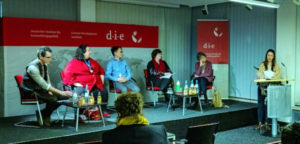
This was also the topic of the following panel discussion: Moderated by Gabrielle Anne Lipton from Global Landscapes Forum, with Patrick Augenstein, Imme Scholz (DIE), Louise Baker (UNCCD), Chad Tudenggongbu (secretariat of the United Nations Framework Convention on Climate Change, UNFCCC) and Maryke van Staden (Global Network of Local Governments for Sustainability, ICLEI) the panellists exchanged insights and experiences on how to support local and indigenous communities with their special knowledge, needs and vulnerabilities but often also site-specific options to enhance drought resilience. National governments have particular responsibilities to avoid that droughts turn into disasters. In that sense droughts and drought policies can, if rightly handled, become connectors and drivers of change.


 Digitalization is an important driver for change in many areas of our lives and there is intense debate about whether it has a positive or negative impact on sustainable development. Often such considerations remain general. The main objective of the project