Jahr: 2020

  • Online data visualisation on environmental provisions in trade agreements updated

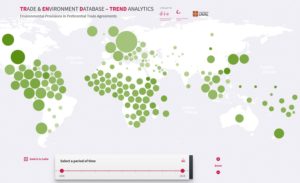
    Photo: Online Tool TREND Analytics
    Online Tool: TREND Analytics, Source: https://klimalog.die-gdi.de/trend/index.html

    The online data visualisation TREND analytics has been updated! The new version covers more than 280 types of environmental provisions in around 730 trade agreements. The goal of the interactive data tool, created in cooperation with the Canada Research Chair in International Political Economy, is to improve access to the design, trends and drivers of environmental provisions in trade agreements for academics, decision-makers and civil society. TREND analytics is based on the unique Trade and Environment Database (TREND) developed by Professor Jean-Frédéric Morin, Canada Research Chair in International Political Economy at the University Laval, Canada. The online data visualisation was developed in cooperation with DIE.

    TREND analytics now includes almost 40 additional trade agreements, such as the United States-Mexico-Canada Agreement (USMCA) signed in November 2018 or the Comprehensive and Progressive Agreement for Trans-Pacific Partnership (CPTPP) signed in March 2018. The data tool also includes new provisions such as references to the implementation of the Paris Agreement and 2030 Agenda for Sustainable Development.

    Based on TREND, researchers from DIE, including Axel Berger, Clara Brandi, and Jakob Schwab, have published several articles in journals such as World Development, Global Environmental Politics and The World Economy, and are providing policy advice to institutions such as the World Trade Organisation (WTO) and the Asian Development Bank (ADB).

    You can find the online tool here.
    A tutorial on how to use the tool can be found here.
  • News from SDSN Germany

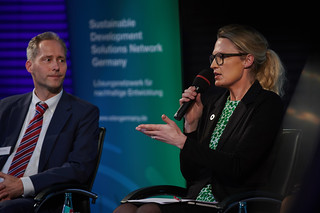
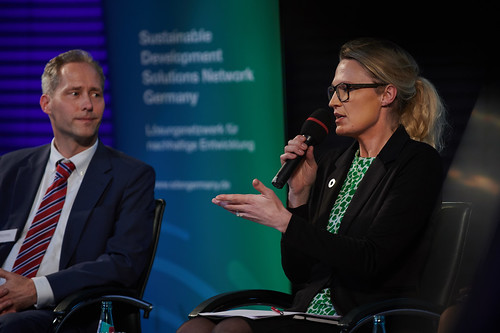
    Connecting the Dots: Digitalization, Finance & Sustainable DevelopmentHow can financial innovations, new technologies and digitalization contribute to financing sustainable development? The conference „Connecting the Dots: Digitalization, Finance & Sustainable Development“ at Allianz Forum in Berlin focused on this question and was organised by the Sustainable Development Solutions Network Germany (SDSN Germany) together with the Sustainable Digital Finance Alliance and the UN Task Force on Digital Financing of the SDGs in cooperation with the Frankfurt School of Finance & Management. The high-level event started with a keynote by Werner Hoyer, President of the European Investment Bank, on financing sustainable development. The keynote was followed by panel discussions and the presentation of the report “Fintech for Sustainability in Germany: Current Landscape and key opportunities”.

    Photo: Anna-Katharina Hornidge
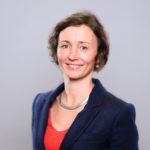
    Anna-Katharina Hornidge ©DIE

    The Leadership Council of SDSN Germany elected Anna Katharina-Hornidge (as from 1 March 2020 new Director of DIE) as new Co-Chair of the network. Together with Gesine Schwan, Mrs Hornidge will lead the network.

    On 11 February, the 11th Extended Leadership Council of SDSN Germany took place under the leadership of Gesine Schwan (Co-Chair of SDSN Germany) at the Stiftung Wissenschaft und Politik (SWP; member organisation of SDSN Germany) in Berlin. The meeting focused on the question „Keep it up? The future of the German Sustainability Strategy between Europe’s Green Deal, industry interests and election dates”. The starting point for the discussions were critical analyses and recommendations on the German Sustainability Strategy, which had been presented in recent months by the Science Platform Sustainability 2030 (wpn2030), the Federal Audit Office and the German Council for Sustainable Development (RNE). Key findings of the recommendations were presented by Marianne Beisheim (SWP and member of the Steering Committee of wpn2030), Kay Scheller (President of the Federal Audit Office) and Imme Scholz (DIE and Vice-Chairwoman of RNE). Members and guests of the Extended Leadership Council discussed how the political relevance of the German Sustainability Strategy can be structurally increased and linked to other processes such as the transformation of energy systems and social issues. SDSN Germany intends to incorporate these considerations in a statement on the further development of the Sustainability Strategy in 2020.

    Find more information about SDSN Germany here.

  • Neues von SDSN Germany

    Connecting the Dots: Digitalization, Finance & Sustainable DevelopmentWie können Finanzinnovationen, neue Technologien und Digitalisierung zur Finanzierung nachhaltiger Entwicklung beitragen? Diese Frage stand am 27. Januar 2020 im Mittelpunkt der KonferenzConnecting the Dots: Digitalization, Finance & Sustainable Development” im Allianz Forum in Berlin. Organisiert wurde die Konferenz vom Sustainable Development Solutions Network Germany (SDSN Germany) gemeinsam mit der Sustainable Digital Finance Alliance und der UN Task Force on Digital Financing of the SDGs in Kooperation mit der Frankfurt School of Finance & Management. Zu Beginn der Veranstaltung mit mehr als 140 Teilnehmer*innen hielt Werner Hoyer, Präsident der Europäischen Investitionsbank, eine Keynote zur Finanzierung nachhaltiger Entwicklung. Anschließend wurde unter anderem der Bericht „Fintech for Sustainability in Germany: Current Landscape and key opportunities“ vorgestellt, der die Entwicklung im Bereich Fintech für nachhaltige Entwicklung in Deutschland beleuchtet.

    Photo: Anna-Katharina Hornidge
    Anna-Katharina Hornidge ©DIE

    Anna-Katharina Hornidge (ab 1. März 2020 neue wissenschaftliche Direktorin des DIE) wurde zur Co-Vorsitzenden von SDSN Germany gewählt und wird gemeinsam mit Gesine Schwan das Netzwerk leiten.

    Am 11. Februar 2020 fand unter der Leitung von Gesine Schwan (Co-Chair von SDSN Germany) bei der Stiftung Wissenschaft und Politik (SWP; Mitgliedsorganisation von SDSN Germany) in Berlin der 11. Erweiterte Lenkungsausschuss von SDSN Germany statt. Die Sitzung beschäftigte sich schwerpunkmäßig mit der Fragestellung „Weiter so? Die Zukunft der Deutschen Nachhaltigkeitsstrategie zwischen Europas Green Deal, Brancheninteressen und Wahlterminen“. Ausgangspunkt der Beratungen waren kritische Analysen und Empfehlungen zur Deutschen Nachhaltigkeitsstrategie, die in den letzten Monaten von der Wissenschaftsplattform Nachhaltigkeit 2030 (wpn2030), dem Bundesrechnungshof und dem Rat für Nachhaltige Entwicklung (RNE) vorgelegt worden waren. Die Berichte wurden von Marianne Beisheim (SWP und Mitglied im Lenkungskreis der Wissenschaftsplattform), Kay Scheller (Präsident des Bundesrechnungshofes) und Imme Scholz (DIE und stellvertrende Vorsitzende des RNE) vorgestellt. Darauf aufbauend berieten die Mitglieder und Gäste des Erweiterten Lenkungsausschusses, wie die politische Relevanz der Deutschen Nachhaltigkeitsstrategie strukturell erhöht und mit anderen Prozessen wie der Energiewende und sozialen Fragen verbunden werden kann. SDSN Germany beabsichtigt, diese Überlegungen in eine Stellungnahme zur 2020 anstehenden Weiterentwicklung der Nachhaltigkeitsstrategie einfließen zu lassen.

    Weitere Informationen zu SDSN Germany finden Sie hier.

  • Michael Brüntrup new member of UNCCD working group on drought

    Photo: Dr. Michael Brüntrup
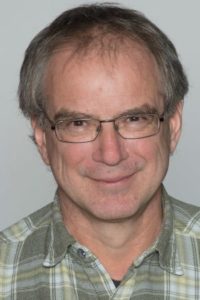
    Dr. Michael Brüntrup, ©DIE

    Dr. Michael Brüntrup has been selected as independent scientist into the International Working Group on drought of the United Nations Convention to Combat Desertification (UNCCD). The creation of this body had been decided in September 2019 during the last Conference of Parties in Delhi. The working group consists of 15 delegated representatives nominated by the five regional groups of member states and of 15 independent participants from key stakeholders including United Nations organizations, the Science-Policy Interface of the UNCCD, and other scientific, regional and civil society organizations. Task of the working group is to identify effective policies and implementation measures for addressing drought under the UNCCD, with a view of presenting its findings and recommendations at the next Conference of Parties.

  • Michael Brüntrup neues Mitglied der UNCCD-Arbeitsgruppe zu Dürre

    Foto: Dr. Michael Brüntrup
    Dr. Michael Brüntrup, ©DIE

    Dr. Michael Brüntrup ist als unabhängiger Wissenschaftler in die internationale Arbeitsgruppe zu Dürre des Sekretariat des Übereinkommens der Vereinten Nationen zur Bekämpfung der Desertifikation (UNCCD ) gewählt worden. Die Schaffung dieses Gremiums wurde im September 2019 auf der 4. Vertragsstaatenkonferenz des Übereinkommens der Vereinten Nationen zur Bekämpfung der Wüstenbildung in Delhi beschlossen. Die Arbeitsgruppe besteht aus 15 delegierten Repräsentanten der fünf regionalen Gruppen der Mitgliedsstaaten der UNCCD sowie aus 15 unabhängigen Teilnehmer*innen von Schlüsselakteuren aus den Vereinten Nationen, dem regulären Gremium zur wissenschaftlichen Politikberatung der UNCCD sowie anderen wissenschaftlichen, regionalen und zivilgesellschaftlichen Gruppen. Aufgabe der Arbeitsgruppe ist es, effektive Politiken und Maßnahmen für die Arbeit der UNCCD zu Dürre zu identifizieren, die auf der nächsten Vertragsstaatenkonferenz vorgestellt und beschlossen werden können.