Jahr: 2020

  • Bonn Water Lecture zu Staudämmen mit Professor David Hulme

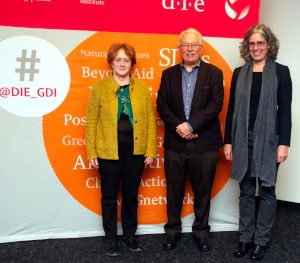
    Foto: Waltina Scheumann, Professor David Hulme und Ines Dombrowsky während der Bonn Water Lecture zu Staudämmen am DIE
    Waltina Scheumann, Professor David Hulme und Ines Dombrowsky während der Bonn Water Lecture zu Staudämmen am DIE, ©DIE

    Der Bau von Staudämmen boomt weltweit. Mehr als 3.700 Staudämme sind in der Planung oder bereits in Bau, um den wachsenden Bedarf an Energie, landwirtschaftlicher Bewässerung und urbaner Wasserversorgung und Hochwasserschutz zu decken. Diese neue Generation von Staudämmen, die überwiegend in „Entwicklungsländern“ gebaut werden, hat das Potential einen signifikanten Beitrag zu wirtschaftlichem Wachstum, den Nachhaltigkeitszielen der Vereinten Nationen und dem Pariser Klimaabkommen zu leisten. Allerdings besteht die Herausforderung, den positiven Nutzen von Staudämmen zu maximieren und gleichzeitig die negativen sozialen und ökologischen Folgen gering zu halten.

    In seiner Präsentation stellte Professor David Hulme vom Global Development Institute an der Universität Manchester Einsichten aus dem Forschungsprojekt FutureDAMS vor. Er reflektierte kritisch darüber, ob neue Staudämme die Erfahrungen der Vergangenheit einbeziehen oder etwa bereits begangene Fehler wiederholen. Ines Dombrowsky, Leiterin des Forschungsprogramms Umwelt-Governance am Deutschen Institut für Entwicklungspolitik (DIE), moderierte eine lebhafte Diskussion mit dem Publikum. Dabei wurde unter anderem angesprochen, ob Staudämme ein globales rechtliches Rahmenwerk benötigen und welche Spannungen sich zwischen Modernisierung und Klimawandel ergeben. Waltina Scheumann, assoziierte Wissenschaftlerin am DIE, steuerte Expertise aus ihrer Forschung zu den sozialen und ökologischen Normen im Staudammbau in Schwellenländern bei.

    Die Bonn Water Lecture ist eine Vortragsreihe, die gemeinsam vom Zentrum für Entwicklungsforschung (ZEF), dem Geographischen Institut der Universität Bonn, der United Nations University (UNU) Bonn, der United Nations Convention to Combat Desertification (UNCCDD) und dem Deutschen Institut für Entwicklungspolitik (DIE) durchgeführt wird. Eine Übersicht zur Expertise des DIE zum Thema „Wasser“ finden Sie hier.
  • Bonn Water Lecture on Future Dams with Professor David Hulme

    Photo: Waltina Scheumann, Professor David Hulme and Ines Dombrowsky during the Bonn Water Lecture on Future Dams at the DIE
    Waltina Scheumann, Professor David Hulme and Ines Dombrowsky during the Bonn Water Lecture on Future Dams at the DIE, ©DIE

    A global boom in dam building is unfolding as more than 3,700 large dams are planned or under construction worldwide. They are to service growing demands for energy, irrigation, urban water or flood control. This new generation of dam schemes, most of them in ‘developing countries’, has the potential to make a significant contribution towards achieving economic growth, the UN Sustainable Development Goals (SDGs) and commitments made by the Paris Agreement on Climate Change. But, maximising the benefits of dams – while minimising the negative social and environmental impacts – remains a great challenge.

    In his presentation, Professor David Hulme from the Global Development Institute at the University of Manchester presented insights from the FutureDAMS research project. He reflected on whether current dams learn from past experience, or whether ‘not learning from experience’ remains a central feature. Ines Dombrowsky, Head of Programme on Environmental Governance at the German Development Institute / Deutsches Institut für Entwicklungspolitik (DIE), moderated a lively discussion that touched on large dams under construction in Africa and Asia, possible global legal frameworks and tensions between modernisation and climate change. Waltina Scheumann, associate researcher at DIE, added insights from her research on social and environmental norms in dam construction in emerging economies.

    The Bonn Water Lecture series is jointly organised by the Center for Development Research of the University of Bonn (ZEF), the United Nations Convention on Combat Desertification (UNCCD), the GermanDevelopment Institute / Deutsches Institut für Entwicklungspolitik (DIE), and the Eco-Hydrology and Water Resources Management Department of Geography, University of Bonn.

    An overview on DIE’s water expertise is available here.

  • Anna-Katharina Hornidge takes office as new Director of DIE

    Anna-Katharina Hornidge takes office as new Director of DIE

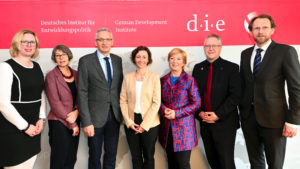
    Photo fLTR: Margret Heyen, Imme Scholz, Martin Jäger, Anna-Katharina Hornidge, Annette Storsberg, Michael Hoch, Axel Berger
    from left to right: Margret Heyen, Imme Scholz, Martin Jäger, Anna-Katharina Hornidge, Annette Storsberg, Michael Hoch, Axel Berger, Photo: Benjamin Westhoff, ©DIE

    With more than 100 invited guests, DIE today celebrated the inauguration of its new Director, Anna-Katharina Hornidge. As high-ranking representatives of DIE’s shareholders, State Secretary Martin Jäger (Federal Ministry for Economic Cooperation and Development) and State Secretary Annette Storsberg (Ministry of Culture and Science of North Rhine-Westphalia) congratulated Mrs Hornidge. Rector Hoch welcomed Mrs Hornidge at the University of Bonn. By filling the position of the Director of DIE in a joint appointment procedure with the University of Bonn, both partners underline the scientific independence of DIE as well as the importance of the cooperation between DIE and the University of Bonn in the context of the Bonn Alliance for Sustainability Research.

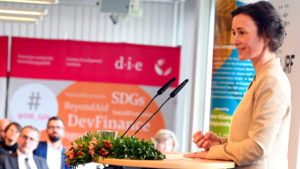
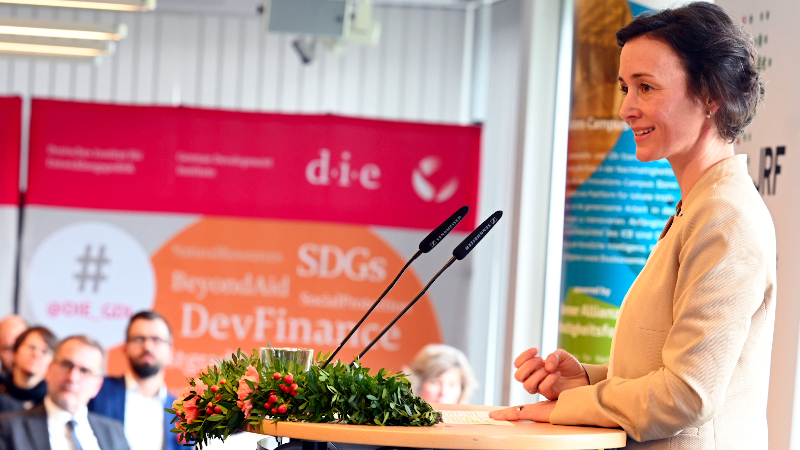
    Photo: Anna-Katharina Hornidge on stage on her welcome event at the German Development Institute / Deutsches Institut für Entwicklungspolitik (DIE)
    Anna-Katharina Hornidge, Photo: Benjamin Westhoff, ©DIE

    Imme Scholz, who has managed the Institute on an interim basis  since the departure of Dirk Messner in October 2018, is looking forward to working with Anna-Katharina Hornidge in the management of the Institute and in the strategic development of DIE’s work in research, policy advice and training. Axel Berger, Chairman of the Works Council, and Andrea Cordes, Equal Opportunities Officer, also thanked Imme Scholz for the interim management of the Institute and look forward to working with Mrs Hornidge.

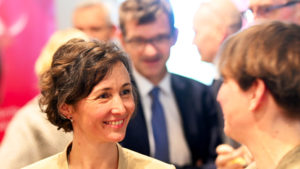
    Anna-Katharina Hornidge, Photo: Benjamin Westhoff, ©DIE

    Prior to her appointment as Director of DIE and her call to the University of Bonn, Anna-Katharina Hornidge was Professor of Social Sciences in the Marine Tropics at the University of Bremen and Head of the Department of Social Sciences at the Leibniz Centre for Tropical Marine Research. There, she also headed the research group Development and Knowledge Sociology.

    The press release on the appointment of Anna-Katharina-Hornidge to the University of Bonn and her appointment as director to DIE can be found here.

  • MGG Conference in Indonesia: The Power of Cooperation: Shaping a positive narrative of global governance

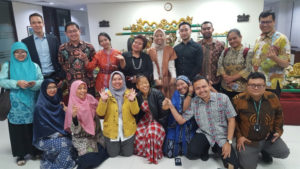
    Photo: Group Photo of MGG conference in Indonesia, alumni of the MGG Academy
    Alumni of the MGG Academy, ©DIE

    „The Power of Cooperation: Shaping a positive narrative of global governance in Indonesia“ was the topic of a joint conference of the Centre for Strategic and International Studies (CSIS) and the German Development Institute / Deutsches Institut für Entwicklungspolitik (DIE) in the framework of the Managing Global Governance (MGG) programme. It took place on 4 February 2020 in Jakarta.

    Different batches of the MGG Academy – the training and dialogue format of the MGG network – together with national and international partners from the MGG network and external guests discussed polarisation and identity questions in Indonesia. They also debated how multi-stakeholder participation can be effectively organised to contribute to fair and open dialogue. In view of plans to build a new Indonesian capital in East Kalimantan / Borneo, another focus of discussions was the relationship between city development and environmental protection.

    The conference was part of a series of events in all MGG partner countries (Brazil, China, India, Indonesia, Mexico, South Africa) that investigate the power of cooperation in times of increasing populist and nationalist tendencies in different parts of the world. The conference in Indonesia built on the discussion from the previous conference in South Africa (4-5 November 2019). Its results will feed into further MGG network activities in 2020.

  • MGG Conference in Indonesia: The Power of Cooperation: Shaping a positive narrative of global governance

    Foto: Gruppenfoto der MGG-Konferenz in Indonesien, Absolvent*innen verschiedener Jahrgänge der MGG Academy
    Absolvent*innen verschiedener Jahrgänge der MGG Academy, ©DIE

    „The Power of Cooperation: Shaping a positive narrative of global governance in Indonesia“ war das Thema einer gemeinsamen Konferenz des Centre for Strategic and International Studies (CSIS) und dem Deutschen Institut für Entwicklungspolitik (DIE) im Rahmen des Managing Global Governance (MGG) Programms. Sie fand am 4. Februar 2020 in Jakarta statt.

    Absolvent*innen verschiedener Jahrgänge der MGG Academy – dem Ausbildungs- und Dialogformat des MGG-Netzwerks – diskutierten zusammen mit nationalen und internationalen Partnern und externen Gästen Polarisierungs- und Identitätsfragen in Indonesien. Sie debattierten ebenfalls, wie Multi-Stakeholder-Beteiligungen effektiv organisiert und zu einem fairen und offenen Dialog beitragen können. Mit Blick auf die Pläne zur Errichtung einer neuen indonesischen Hauptstadt in Borneo lag ein weiterer Schwerpunkt auf dem Verhältnis zwischen Stadtentwicklung und Umweltschutz.

    Die Konferenz war Teil einer Serie von Veranstaltungen in den MGG-Partnerländern (Brasilien, China, Indien, Indonesien, Mexiko, Südafrika), in denen das Potential der globalen Zusammenarbeit in Zeiten zunehmender populistischer und nationalistischer Tendenzen in verschiedenen Teilen der Welt untersucht wird. Die Konferenz in Indonesien schloss an die Diskussion der letzten Konferenz in Südafrika (4.-5. November 2019) an. Die erarbeiteten Ergebnisse werden in weitere MGG-Aktivitäten im Jahr 2020 einfließen.