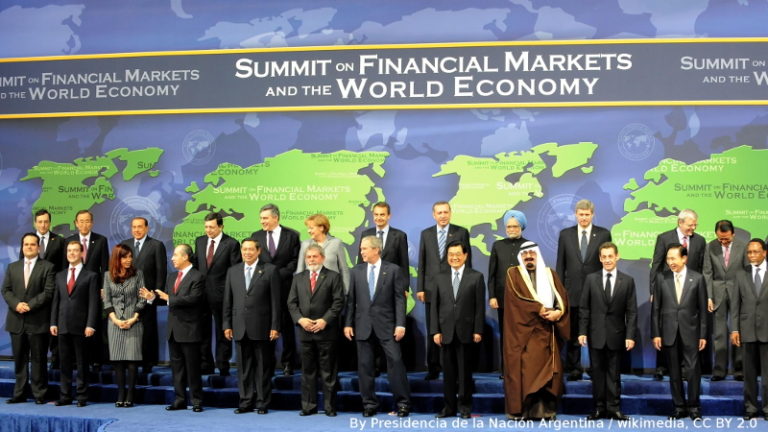
 I have been writing about the G20 for seven years. The G20 has evolved substantially over that time, with an ever-broadening agenda that now covers issues far beyond those envisioned in the first G20 summits in Washington and London over 2008 and 2009, when the G20 was at its peak as a globally influential governance body. As a result, and in order to stay on top of the expanded agenda, the trend has been towards greater reliance by G20 Ministers and Leaders upon lower-level officials and bureaucrats to both prepare and even draft the main G20 outcome documents – particularly the final communique.
-
Hamburg Summit may see G20 leaders’ meeting return to its informal roots
-
Globale Kooperation: Illusion oder dringliche Notwendigkeit?

Keiner Illusion aufliegen Das Jahr 2015 war ein zukunftsweisendes: in Paris wurde ein Weltklimavertrag. In New York wurden nachhaltige Entwicklungsziele für alle Länder dieser Erde beschlossen. Der Wille, eine Welt zu schaffen, in der Hunger und Armut abgebaut werden sowie innerhalb der Grenzen unseres Planeten gewirtschaftet und Wohlstand gerechter verteilt wird, war als Gipfelergebnis mehrheitsfähig. Doch wo stehen wir heute? Der neue US-Präsident scheint an internationalen Vereinbarungen kein Interesse zu haben, brüskiert die G7-Staaten und hat den Ausstieg aus dem Klimavertrag verkündet.
-
What we can expect from the Hamburg G20 Summit

Hamburg could mark a departure Much of the criticism levelled at the Group of 20 (G20), the club of the world’s most economically powerful industrialised and emerging economies, is justified. The Hamburg summit will play host to high-level autocrats and, in many ways, its agenda is far removed from the needs and standards of a just, inclusive and sustainable global economy. Policy advisors still hoping for the gathering to deliver in some way are banking on an initiative supported by the EU countries and their civil societies in cooperation with several partners from the global South, an initiative designed to promote sustainability solidarity and participation.
-
Syrians in Turkey: Is Work Permit Regulation Enough?

Beyond formalizing the legal ground Since 2011, the Syrian Civil War has created five million displaced Syrians. With the world struggling to accommodate them, most of the responsibility has fallen on to the shoulders of neighboring countries, especially Turkey, Lebanon and Jordan. Six years into the war, the initial emergency phase is over, as the outflow of displaced Syrians has declined. International aid interventions and institutions are in place, and for the most part, working. Now, the issue is less about emergency humanitarian aid, and more about sustainable integration. Hence, the role of public policy to enable labor market integration becomes more pressing and challenging.
-
Wie kann Deutschland seine UN-Politik verbessern?

Forderungen für progressive Politik Im September finden die nächsten Bundestagswahlen statt. Zivilgesellschaft, Wissenschaft, und politische Stiftungen bringen ihre Forderungen an die Parteien und an einen zukünftigen Koalitionsvertrag ein. Auch die Deutsche Gesellschaft für die Vereinten Nationen (DGVN) hat einen umfassenden „Forderungskatalog 2017“ veröffentlicht.