
Blog Header: Sustainable Futures. Debates to shape a collaborative multipolar world
  • The Twelfth Ministerial Conference of the WTO: More than expected but still short of a success story

    The Twelfth Ministerial Conference of the WTO: More than expected but still short of a success story

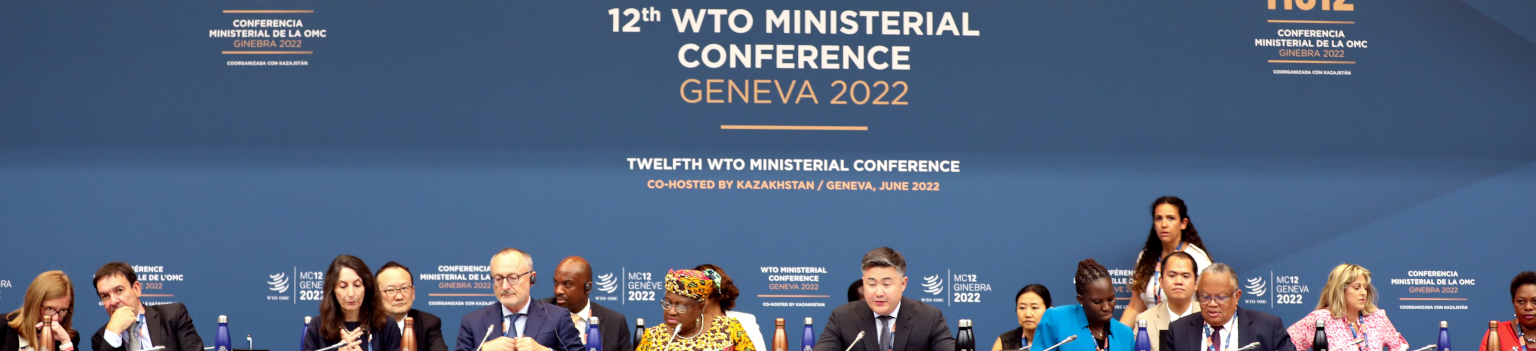
    Photo: ©WTO/Jay Louvion
    ©WTO/Jay Louvion via Flickr

    The WTO’s Twelfth Ministerial Conference (MC12) was finally held in mid-June 2022, after being postponed twice due to COVID-19 pandemic. Ministerial Conferences are the WTO’s highest decision-making body bringing together high-level representatives of all members to take decisions on pertinent trade issues. MC12 was important because the members have been struggling to respond to the WTO institutional crisis and its inability to adress critical cross-cutting issues ranging from sustainability, environment, health, digital technologies, food security, energy policy to national security matters.

    The outcomes of MC12 were definitely more remarkable than those reached at the last ministerials in Bali 2013, Nairobi 2015 and Buenos Aires 2017. In the closing session Dr. Ngozi Okonjo-Iweala, Director General of the WTO, declared that members “secured an unprecedented package of deliverables”. The package may, however, neither be comprehensive nor ambitious enough, but nevertheless confirms that the WTO is still a relevant body to respond to global trade challenges, and more importantly helped the organisation avoid an “existential crisis”.

    MC12 with concrete results breaks WTO’s long silence

    Ministerial Conferences are not only technical talks, but are also politically important events navigating diverse positions and approaches of members on sensitive matters.  Therefore, it is not easy to predict beforehand if they ever lead to successful outcomes. They can bring a breakthrough or end up in political stalemate. However, the WTO (and its members), this time, did not have the luxury to produce another deadlock. The agenda was a mixture of a long-standing debate about the future of the WTO and immediate crises related to the pandemic, climate change, rising energy and food prices and disruptions in global supply chains. Against this background, nine Ministerial decisions and declarations were adopted as parts of MC12.

    The most significant outcome of MC12 was the Agreement on fisheries subsidies which had been negotiated for two decades. The objective of the Agreement is to prohibit and control harmful subsidies causing overfishing, and eliminate those that contribute to illegal, unreported and unregulated fishing. This was an achievement for two reasons: it was the first new multilateral trade agreement being adopted since the Trade Facilitation Agreement almost a decade ago. Also, it is the first multilateral trade agreement addressing the United Nations Sustainable Development Goals, in particular goal 14 on life below water.

    Apart from fisheries, food security is another important SDG aming at ending hunger by 2030. MC12 addressed the challenge of food shortages resulting from the war in Ukraine. Rising food prices led many countries to apply export restrictions and trade bans. However, many vulnerable members are dramatically affected by reduced supply and high prices. Food security issues became a global concern as agricultural supply chain disruptions started to emerge. At MC12, WTO members affirmed the need to avoid export restricytions on food and declared export restrictions should not include World Food Program’s food purchases.

    Furthermore, members have agreed to “maintain their practice of not imposing customs duties on electronic transmissions”. The moratorium is important for consumers to have easier and affordable access to digital platforms, and for millions of small businesses to market their products and services globally. The agreement helps digitalisation, a twin sister of sustainability.

    The Covid-19 pandemic resulted in rising trade restrictions in medical products and equipment and difficulties in access to vaccines especially by developing countries and least-developed countries (LDCs) due to patent constraints. An earlier decision by G20 trade ministers asked such measures to be targeted, proportionate, transparent, temporary, and not create unnecessary disruptions in supply chains. For achieving global justice in the provision of vaccines, MC12 delivered a waiver of parts of the TRIPS agreement to facilitate the manufacturing and exportation of Covid-19 vaccines. It also provides a response to Covid-19 and future pandemics by emphasising the role of transparency and notifications (i.e. trade monitoring), another important function of the WTO.

    Despite wide differences in their positions on critical issues, members drove the process soberly converging on substantial matters to keep the WTO alive. Equally important in the MC12 outcome document was that members committed to undertake necessary reform of the WTO. The General Council is expected to launch a process to conduct its work on the matter, and review the progress until the next Ministerial Conference.

    Are piecemeal steps sufficient to save WTO’s future?

    Outcomes of the MC12 demonstrated that members were in need of adopting new rules and texts; and, more generally, to negotiate global problems at the multilateral level. They also acknowledged their concerns with respect to the other functions, such as trade monitoring and dispute settlement. But, the challenges facing rules-based multilateral system are deeper and more complex than what has been addressed during the MC12.

    Many earlier calls by major players for reforming the WTO revealed gaps in their positions. Many members do not want their existing “rights” for special and differential treatment to be challenged. Many are reluctant to eliminate trade-distorting subsidies and measures. A clash between market-oriented and state-driven capitalism continues. Accomodating such diverse interests in a “balanced” way is a formidable task. More importantly, trade policy is becoming increasingly linked to cross-cutting and non-trade issues, and pushing many topics to be brought to the WTO agenda. However, the more incremental the agenda, the more exhausting it becomes to “reform” the organisation to achieve its objectives. The General Council in its work programme has to respond to many daunting and mounted issues:

    First, the complex nature of multilateral trade negotiations proves they are time-consuming and requires high levels of patience, sobriety and creativity and more importantly unanimity among the members with differing interests and developmental concerns. The failure to reach concensus drives many members to venue-shifting into regional or plurilaterals negotiations. Plurilateral talks are preferred in many topics like e-commerce, domestic regulation of services and investment facilitation for development and other so-called Joint Statement Initiatives (JSIs) are in the pipeline. Successful completion and ratification of those JSIs can revitalise the WTO’s negotiation function. However, such initiatives need more structured and institutionalised approaches to mitigate concerns of many developing countries with respect to fragmentation of the multilateral system. The WTO reform process to be undertaken by the General Council needs to search for possible ways of ensuring transparent, inclusive and development-friendly plurilaterals with capacity-building mechanisms for developing countries and LDCs.

    Second, special and differential treatment will continue to be a controversial issues. A tailor-made differentiation rather than accross-the-board exemptions without indefinite transition periods need to be contemplated to maket hem “precise, effective and operational” as stipulated in the MC12 outcome document (para. 2).

    The third issue that deserves a major discussion is subsidies. The General Council should launch a work programme to gather information about the scale of subsidies, their trade-distortive effects, and to identify main aspects to be addressed.

    On the way to MC13 due to take place by the end of 2023, members need to work on their differences on agriculture. Efforts to modernise agricultural rules, including issues of market and trade-distorting subsidies and tariff liberalisation must reflect today’s global concerns like fragilities in food supply chains, export restrictions, public stokholding, vulnerabilities arising from poverty and must be re-built confidence.

    Last but not least, reforming the WTO will be incomplete without reforming the dispute settlement system. Interim solutions help the system to function and retain the rights of some members, but the multilateral system should go beyond it to overcome the impasse over the Appellate Body.

    In assessing the MC12 let us go one step further than Dr. Ngozi and claim that members secured WTO’s reputation and avoided a collapse in their trust to the system for now. However, WTO’s future depends on a root-and-branch reform. Let us hope the process initiated in MC12 paves the way for it.

  • China in the Pacific: economic interests and security cooperation in a contested region

    Photo: Boats at Sundawn in the water

    Rivalry between an increasingly assertive China and the United States is mounting in Asia and the Pacific. On several occasions, China has seen its interests threatened by the United States in the region. The US president’s recent visit to Japan and the so-called Quad summit between the US, Australia, Japan and India, which took place during his stay have driven the attention and interests of Beijing’s officials to make a trip to the Pacific Islands in order to negotiate and sign a security agreement with countries of the region. China’s officials see Joe Biden’s recent trip to Asia, as an effort to counter Beijing’s economic, political and diplomatic influence as well as the recognition of China over Taiwan in the region. Wang Yi’s visit to the Pacific Islands in late May for a ten-day tour in eight countries was meant to contribute to securing China’s political, economic and diplomatic stance in the region. (mehr …)

  • 30 years with common but differentiated responsibility, why do we need it ever more today?

    Photo: Colorful windows in Bords de la Nive, Bayonne, FranceBords de la Nive, Bayonne, France

    The principle of “common but differentiated responsibility” (CBDR), formalized at the 1992 United Nations Conference on Environment and Development in Rio de Janeiro, is ultimately pertaining to the matter of climate justice. Its basic meaning is first and foremost a “shared” moral responsibility between different groups of countries to address global climate change, nevertheless the proportions of such responsibility are differentiated. CBDR’s underlying concepts of fairness and equity has also been manifested in other global governance architectures than just the climate. The World Trade Organization, for example, knows the principle of “special and differential treatment” for developing and least-developed countries. The CBDR principle has gone through “ups and downs” in the past 30 years and the world has further evolved. While it is entering the fourth decade, it still remains relevant today.

    (mehr …)

  • Elusive vaccine solidarity – A long shadow over globalisation

    Photo: Lady Justice with scales, Image to picture global vaccination justice

    If there ever was a litmus test on whether the world would cooperate in solidarity in the midst of the greatest global challenges, the COVID-19 pandemic provided such a test given its transferability across borders and the need for a rapid global response. In this blog post I argue that the onset and response to the COVID-19 pandemic has been a watershed event that has significantly – or perhaps irreversibly – ushered the world where cooperation will be more challenging than ever before.

    (mehr …)

  • The war in Ukraine: financial, political and credibility challenges for EU-Africa cooperation on peace and security

    Photo: Flags of African Union and European Union on the Paul Kagame AU-EU Summit | Brussels, 18 February 2022

    On 24 February, Russia invaded Ukraine. The invasion prompted a strong reaction from the EU in a manner and speed that few had anticipated. Just a week prior, the EU summit with the African Union convened 40 African heads of state and government and 27 of their European colleagues. As the global setting for EU security policy has dramatically changed within a few weeks, the war in Ukraine will also have important implications for EU-Africa cooperation on peace and security.

    Former Finnish prime minister Alexander Stubb remarked on social media that he had “never seen the EU acting with more determination, speed and unity.” In a similar fashion, the EU’s High Representative for Foreign and Security Policy Borrell called the EU’s response to the war the ‘geopolitical awakening of the EU’, while Commission President von der Leyen described it as a ‘watershed moment’ in the history of the Union.

    Within the span of twenty days, we have indeed witnessed EU unity and action, covering the full range from expressions of solidarity to strong sanctions. The actions taken also involved leaving behind old taboos: the Union decided to use the European Peace Facility (EPF) to procure and distribute lethal military equipment to Ukraine. This is the first time ever the EU provides weapons to another country, with a first €500 million agreed on 28 February and EU foreign ministers reaching political agreement to an additional EPF contribution of the same size during their meeting on 21 March.

    Ramifications beyond Ukraine

    Significant questions remain both on if and how the AU and EU may jointly respond to the conflict, and how their cooperation on peace and security will be affected – both intentionally and unintentionally – by the war in Ukraine.

    Supporting peace and security in Africa has been a key priority of the EU’s foreign and security policy since the first Africa-EU summit in 2000. The EU has currently deployed eleven military operations and civilian missions under the EU’s Common Security and Defence Policy (CSDP) to African conflict contexts. These include two maritime operations at the Horn of Africa and the Mediterranean, four military training missions deployed in Mali, Somalia, Central African Republic, and Mozambique, and five civilian missions in Libya, Central African Republic, Somalia, Mali and Niger. Recent months have shown some tensions between the EU’s engagement and the involvement of Russian private military corporation Wagner as requested by some of these states.

    European funding for African security efforts

    In addition to its own military and civilian missions, the EU has made important and predominantly financial contributions to the long-term strengthening of the African Peace and Security Architecture (APSA). Under the motto „African solutions to African problems,“ the EU has since 2004 provided nearly €3 billion under the African Peace Facility (APF) for AU-mandated African peace support operations, capacity building of APSA structures, and short-term crisis prevention and peace mediation. A substantial portion of the APF funds were dedicated to the African Union peacekeeping mission AMISOM in Somalia.

    On 21 March 2021, around a year ago, EU foreign ministers agreed to create a European Peace Facility that replaced the APF. This was part of a larger reform in the EU’s legal basis for the financing of its external action, specifically the integration of the European Development Fund through which the APF was funded into the EU’s general budget. By remaining outside the EU’s budget as an intergovernmental fund, the EPF can finance assistance measures to support the military aspects of peace support operations led by a regional or international organisation. In addition, the EPF can also fund the provision of lethal military equipment to partner countries’ armed forces, which was not possible through the APF. To pursue these objectives, the EPF was equipped with a financial ceiling of €5.692 billion in current prices (€5 billion in 2018 prices) for the period 2021-2027, with an annual ceiling that increases from €420 million in 2021 to €1.132 billion in 2027. While the EPF will also provide financial support to peace operations in Africa in the same way the APF has, it does not require an AU mandate to do so. Moreover, the ‘demand-driven’ nature of the EPF means that no funds are earmarked or otherwise reserved for countries or regions, including Africa.

    An ambitious agenda for EU-Africa cooperation

    In view of this track record, the February summit in Brussels provided the first occasion for a political ‚continent-to-continent‘ dialogue on peace and security since the previous Abidjan Summit of December 2017. The resulting outcome document did not include very specific statements on next steps, but confirmed key thematic areas for future cooperation. These commitments include the strengthening of cooperation in the area of military capacity building and the provision of training and equipment, the continued support of African-led peace support operations and a stronger integration with EU military and civilian missions as well as enhanced cooperation on cybersecurity. The text also includes a general commitment to intensify cooperation in the field of civilian crisis prevention, but overall there is clear focus on intensifying military-related domains of cooperation.

    The invasion of Ukraine: three implications for EU-Africa relations

    The war in Ukraine already challenges the realisation of the peace and security agenda agreed at the AU-EU summit, with the EU facing its financial implications for the EPF, the political implications for the EU member states, and the credibility related to the design and added value of the EPF.

    Financial implications. With an annual ceiling of €540 million for 2022, the two assistance measures for Ukraine adopted on 28 February worth €500 million already account for 90 percent of the planned budget for 2022. On 21 March, foreign affairs ministers reached a political agreement on an additional €500 million to be mobilised under the EPF, which will necessitate re-negotiations of the EPF annual ceilings. But it will also require member states to have a more strategic discussion about how the assistance to Ukraine affects (planned) EPF engagements in other countries and regions. An open dialogue with the African Union about what the war in Ukraine and the EPF expenses means for the implementation of the priorities agreed at the AU-EU summit is warranted, as well as for the planned and continued EU financial contributions to African peace operations through the EPF.

    Political implications. The immediate focus of European foreign and security policy will be on Eastern Europe. The measures adopted at the EU level to provide military and economic support to Ukraine, the strengthening of NATO’s military presence in the Baltic and Eastern European states, and the bilateral support provided to Ukraine by many European states demonstrate this shift of priorities. It may also lead EU member states to put a stronger focus on tasks of territorial and collective defence, which may decrease their willingness to contribute troops to peacekeeping missions abroad. The EU’s engagement in the Sahel could be seriously affected, as the Ukraine war may make EU-wide debates about how to compensate for the French military withdrawal from Mali even more complex. Again, this may lead to a (partial) winding down of the EU’s military presence in Africa, the implications of which are hard to predict at this point. At least it is clear that the EU will need to seriously engage with its African partners to ensure that any decisions on withdrawals or adjustments are well coordinated with them.

    Credibility challenges. The use of the European Peace Facility in Ukraine to provide lethal equipment to a country facing a full-scale military invasion by another country along the EU’s external borders is a dramatically new situation. Assistance measures were primarily intended to support military capacity building and train and equip efforts of the EU in partner countries that face armed conflict within their territory and that need long-term support in strengthening their security forces.

    Given the urgency of the situation in Ukraine, it is hard to imagine that the EU could follow its integrated methodological framework for EPF assistance measures. As per this framework, the EU would be required to conduct rigorous conflict risk analyses and impact assessments for the first-ever provision of lethal equipment to a third country. Their relevance notwithstanding, the EU officials who negotiated the legal basis of the EPF may not have anticipated the use of the instrument in an ongoing war where monitoring and evaluating the measures would however be close to impossible. The current situation in Ukraine indeed makes it impossible for the EU to send in personnel to monitor how the equipment was used and if compliance rules have been followed. In view of the exceptional nature of the situation under which the assistance measures for Ukraine were adopted, the EU should ensure that the decisions made are well-communicated, well-understood and accepted by its African partners.

    The need for dialogue

    Communicating the exceptional nature of this war along the EU’s borders – and the pressure it puts on its new European Peace Facility – should be the starting point of the AU-EU dialogue on peace and security, as opposed to an impediment to it. Many African states chose not to support the recent UN General Assembly resolution on Ukraine, which shows that this dialogue will not always be easy. Yet, it is also a crucial case where both continents are challenged to show that their commitment to international cooperation goes beyond the words expressed in their summit document. To this end, the EU needs to engage in serious and open dialogue with African partners on the possible implications of the Ukraine war for EU-Africa cooperation and to identify possible areas for cooperation and a joint response.