
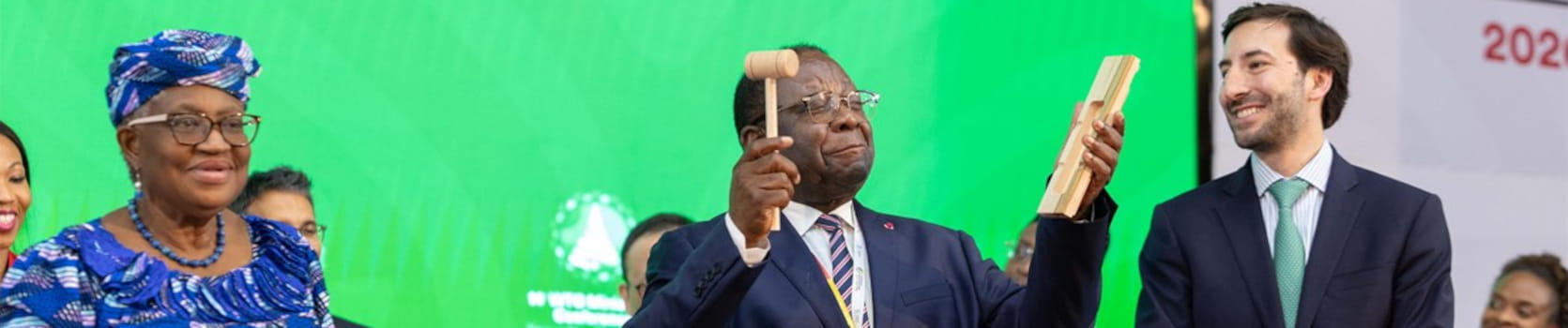
The members of the World Trade Organization (WTO) gathered for the past few days in the capital of Cameroon for their biennial ministerial conference. Before the 14th Ministerial Conference (MC14), sober pragmatism seemed possible. After four days of tense but fruitless negotiations in Yaoundé, sobering pragmatism carried the day. And both assessments still sit at the positive end of the evaluative spectrum.
A System Under Extreme Pressure
The multilateral trading system is under greater pressure than at any point since the end of the Second World War. WTO Director-General Ngozi Okonjo-Iweala herself put it in precisely those stark terms in her opening address. US escalatory tariff policy, the massive subsidization of the Chinese economy, and the growing willingness of major trading powers to question core principles such as most-favored-nation treatment are hollowing out the very foundations on which the WTO has stood since 1995.
And yet, there were positive signs before the conference began. The United States is no longer fundamentally questioning its WTO membership, is paying its membership contributions, and has sent a knowledgeable ambassador to Geneva as well as a high-level delegation led by US Trade Representative Jamieson Greer to Yaoundé. The US also tabled two reform proposals, though the seriousness of these was partly called into question. South Africa, long a veto player against plurilateral agreements, showed a willingness to compromise ahead of the conference. Even India appeared to be exploring scenarios under which it might allow the plurilateral Investment Facilitation for Development (IFD) agreement to pass. On the moratorium for customs duties on electronic transmissions, a compromise seemed to be taking shape. And on the core issue of WTO reform, there was at least the prospect of a roadmap through to the next ministerial conference.
None of that materialized.
Derailed by the Moratorium
In the end, negotiators quite literally ran out of time. The conference failed, at least at first glance, over the dispute concerning the moratorium on tariffs for electronic transmissions. The US insisted on a permanent arrangement. Brazil and other low- and middle-income countries were willing to accept only a time-limited extension at most. The compromise that had seemed possible before the conference fell apart.
But the moratorium was never really the sole point of contention. It was a proxy for a deeper unwillingness to compromise: the inability of member states to set aside their particular interests for the greater good of a functioning global trading system.
The consequences of this failure on the moratorium are far-reaching: none of the five negotiating packages – WTO reform, e-commerce, intellectual property rights’ flexibilities, fisheries subsidies, and development issues – could be concluded. The topics are now being sent back to Geneva, where it is no longer ministers sitting at the table but instruction-bound ambassadors with even less room to manoeuvre to reach compromises. The political momentum that a ministerial conference was meant to generate is likely to dissipate quickly.
The Plurilateral Innovation and Its Limits
The instruments for making progress had, in principle, already been developed. At the Buenos Aires Ministerial Conference in 2017, groups of WTO members launched so-called Joint Statement Initiatives: plurilateral negotiating formats covering domestic services regulation, e-commerce, and investment facilitation. Plurilateral agreements between countries with shared interests are not a 21st-century invention, they have been part of the multilateral trading systems since decades. They, however, simply fell out of fashion amid the comprehensive Uruguay Round of the late 1980s and early 1990s and the establishment of the WTO.
The progress made has been genuinely noteworthy. The agreement on Domestic Services Regulation brings together 55 members and entered into force in 2024, mainly due to the fact that the rules could be integrated into the national schedules of participating members thus limited the veto options of non-signatories. That avenue does not exist for the e-commerce agreement or the IFD agreement. The IFD now involves 129 countries, including many low- and middle-income nations. South Africa had already dropped its blockade against plurilateral agreements in December; Turkey withdrew its opposition to the IFD agreement at the start of the conference. Yet India held firm in its refusal. In the end, the count stood at 165 against 1.
India’s rejection is difficult to comprehend. India is already negotiating many of the rules it opposes in the multilateral system through bilateral agreements, whether on digital trade or investment facilitation. This is not about substantive arguments or legal intricacies. It is about power politics and protecting India’s veto within the WTO.
Short-term Pragmatism
The signatories to the IFD agreement intend to keep trying to integrate it into the WTO framework. It is, however, hard to imagine why India would suddenly abandon its resistance. More likely, therefore, is the path that the signatories to the e-commerce agreement charted on the margins of MC14: provisional application outside the formal WTO framework, with the hope of integrating the agreement into the WTO at a later stage.
A similar path has already been chosen by around 60 WTO members to circumvent US obstruction in the area of dispute settlement. The Multi-Party Interim Appeal Arrangement (MPIA) is a direct response to the American veto against filling vacancies on the WTO Appellate Body. There too, members chose a route around the system because the path within it was permanently blocked and no willingness to compromise was forthcoming.
If the e-commerce example sets a precedent, we are heading toward a hybrid multilateral trading system. The WTO would then serve as a platform for negotiating new agreements in specific regulatory areas and bringing together „willing“ countries. But those agreements would be applied outside the formal system. This may seem pragmatic in the short to medium term.
Long-Term Erosion
In the long term, however, it is not a viable strategy for the WTO, as it unleashes centrifugal forces that further undermine the system. Yes, there has been some progress at MC14 among “coalitions of the willing” on important issues that can be seen as signs of hope. For example, Ministers from 48 diverse WTO Members have reaffirmed their commitment to fossil fuel subsidy reform. But one may doubt whether groups of countries will sustain the energy and political capital needed to forge coalitions and negotiate rules if the prospect of integration into the WTO system is absent. Why invest in a system that cannot absorb its own outcomes? Discussions between the EU and members of the Comprehensive and Progressive Agreement for Trans-Pacific Partnership in the digital sphere show that such cooperation can take place entirely outside the WTO system altogether.
One glimmer of hope remains: the provisional application of plurilateral agreements could generate sufficient economic and political momentum to increase pressure on the veto players, i.e. those countries for whom their veto seem to matter more than the interests of the overwhelming majority of WTO members. The hope is this: those who cannot stop the train may eventually want to board it. Let’s remain hopeful!


Schreibe einen Kommentar