IDOS Expert Niklas Wagner has followed the Bonn Climate Conference SB 64 in Bonn and shares his reflections on deliberation, finance, the new climate and trade dialogue, and missed synergies between the Rio Conventions.
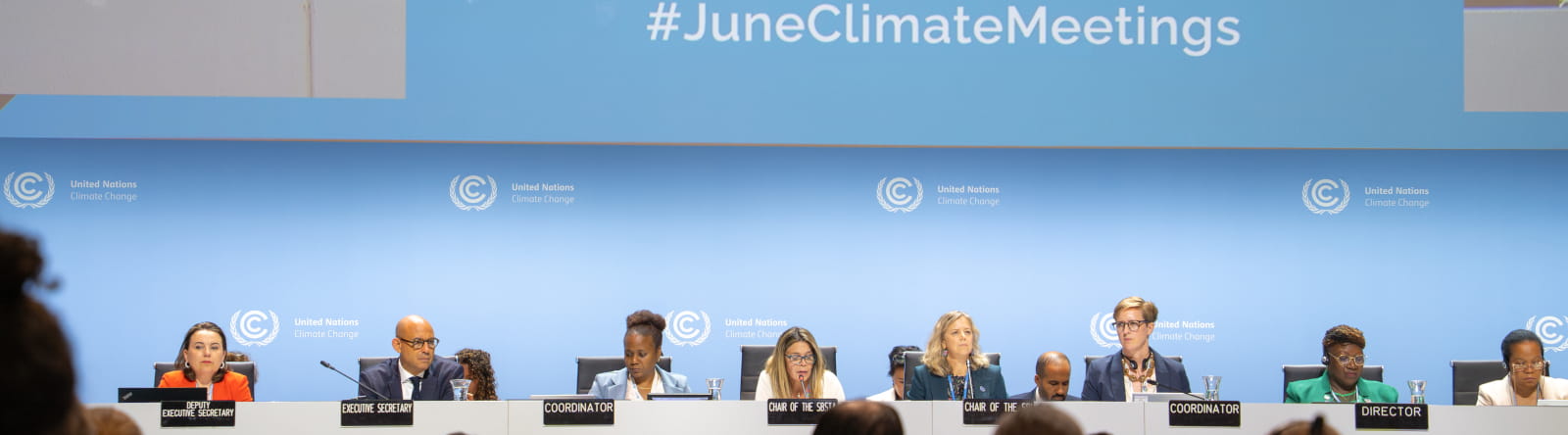
The 64th sessions of the UNFCCC Subsidiary Bodies (SB64) took place from 8 to 18 June 2026 at the World Conference Center Bonn, the mid-year negotiating round that prepares the ground for COP31 in Antalya this November under a joint Turkish–Australian presidency. The June climate conference in Bonn was the last major technical checkpoint before countries must demonstrate that the ambitions of the Paris Agreement can be translated into concrete implementation.
I have attended these meetings for the past seven years, witnessing both growing participation and rising tensions. This year, walking through security on my way into the venue on the opening Monday came with some surprising impressions marked by the comment of a security officer who has known me from previous years. He asked, “why are you all so friendly this year?” It was a throwaway comment, but it stuck with me. My own first impression was that these SBs felt smaller and calmer than in past years, less busy, less tense and yes, more friendly.
I suspect there are two reasons for this. First, in times of geopolitical tensions, climate has become less of a political priority internationally, which shows up here as shrinking delegation budgets and thinner attendance, particularly on the opening days. Second, and more encouragingly, the Paris Agreement is moving decisively out of its negotiation phase and into implementation. That shift changes not only what gets discussed in these rooms, but the mood of the rooms themselves. What follows are four reflections on where that transition currently stands.
1. Implementation needs deliberation
Implementing climate action requires genuine spaces for meaningful exchange between the people actually doing the implementing. The climate regime, however, is still built on the premise of negotiation positions against each other, instead of deliberating with one other, and SB64 illustrated the tension clearly. Take the UAE Dialogue, the mechanism to address the implementation of the Global Stocktake outcomes, the periodic review of collective progress toward the Paris Agreement’s goals, whose outcomes in 2023 included, among other things, the agreement to transition away from fossil fuels. The discussions on this Dialogue have been underway for two (!) years and hence my expectations were high when it took place the first time in Bonn this year. I was excited to see that the Secretariat and the facilitators prepared break-out groups to allow for a more open exchange. However, several parties objected, arguing the format was inconvenient, and after some back and forth the session reverted to formal statements.
The experience was somewhat similar for the annual dialogue on how implementation of nationally determined contributions is progressing, the so-called NDC-GST dialogue. It was split into two breakout groups, each with a co-facilitator. But rather than genuine deliberation, what happened was closer to a chaired reading session: delegates stood up, laptop in one hand, microphone in the other, and read out prepared national positions. These statements were sometimes word for word identical to the statements read in the other breakout group, because larger delegations had enough staff to place members in both breakout groups at once. It was a fairly stark example of how authentic deliberation continues to struggle to take hold within the formal regime.
While being a civil society space rather than part of the formal negotiations, the Bonn Climate Camp stood out as a bright spot in terms of deliberation for me. This camp, located just next to the negotiation halls on the banks of the river was explicitly built to connect people, bringing together different kinds of stakeholders from across the world to talk through the challenges of implementing climate action in an equitable and just way. I co-organised, for instance, a session on synergies between the Rio Conventions, with stakeholder from policy and civil society from different parts of the world actively deliberating – in a World café format while sitting in the gras.
2. Implementation needs finance
Across almost every format and repeatedly throughout the two weeks, delegations from non-Annex parties (the so-called “developing” countries or Global South) stated plainly that finance is essential for implementing their climate action. This connects to the principles of equity and common but differentiated responsibilities highlighted in the Paris Agreement and the climate convention, and it is often accompanied by pointed reminders of unmet finance promises. It would be too simple, though, to read this purely as a negotiating tactic of all actors. Listening to statements for two weeks across formats from various parties, underlying need for finance to implement climate action is real and substantial. During the UAE Dialogue, for instance, the African group of negotiators highlighted that for implementing their climate actions they depend on finance, noting that borrowing costs for developing countries can run up to eleven times higher than for developed countries. For effectively implementing climate action, the group called for enabling broad access to climate finance as well as reducing the cost of capital.
3. The climate and trade dialogue
For the first time, a dedicated climate and trade dialogue featured on the SB agenda, a topic contentious enough that procedural disagreement over it stalled the wider agenda for two days a year ago. Trade had already been discussed extensively at COP30 in Belém, where parties agreed on a three-part series of trade dialogues under the Mutirão decision, of which this was the first, held here at SB64 in Bonn. I think this issue has potential to reshape the climate regime going forward, because the financial magnitude involved in linking trade and climate measures is an order of magnitude larger than anything promised so far under existing climate finance arrangements: Trade in just the steel and aluminium sectors exposed to carbon border measures already exceeds $1 trillion, compared with the $300 billion a year pledged under the finance goal of the climate regime.
Much of the debate centres on unilateral trade measures, above all the EU’s Carbon Border Adjustment Mechanism (CBAM), a planned levy on imported goods that are more carbon intensive than equivalent goods produced – under tighter climate regulations – within the EU. The aim is to let the EU decarbonise its industry without exposing it to competition from less regulated, cheaper alternatives abroad. Some of the EU’s traditional partners such as Switzerland, the UK, or New Zealand backed the EU in these plans. However, what impressed me was the unity shown by the G77 and China in opposing this kind of unilateral trade measure, especially given how increasingly heterogeneous the group’s interests have become in recent years (A dynamic examined in detail in a recent IDOS study on the G77’s internal decision-making).
Critics of CBAM raise two main arguments. First, that it risks contradicting the bottom-up logic of nationally determined contributions, since the effective standard ends up being set by the EU rather than by each country itself. Second, and to me more compellingly, that a carbon levy collected at the EU’s border generates revenue for the EU itself, which runs counter to the North to South direction that climate finance is meant to follow. Instead, money would effectively flow from the South to the North. Redirecting that revenue back toward climate action in the countries most affected, particularly for adaptation and loss and damage, could be a possible way to address this.
4. A missed opportunity for synergies between the Rio Conventions
2026 is a triple-COP year. The anti-desertification UNCCD holds its COP17 this August in Ulaanbaatar, Mongolia, the biodiversity CBD’s COP17 follows in October in Yerevan, Armenia, and the climate UNFCCC COP31 takes place in November in Antalya, Türkiye. Against that backdrop, there are good reasons to push harder for synergies between the three Rio Conventions.
For one, it is somewhat artificial to treat biodiversity, desertification and climate as entirely separate domains. A growing body of literature underlines the importance of thinking about them together, and treating them as fully separate risks incoherent action and unnecessary trade-offs. Food security is a good example: all three conventions touch on it in some way, and it makes more sense to bring those conversations together rather than leaving them siloed. There is also a practical argument tied to shrinking budgets for environmental governance, both at the level of the secretariats and potentially at the national level, where a shared reporting format could ease the burden on countries reporting to all three conventions.
At SB64, agenda item 12, on cooperation between international organisations and referring among other things to synergies between the Rio Conventions, ended without an agreement between parties. The item was closed under Rule 16, meaning no formal outcome was recorded. The hope now rests on Antalya later this year delivering a stronger outcome on this front.
Taken together, these four threads point to the same underlying story: the Paris Agreement’s shift from negotiation to implementation is real, but the regime’s formats, finance, and institutional plumbing have not yet caught up. Deliberation remains scarce, finance remains contested and insufficient, trade is emerging as a new and much larger battleground, and the chance to align climate action with the other two Rio Conventions keeps slipping by procedural default rather than active choice. COP31 in Antalya this November is the next test of whether that gap can start closing.

Schreibe einen Kommentar