
 The International Security Forum Bonn is a high-level international event to ensure a dialogue on current foreign and security policy issues. This year’s forum focused on the challenges arising from changes in transatlantic relations, the upcoming global geo-economic and geopolitical obstacles, and the crises caused by the Covid-19 pandemic. As part of the panel „Aftermath: The Geopolitics of the Pandemic – Trend Multiplier of Game Changer?“ the Director of the DIE Prof. Dr. Anna-Katharina Hornidge discussed with five other participants the consequences of the pandemic with regard to geopolitical issues. The conference closed with a virtual dinner lecture by the virologist Prof. Dr. Hendrik Streeck of the University of Bonn. The dinner debate provided an opportunity to discuss HIV-related health infrastructures in Africa regarding their positive role in dealing with Covid-19.
Jahr: 2020
-
International Security Forum Bonn 2020
-
International Security Forum Bonn 2020
Das Internationale Sicherheitsforum Bonn ist eine hochrangige Veranstaltung, um einen Dialog über aktuelle Themen der Außen- und Sicherheitspolitik zu gewährleisten. Das diesjährige Forum widmete sich unter anderem den Herausforderungen, welche sich aus den Veränderungen in den transatlantischen Beziehungen ergeben, aus den anstehenden globalen geo-ökonomischen und geopolitischen Hürden sowie die durch die Covid-19-Pandemie verursachten Krisen. Im Panel „Aftermath: The Geopolitics of the Pandemic – Trend Multiplier of Game Changer?“ diskutierte DIE-Direktorin Anna-Katharina Hornidge mit fünf weiteren Teilnehmer*innen über die Folgen der Pandemie mit Bezug auf geopolitische Fragen. Die Konferenz schloss mit einem Virtual Dinner Vortrag des Virologen Prof. Dr. Hendrik Streeck der Universität Bonn. In der Diskussion bot sich Gelegenheit, die HIV-bezogenen Gesundheitsinfrastrukturen in Afrika mit Herrn Streeck in Bezug auf ihre positive Rolle im Umgang mit Covid-19 zu befragen.
-
Congress of the German Sustainability Award

© Dariusz Misztal & Christian Köster At this year’s congress of the German Sustainability Award (3 December 2020) Prof. Dr. Imme Scholz spoke about potential contributions of development policy for a sustainable recovery of the Corona Pandemic. As a matter of urgency, development policy should strive to restore the ability of public budgets in developing countries to act through the use of debt moratoria and debt relief: to mitigate the social and economic consequences of the pandemic and at the same time invest in adaptation to climate change, in the development of a climate-friendly energy supply and other infrastructures, for an efficient and employment-strong economy. A detailed article will be published in the journal of the Environment and Development Foundation of North Rhine-Westphalia.
-
Deutscher Nachhaltigkeitspreis
© Dariusz Misztal & Christian Köster Beim diesjährigen Kongress des Deutschen Nachhaltigkeitspreises am 03.12.2020 sprach Prof. Dr. Imme Scholz über mögliche Beiträge der Entwicklungspolitik für eine nachhaltige Überwindung der Corona-Pandemie. Vordringlich sei, dass sich die Entwicklungspolitik dafür einsetze, über Schuldenmoratorien und Erlasse die Handlungsfähigkeit der öffentlichen Haushalte in den Entwicklungsländern wiederherzustellen: um die sozialen und ökonomischen Folgen der Pandemie einzuhegen und gleichzeitig in die Anpassung an den Klimawandel zu investieren, in den Ausbau einer klimafreundlichen Energieversorgung und anderer Infrastrukturen, für eine leistungsfähige und beschäftigungsstarke Wirtschaft. Ein ausführlicher Beitrag dazu wird in der Zeitschrift der Stiftung Umwelt und Entwicklung des Landes Nordrhein-Westfalen erscheinen.
-
New publication: The Palgrave Handbook of Development Cooperation for Achieving the 2030 Agenda
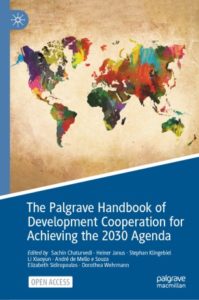
©Springernature How can different approaches of development cooperation be better reconciled to achieve the Sustainable Development Goals (SDGs)? This is the main question addressed in a new handbook published by Palgrave this month and edited by the Network of Southern Think Tanks (NeST, Sachin Chaturvedi, Xiaoyun Li, André de Mello e Souza, Elizabeth Sidiropoulos) and DIE (Heiner Janus, Stephan Klingebiel, Dorothea Wehrmann). The 2030 Agenda does not determine how and whether different forms of cooperation can be aligned across regions to achieve the SDGs. To identify the resulting gaps and potentials for improving coordination the handbook introduces the new concept of “contested collaboration”.
The 33 chapters written by 45 researchers with different disciplinary backgrounds and from different countries investigate different forms and concepts of cooperation (e.g. South-South Cooperation), narratives and norms, measurements of development cooperation, institutions and non-state actors as well as connections between national priorities and the SDGs. The handbook sheds light on transformations within established forms of cooperation (e.g. the UN System) but also on new actors (e.g. the New Development Bank). It contributes to a better understanding of the resulting coordination challenges and potentials for developing policies geared towards achieving the SDGs. The handbook further identifies opportunities to improve the effectiveness of the global development cooperation architecture and classifies them also by considering global processes. Research for this handbook formed part of the BMZ-funded project “Role and effectiveness of development cooperation to achieve the 2030 Agenda”. The open access ebook of the handbook is already available and a print version will be published in January 2021.