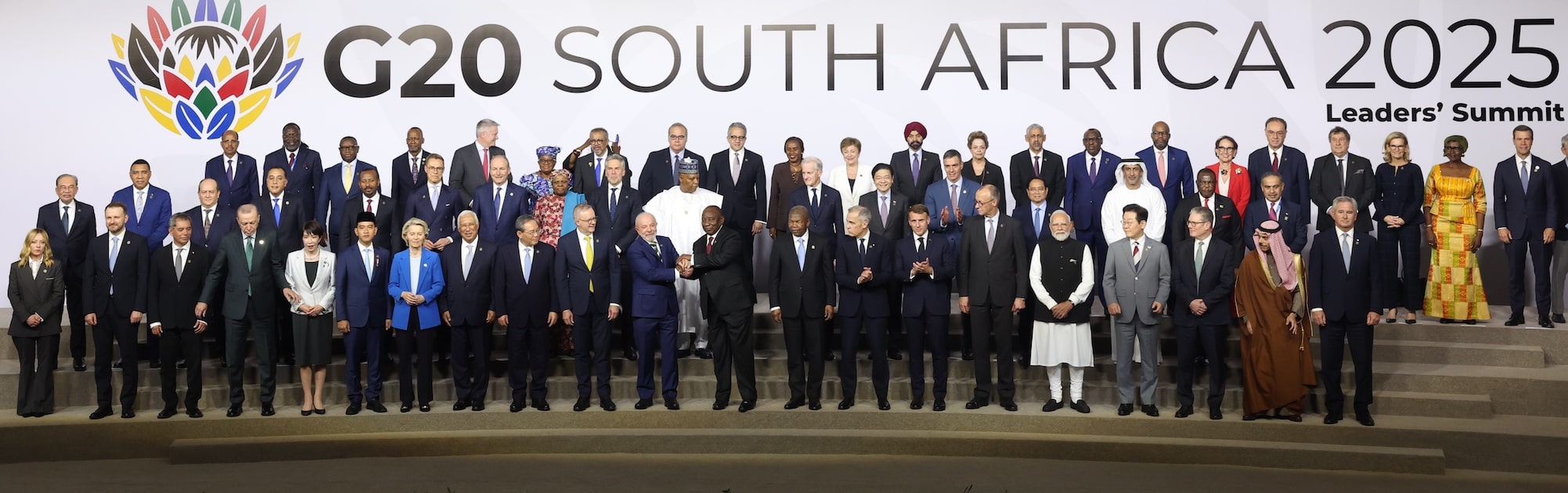
Club governance formats were meant to work around blockages and challenges in the multilateral system. In a system under pressure, these have become more important. Simultaneously, they become embattled themselves in a political climate that has become more ruthless. Just after its presidence, South Africa has declared it would ”pause” its engagement in the G20 for 2026 after intense bullying by the US President. Yet, the existence of the G20 is based on the recognition that (financial) crisis of global scale require close cooperation among countries across the globe, going beyond the G7. That fact remains valid. (mehr …)
In the wake of the 2021 UN climate change conference in Glasgow (COP 26), things looked quite promising for international climate cooperation. The summit had yielded a flurry of new commitments and initiatives. Importantly, an ambitious plurilateral partnership with South Africa, a major emerging economy, was heralded as a new approach in results-oriented climate diplomacy. Germany, France, the United Kingdom, the United States, and the European Union pledged to support South Africa in its just transition, i.e. in weaning itself off of its coal-fuelled energy production in a manner that affords social protection to those affected by structural change in the economy. More Just Energy Transition Partnerships (JETPs) like the one with South Africa could follow in the future and, their proponents hope, accelerate implementation of the Paris Agreement and reinvigorate global climate action. The G7, under German presidency, has certainly catered to that notion.
Less talk, more action?
However, not all is rosy in international climate cooperation, far from it. Pledges and policies for decarbonisation are nowhere near sufficient to meet the goals of the Paris Agreement. Longstanding issues are causing growing frustration among developing countries. In particular, financial support from industrialised countries is neither as high as promised, nor does it meet the needs. Discussions about climate-related loss and damage and commensurate support for climate-vulnerable poor countries are proving a veritable challenge, as the intersessional climate negotiations in June have shown. To make matters worse, geopolitical concerns about energy security, strained public budgets grappling with the impacts of the COVID-19 pandemic, and a surge in inflation are shifting short-term priorities in many developed countries. These factors have severely hampered the momentum and relative optimism for ambitious climate action in the run up to COP 27, which is set to convene in Sharm El Sheikh, Egypt, from 6 to 18 November 2022. Can the envisioned ‘JETPs’ be a much-needed shot in the arm in this context?
UN climate negotiations are slow and cumbersome affairs. Bi- and minilateral Just Energy Transition Partnerships, then, do seem like a promising and politically relatively inexpensive option to get things moving while cushioning transition pains – without requiring the consensus of 198 parties to the UN Framework Convention on Climate Change (UNFCCC). Realising this potential, however, may prove difficult if the JETPs are not seen to deliver. The perceived hypocrisy of the West’s energy policy has already put a strain on international climate cooperation. At the same time, the momentum brought on by the Paris Agreement is getting lost and trust in the multilateral process among the most affected – least developed countries and small-island states – is low.
Credibility requires coherence
With its reliance on gas and even resorting to coal in the current energy crisis, Germany, in particular, sees its credibility under scrutiny. Fossil fuel subsidies as a means to combat price surges for gas and oil do not go unnoticed abroad. Germany risks being accused of double standards and backsliding if it does not at least communicate its long-term intentions more effectively. Its pandering towards Senegal for a gas-fuelled JETP does not bode well in this regard. Moreover, emerging economies that are less dependent on coal than, say, Indonesia or South Africa will wonder what they can get instead of a JETP. The impression that exploiting coal and gas resources is the ticket to financially strong partnership agreements may alienate lower and middle-income countries that also seek support in dealing with climate change. But the engagement of all of these countries is required to bend the curve of global greenhouse gas emissions.
With regard to implementation, and despite unprecedented efforts to establish a common strategy to climate policy as a united Team Germany, tensions between the mandates and priorities of various ministries with regard to JETPs remain. Moreover, just transitions are difficult to realise even if the aforementioned challenges can be overcome. Transitions are never without friction. Circumstances on the ground – such as the structure of economy or the technical and legal particularities of any given energy system – invariably pose significant challenges. Additionally, they vary considerably across prospective partner countries. There can, therefore, be no common blueprint for expedient JETPs. Country ownership is key to be able to appropriately take national and local contexts into account.
What’s next?
These are challenging times for multilateral climate cooperation. Adding and owing to the withering trust and changing priorities described above, there has been a shift away from multilateral climate negotiations towards alternative forms of cooperation. Some even wonder if the large annual climate summits are still fit for purpose. A proliferation of JETPs could, despite good intentions, end up contributing to this shifting of the centre of gravity away from multilateral fora. This could prove detrimental in view of a global challenge that needs all hands on deck. To avoid further erosion of multilateral climate governance, any meaningful partnerships with individual countries should go hand in hand with a systematic strengthening of the climate summits’ governance functions to hone their relevance for implementation across countries and pertinent sectors, e.g. by shifting from negotiation only to tangible guidance for action.
The envisaged JETPs will best serve this purpose if they can clearly demonstrate that engagement and resolve, underpinned by commensurate resources, will actually yield ambitious results for global climate governance and national development. The currently ongoing New York Climate Week, deliberately coinciding with the UN General Assembly, and the UNFCCC’s COP 27 in November can serve as crucial stepping stones to that end. To be able to rise to the occasion, prospective sponsors like Germany and the EU will need to coherently realign their domestic climate policy with credible international commitments.
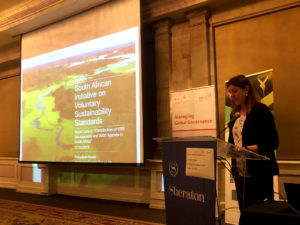
More than 70 representatives from the public sector as well as from research, civil society and business/industry attended the event. The goals of the meeting were to promote public awareness in South Africa on the potentials of VSS, engage and empower multiple stakeholders to support the implementation of the Sustainable Development Goals (SDGs) as well as to initiate the momentum to establish a national framework such as a National Platform on VSS in South Africa.
VSS are an instrument to achieve sustainable development goals, and they are also additional opportunities for business and industry. These standards are significant for businesses exporting abroad, as well as for Micro-, Small-, and Medium-size Enterprises (MSMEs) seeking to optimise their business operations, thus, reducing costs through efficiency.
Using innovative formats such as one-to-one interviews, world cafe and fish bowl, the DIE co-organised stakeholder meeting provided space for exchange among experts from both South Africa and from other countries with emerging economies such as Brazil, India, Colombia, and Vietnam, which already have a national platform on VSS.
The insights gathered at the meeting were collected and will be evaluated in a report that will be published and shared to all stakeholders. You can also follow the debates under the hashtag #VSSforBioeconomyZA on Twitter. For further information please contact Ariel Hernandez.
Die freiwilligen Nachhaltigkeitsstandards (Voluntary Sustainability Standards, VSS) umfassen mehr als 500 Zertifizierungen und Umweltsiegel, die in 199 Ländern mit einem Gesamtwert von 50 Milliarden US-Dollar verwendet werden. Das Programm Managing Global Governance (MGG) des Deutschen Instituts für Entwicklungspolitik (DIE) hat vom 6. bis 7. November in Pretoria, Südafrika, das Stakeholder-Awareness-Meeting: South African Initiative on Voluntary Sustainability Standards mitorganisiert. Über 76 Vertreter*innen aus dem öffentlichen Dienst sowie aus Forschung, Zivilgesellschaft und Wirtschaft / Industrie nahmen an der Veranstaltung teil. Ziel des Treffens war es, die Öffentlichkeit in Südafrika für die Potenziale von VSS zu sensibilisieren, mehrere Interessengruppen in einen Dialog einzubeziehen und zu befähigen, die Umsetzung von SDGs zu unterstützen. Das Treffen sollte zudem den Anstoß geben, einen nationalen Rahmen wie z.B. eine Nationale Plattform für VSS in Südafrika zu etablieren.
VSS sind ein Instrument zur Erreichung nachhaltiger Entwicklungsziele und bieten zusätzliche Chancen für Unternehmen und Industrie. Diese Standards sind sowohl für Unternehmen, die ins Ausland exportieren, als auch für Kleinst-, Klein- und Mittelunternehmen (KKMU) von Bedeutung, da sie dadurch ihre Geschäftsabläufe optimieren und so die Kosten durch Effizienz senken.
Mit innovativen Formaten wie Einzelinterviews, World Cafe und Fish Bowl bot das vom DIE mitorganisierte Stakeholder-Meeting Raum für den Austausch zwischen Expert*innen aus Südafrika und anderen Ländern mit aufstrebenden Volkswirtschaften wie Brasilien, Indien, Kolumbien und Vietnam, die bereits eine nationale Plattform für VSS haben.
Die bei dem Treffen diskutierten Erkenntnisse wurden gesammelt und werden in einem Bericht ausgewertet, der veröffentlicht und an alle Beteiligten weitergegeben wird. Sie können die Diskussionen auch auf Twitter unter dem Hashtag #VSSforBioeconomyZA nachlesen. Für weitere Informationen wenden Sie sich bitte an Ariel Hernandez.
Leaders of five BRICS countries – Brazil, Russia, India, China and South Africa – will meet in Johannesburg, South Africa from 25-27 July for the 10th BRICS Summit, convened under the theme: BRICS in Africa: Collaboration for Inclusive Growth and Shared Prosperity in the 4th Industrial Revolution.