Author: Eva-Maria Lynders

  • “Consolidate and sustain” under immense pressure – South Africa closes series of four ‘Southern’ G20 Presidencies

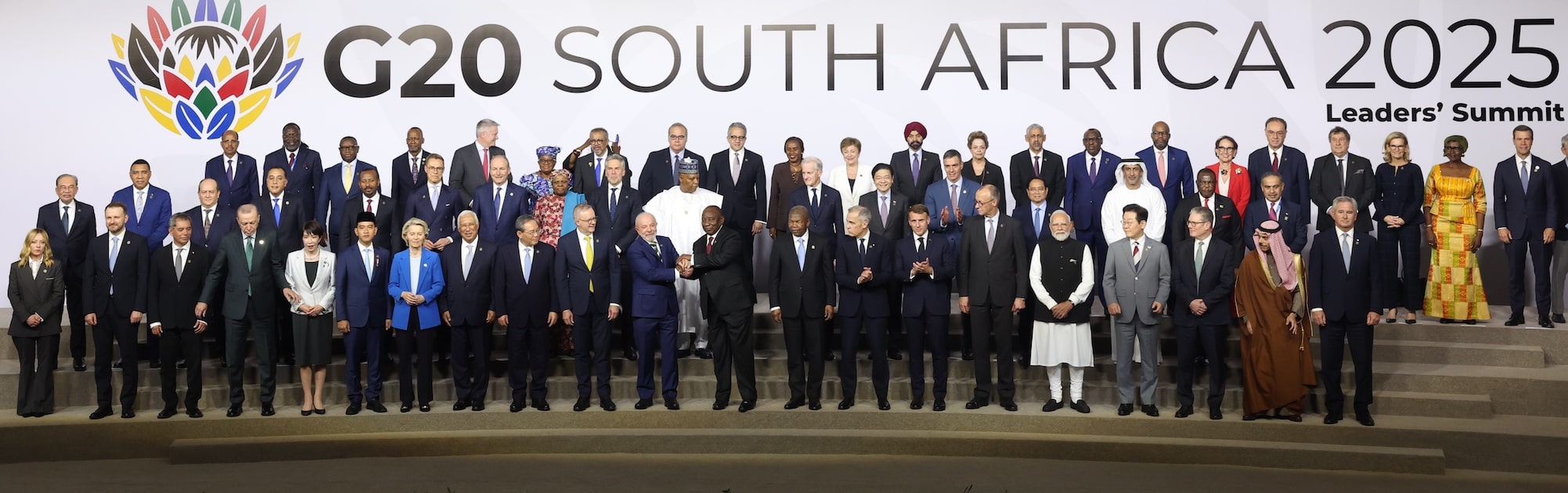
    Group photo of the delegates at the 2025 G20 Summit in South Africa.
    By UNCTAD on flickr

    Club governance formats were meant to work around blockages and challenges in the multilateral system. In a system under pressure, these have become more important. Simultaneously, they become embattled themselves in a political climate that has become more ruthless. Just after its presidence, South Africa has declared it would ”pause” its engagement in the G20 for 2026 after intense bullying by the US President. Yet, the existence of the G20 is based on the recognition that (financial) crisis of global scale require close cooperation among countries across the globe, going beyond the G7. That fact remains valid.

    The G20 is a collection of key countries that have to engage with each other – and that Europe has to engage with – to push for solutions for global challenges. Yet, polarisations are making G20 presidencies increasingly challenging. How did the last four “Southern” presidencies – Indonesia, India, Brazil and South Africa – navigate the increasingly choppy waters? And which elements can we distil from deliberations as communalities?

    G20 Presidencies 2022 to 2025: marked by crisis and decreasing trust in the international system

    Over the last four years, globalisation and global cooperation have taken various blows: We saw a struggling economic order, with vulnerable global value chains and aggravated national debt crisis in several low-income countries, as a repercussion of the COVID-19 pandemic. Further, the outbreaks and escalations of armed conflicts – not least so Russia’s full-scale invasion of Ukraine in 2022 – put the world order and its key principles under massive pressure. Since January 2025, with the second Trump administration, we also see aggressive tariff policies, withdrawal from multilateral engagements and further questioning the current order based on international law. Much trust has been lost in the international system and cooperation has become more complicated.

    Many international actors, for years, have been calling for fundamental reforms to the current global governance system, which was shaped after the Second World War and has not been updated to the current global setting. For instance, the international financial system makes it difficult for countries to consolidate their budgets when facing debt crisis. Questions persist whether the system is still fit for purpose. Consequently, systemic crisis shaped the G20 Presidencies between 2022 and 2025, who still aimed at communalities across presidencies.

    Indonesian, Indian, Brazilian, and South African leadership aspired to raise issues relevant to low and middle-income countries. Indonesia, despite Russia’s escalating war against Ukraine, kept the group intact and despite strong frictions facilitated a joint (!) G20 Leader’s Declaration. India managed the admission of the African Union (AU) to the G20 by 2023, making for a better representation of African countries– and thus lived up to a recommendation repeatedly brought forward by Think20 (T20) experts since 2017. Building on the AU’s inclusion, Brazil focused on representation of think tanks beyond G20 countries, especially from Africa, in 2024, and initiated the Global Alliance Against Hunger and Poverty. South Africa, as the first G20 Presidency “on African soil”, promoted “Solidarity, Equality, Sustainability” as this year’s G20 theme, in an attempt to set positive principles, countering crisis. South Africa’s leading think tanks for the T20 process chose the theme “consolidate and sustain”.

    The absence of several heads of state – among them those of China, Russia, and the US, with the latter continuing to challenge South Africa’s role based on false allegations – hampered the G20 Summit in Johannesburg. Yet, the G20 is more than a heads of state club as activities around it are also indicative of debates. The T20, for instance, comprises policy-oriented think tanks from across the globe – and provides evidence-based policy advice.

    T20 – think tanks and proposals to reform global institutions

    With the four consecutive “Southern” presidencies, “Southern” think tanks led the T20, too. In the communiqués that condense the work of each T20 process, recommendations throughout all four processes call for the leaders of the G20 to ensure and enhance cooperation on reforms of (1) global governance structures and (2) the multilateral trading system.

    1. Modernising the international order 

    Published in the direct aftermath of COVID-19, the Indonesian T20 Communiqué called for a general modernisation of the international order to account for the interests of developing countries, and to be able to address “global problems as climate change and future pandemics”. The Indian T20 process specified this call suggesting the establishment of an expert group by the G20 to develop concrete proposals for global governance reform, a “roadmap for ‘Multilateralism 2.0’”.

    The recommendation, inter alia (and not surprisingly), explicitly refers to a reform of the UN Security Council, which experts in the Brazilian T20 process took up. Both countries have ambitions for a permanent seat at that table. Building on the recommendation of establishing an expert group, the Brazilian T20 Communiqué formulates the idea of establishing a permanent task force on UN reform within the G20 Sherpa Track.

    1. Ensure cooperation in the multilateral financial and trading system 

    The general call for more representation for low- and middle -income countries goes along with specific recommendations for the reform of multilateral procedures at the IMF and WTO. The Indonesian T20 Communiqué called for a “new Bretton Woods”. The recommendations especially highlight the importance of a change in the quotas of IMF special drawing rights (SDR) in favour ofl ow-income countries, who are currently only allocated 3.2% of the USD 650 billion that the IMF allocated in total in SDR in 2021. Underlining the call for a reform of the IMF quota system, the Brazilian T20 process also published an Implementation Roadmap to reform the G20 Common Framework for Debt Relief that links its outcome to the recent G20 Leaders’ Summit of South Africa.

    Recommendations to reform the multilateral trading system and the international financial architecture formulated in the T20 processes under the Indonesian, Indian, Brazilian and South African G20 Presidencies call for structural adjustments to develop more fair and cooperative processes. India, for instance, proposed that the G20 “tasks” the WTO with coordinating an agreement to reform trade rules, with G20 meetings as regular reporting occasions. The High-Level Recommendations published during the South Africa T20 Midterm Conference recommends strengthening the WTO secretariat. These calls can be read as commitments to existing multilateral institutions and processes.

    Urgency in building on policy proposals

    The four T20 processes under the G20 Presidencies between 2022 and 2025 reaffirmed that reforms are needed in the multilateral system. Questions remain about rising powers’ increasing global responsibilities, and how they are exercised, e.g. with regard to G20 countries’ role in the international financial system. Recommendations by experts from leading research organisations consider it crucial to make the multilateral global governance system fairer and more fit to address global challenges.

    The G20 South Africa Leaders’ Declaration, adopted at the Johannesburg Summit on 22 and 23 November, makes reference to enhancing the international financial architecture as well as to the reform process of the United Nations, UN80. The text also refers to the G20 Call to Action on Global Governance Reform, adopted under the Brazilian G20 Presidency in 2024. The absence of the US government as next chair of the G20 in 2026 at the Summit in Johannesburg leaves little room for optimism that further steps will be taken in these areas in the coming year. And yet, Europe would be wise to continue engaging on the substance elaborated in the T20 process.

    The G20 will become more difficult, if not dysfunctional in 2026. From a European perspective, it is all the more important to keep in dialoge with so-called “rising global powers”, and particularly seek partnership of the middle-powers. Building and expanding these alliances is in Europe’s vital interest. Consequently, European actors should actively take up reform proposals that are already on the table. In this line of thinking, it is obviously unwise to exclude African representation from the next G20 meeting, be that South Africa or the often-ignored African Union. Engaging for a legitimate international order is in Europe’s crucial interest in an increasingly multipolar global setting.

  • The G20 and the Re-Calibration of Global Governance – Insights from the T20 Summit 2024 in Brazil

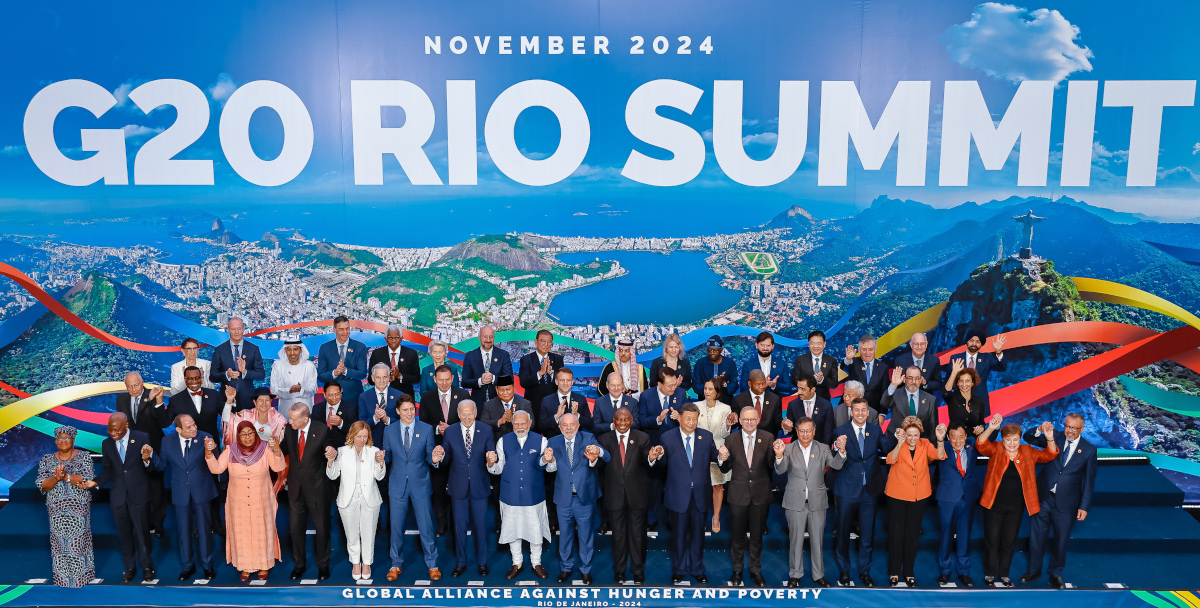
    The Heads of State at the G20 Summit in Rio de Janeiro in November 2024, forming a global alliance against hunger and poverty. © Palácio do Planalto on flickr, Photo: Ricardo Stuckert/PR

    In November 2024, Brazil concluded its G20 presidency with the handover to South Africa. Just one week before the G20 Leaders‘ Summit in Rio de Janeiro on 11-12 November 2024, think tanks and research organisations from around the world gathered for the Think20 (T20) Summit. They took stock of the uptake and implementation of the policy advice they provided to the G20 throughout the year. This blog post provides an overview of key discussions at the T20 Summit with a focus on the priorities under Brazil’s G20 presidency. It analyses to which extent Brazil has continued initiatives of India’s G20 presidency in 2023, and shares an outlook on the potential approach of the South African presidency in 2025. (mehr …)

  • A new era for the G20? Insights from the T20 Summit 2022 in Indonesia

    A new era for the G20? Insights from the T20 Summit 2022 in Indonesia

    Logo: G20 Indonesia By Hellosumanjaya – Own work, CC BY-SA 4.0, https://commons.wikimedia.org/w/index.php?curid=110382121

    “Recover Together – Stronger Together” is the slogan of the G20 presidency of Indonesia 2022. Formulated in 2021, it was meant as a signal to focus on economic recovery and the global health architecture after the Covid-19 pandemic, combined with sustainable energy transition. In 2022, geopolitical tensions amongst G20 member states and a series of yet more global challenges, including a severe food and energy crisis, place a bold question mark behind literally all components of the slogan. Economies and societies do not ‘recover’ at the aspired pace. The recent drop of the global Human Development Index erases gains of the last five years. The G20 is not ‘together’ and most of the world’s economies cannot be considered ‘stronger’. In sum, global governance is anything but fit to address the “interwoven sustainability emergencies” with a climate crisis at its core. Still, there is hope that the Indonesian presidency marks the beginning of a new era for the G20, and, thus, for the global cooperation system as a whole.

    The new era arguably has already begun, even if keeping the G20 alive may turn out to be the Indonesian presidency’s main success under challenging circumstances. We will see a set of four G20 presidencies with a markedly “Global South” identity in a row: India (2023), Brazil (2024), and South Africa (2025) are to follow Indonesia. This comes with great potential in the mid-term for closer cooperation, more continuity in the G20 agenda and a stronger focus on development that works for the South.

    The hope for more cooperation and a shift of focus towards development within the boundaries of the earth system crystallised during the recent summit of the Think 20 (T20) in Indonesia. The T20 is an official G20 engagement group that brings together leading think tanks and research institutions to provide research-based policy recommendations. In its final message to the G20 leaders, condensed from more than 130 policy briefs produced in 9 Task Forces and launched during the Summit, the community highlighted five core areas on how to:

    1. foster recovery and resilience,
    2. accelerate the process toward net zero emissions and combat climate change,
    3. govern transformation to the digital society,
    4. make the economy more inclusive and people-centred, and
    5. revive global governance.

    Beyond these core points, discussions during the Summit revolved around the role of the T20 and the science and think tank community for international cooperation. In this way, the T20 tried to deliver on the thematic priorities of the Indonesian G20 presidency, while recognising at the same time that at the moment food and energy security are more immediate concerns than green and digital transformations.

    A divided G20 faces interwoven crises

    In 2022, cooperation in the G20 is both more difficult and more needed than ever. The core challenge of climate change becomes ever more pressing with numerous direct and indirect effects on societies, economies and ecosystems. Other, new challenges have been added, not least manifold implications of the Covid-19 pandemic. Despite the Covax initiative and related efforts, worldwide access to affordable vaccines remains a key challenge. Economic recovery is hampered by geopolitical tensions that come with a substantial food and energy crisis, a slowdown of growth for major world economies, a looming ‘stagflation’ period and an excess debt crisis. All of these effects hit less resilient economies hardest and it happens at a time when production and demand were still suffering from the disruption of supply chains during the pandemic. People mobility was reduced because of Covid-19-related restrictions and today harms both economic re-opening and the transnational cooperation between countries in more general terms. To illustrate, the already complex exchange with China has become even more difficult in the face of China’s strict public health measures due to its zero-Covid approach. Within societies worldwide, the pandemic widened the gender gap regarding income and socio-economic security; women were the first to lose their jobs and are the last to return to the labour market. Young generations suffer from “lost years” of education, the real consequences of which are likely to unfold in the next years only. The high share of young people in developing and emerging countries implies strongest effects here. The boost of digitalisation fuelled by the pandemic – occasionally perceived as a modernisation of services – results in more automation, adding an additional disruptive element to the labour market with a likely increase of existing inequalities.

    The complexity and urgency of these interwoven challenges call for globally coordinated action. The G20 might be a forum for that, but political disagreement hampers comprehensive cooperation and, thus, increases the risk that the major challenges of our time remain unaddressed. G20 members are divided over their positions on Russia’s war against Ukraine, while its repercussions – including rising energy and food prices – put an additional burden on economic recovery. Additional political and economic uncertainty comes with strong disputes between the US and China regarding Taiwan. Under the Indonesian presidency, the G20 disguises these developments under the notion of ‘geopolitical tensions’ without addressing the elephants in the room openly. However, the absence of trust between various actors constitutes a key obstacle to the formulation of joint positions, and it is not unlikely that President Joko Widodo will have to close the Summit on 16th November without a joint communiqué.

    A new era of cooperation in a ‘Southernised’ G20?

    Despite these risks, there is hope that the sequence of chairing countries in the coming years bears the potential to initiate a ‘Southernisation’ of the G20 after a period of agenda setting by developed countries with positive effects. The incoming presidencies share similar development challenges and economic and political roles in their respective regions. This background can make it easier for them to arrive at common understandings of global problems – the precondition for joint and, thus, effective solutions. These countries also share the ambition to co-shape world affairs based on a better recognition of global power shifts towards the South. Three of them are members of BRICS, which can contribute to the synchronisation of initiatives. In this way, the sequence of presidencies can bring a stronger development focus and more continuity to the agenda, the lack of which remains a key obstacle to effective cooperation structures. The already established troika system, meant to synchronise the efforts of three consecutive G20 presidencies, could be made to work into the same direction. Initiatives like the T20 Research Forum, established during the T20 summit, may help develop joint understandings and continuous agenda setting, too. Beyond the set of chairing G20 countries, attempts to better integrate G20 views in the G7 process under the German G7 presidency 2022 shows potential for a parallel ‘G20-fication’ of the G7, with prospects for improved cooperation between the two country clubs. Crucially, together, the trends of 2022 – Southernisation of G20, and G20-ification of G7 – may also mark the beginning of a new era of global cooperation, in which Southern leaderships shift the focus to the Global South.

    Indonesia is well positioned to keep the G20 alive. Its geopolitical position between major blocks, diverse international economic connections, its strong role in ASEAN and membership in APEC, the approval of the UN resolution ES-11/1 to deplore Russia’s invasion of Ukraine in combination with a non-alignment with ‘Western’ sanctions against Russia, and an overall careful diplomatic approach can help keep the show going when leaders meet for a showdown on Bali in November. However, as agreement on a comprehensive common approach to key crises remains unlikely, regional and thematic country clubs, which share higher ambitions in selected areas, could be a pragmatic means to create dots – within and outside the G20 – that can be connected at a later stage. The four presidencies of emerging powers in the G20 should work together to materialise the potential of a better-harmonised and more continuous agenda until 2025, with shared development and climate questions at the centre.

    Here, the role of a cooperative and effective T20 as a “bank of ideas” underpinned by sound scientific evidence is crucial. It can help in setting and maintaining a multiannual agenda, building necessary transboundary bridges and finding common solutions. It remains to be seen in how far the strong T20 efforts under Indonesian guidance can contribute to a successful G20. Arguably, the T20 process can be most important when successful cooperation amongst G20 members is most difficult. While Indonesia’s presidency might not be able to fully live up to the ambition of its motto to have the G20 recover together and stronger in 2022, its legacy could be the preparation of a new phase of togetherness, which allows for better cooperation in the future.