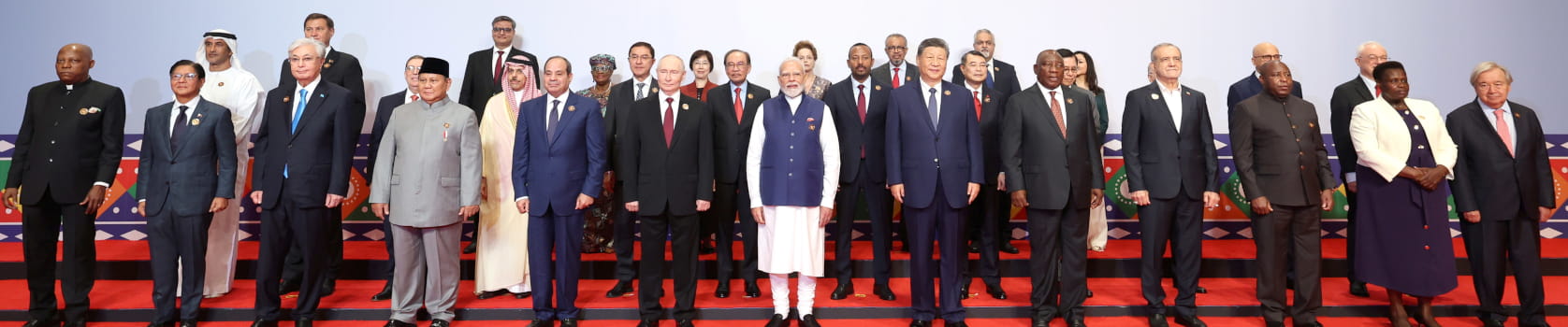
 © MEAphotogallery on Flickr, CC BY 4.0, cropped by IDOS.
The BRICS group gets limited attention in Europe. Indeed, the BRICS member countries are “non-Western”, but not a coherent block. It is exactly for this reason, that it merits close attention. The BRICS+ as a group are economically fast catching up with the G7 in global weight – on purchasing power parity, BRICS+ has already overtaken the G7. Starting as an investment banker’s idea, the countries whose initials stand for BRICS – Brazil, Russia, India, China, and later also South Africa – have since taken more members to their informal club, inter alia Iran, Ethiopia, the United Arab Emirates and Indonesia.
Diversity as a limitation – and an asset
BRICS is too diverse to become a coherent geopolitical bloc: China and India remain strategic competitors, the interests of Russia and the Gulf states do not always coincide, and its members have very different relationships with the United States and Europe. Yet that diversity is precisely what makes BRICS increasingly important. Its members are trying to make the global order less dependent on any single centre of power. The question is no longer whether BRICS will become an alternative to the West (as assembled in the G7), but how much influence European countries will retain in a world where more countries have alternatives.
The New Delhi Declaration contains plenty of familiar BRICS language: reform of the UN Security Council, greater representation in the Bretton Woods institutions and a stronger voice for the Global South. More interesting is how these long-standing demands connect to the economic pressures of the present. BRICS continues to oppose unilateral and secondary sanctions and criticises protectionist tariff and non-tariff trade measures, while reaffirming the G20 as the premier forum for international economic cooperation. The evolution of its financial agenda is particularly revealing. At the 2025 summit in Brazil, Donald Trump threatened further tariffs against countries supporting the BRICS agenda, while earlier threats had focused on any move towards a BRICS currency that could challenge the dollar. New Delhi is taking a more pragmatic route. The emphasis is on increasing trade and investment in national currencies and making cross-border payment systems more interoperable. The important development may therefore not be the vision a new BRICS currency at all, nor simply follow the Chinese aspiration to further internationalise their currency, the Renminbi. It is the gradual construction of ways to trade without always needing the dollar. Trump’s threats have not stopped that process. For Europe, this matters because its economic and geopolitical influence is increasingly tied to choices over trade, finance, sanctions and supply chains that it does not control alone.
India’s role – cooperation in a fragmented and polarised world
India’s diplomacy at the summit works with a fluid environment. New Delhi managed to bring together relationships that are often treated in Europe as belonging to separate geopolitical camps. Vladimir Putin made his first major international visit to India in seven years. Xi Jinping made his first visit since the 2020 Galwan clash, in which Indian and Chinese soldiers clashed and some died. And the summit offered an occasion for the leaders of Iran and the UAE to engage directly despite their tensions. None of this resolves the underlying conflicts. But it demonstrates India’s ability to maintain multiple strategic relationships at once: with China and Russia, with Iran and the Gulf, and with Europe and the United States. BRICS is one instrument of that strategy. Rather than choosing one camp, India is using different institutions and partnerships for different purposes. This is likely to become a more common feature of international politics, and it challenges the perception of fixed alliances and blocs, which Europeans tend to use when looking at cooperation – possibly as a legacy of the Cold War, and certainly revived by the more recent Russian war on Ukraine.
The Declaration’s treatment of war and conflict similarly illustrates both the possibilities and the limits of BRICS cooperation. On Ukraine and the conflicts in West Asia, the language concentrates on sovereignty, international law, dialogue and diplomacy rather than assigning responsibility. Given that countries directly involved in these conflicts are themselves represented at the summit, this caution is hardly surprising. The treatment of Palestine is different: the Declaration is considerably more explicit in calling for a ceasefire, humanitarian access, an end to forced displacement and Palestinian self-determination. The significance for Europe goes beyond the wording of the Declaration. Across the Global South, questions about international order are increasingly connected to perceptions of whether international rules are applied consistently, and this will have added to the the recent loss of vote for Germany as a contender for a non-permanent seat at the UN Security Council. European governments therefore face a difficult balancing act: maintaining their own positions while engaging partners who may interpret sovereignty, international law and political responsibility differently. Ignoring these differences will not make them disappear.
Global issues for which the BRICS are needed – from AI to sustainability
Artificial Intelligence (AI) may offer an even clearer illustration of where BRICS is heading. Most BRICS countries are not in a position to compete with the United States and China at the frontier of AI. They have strong reasons to retain access to both technological ecosystems, and therefore little incentive to choose between an American and a Chinese model of AI governance. Instead, the New Delhi Declaration points towards a third objective: greater influence over the rules governing AI, combined with wider access to the infrastructure, skills and economic opportunities it creates. Its emphasis on inclusive, trustworthy and sustainable AI, energy efficiency, capacity building and international cooperation builds on the AI governance agenda advanced under Brazil’s BRICS presidency. This is not the same as the European approach with its greater emphasis on risk regulation, but there is potential common ground. Europe, too, has an interest in avoiding a world in which the technologies, standards and governance models of two AI superpowers become the default choices for everyone else.
This is also why the summit’s sustainability agenda deserves more attention than it usually receives. The Declaration links energy security with a just and orderly transition, promotes circular economy principles and resource efficiency, and explicitly looks towards shaping the sustainable development agenda beyond 2030. Here again, BRICS is not offering a single model. Its members have very different energy systems, development priorities, economic interests, and climate policies. But most of them share an interest in avoiding that a small number of actors dominate. That is the larger lesson from New Delhi.
Conclusion: Multipolarity in practice
The BRICS summit in New Delhi is a useful reminder that the emerging international order will not divide neatly into Western and non-Western camps. BRICS is not necessarily building a new world order, but to discard it would be ignorant of new realities. This grouping is helping to build a world with more options. For Europe and the G7, the challenge is therefore not to decide whether BRICS represents a new bloc to be embraced or resisted. Europe rather needs to work on capabilities to operate effectively in a world in which more actors are capable of shaping the rules. Being principled and pragmatic is the challenge for all global actors. Influence will increasingly depend on the ability to work across rather than simply within geopolitical camps.