

This week, the international development community will gather in Bangkok for the Annual Meetings of the International Monetary Fund (IMF) and the World Bank. Amid pressing development needs and empty public purses, the Governors of the World Bank will discuss (one time more) how to mobilise private capital at scale, a pledge the international community has made but failed to realise. Multilateral Development Banks (MDBs) have been the predominant mobilisers of financial resources, accounting for 71% of the total mobilised private finance, with current mobilisation figures standing at approximately $108 billion per annum. However, this is only a tiny fraction of the private investment needed to achieve development and climate goals, highlighting the urgent need for a change in mobilisation approaches.
In general terms, MDBs utilise their limited resources on two distinct levels. The first level primarily encompasses the funding side, i.e., expanding their own financing capacity, notably through capital-market borrowing, and repeated replenishments of their concessional windows. The second level is predominantly concerned with the mobilisation of private capital through the use of MDB funds. A new paper by the German Institute of Development and Sustainability (IDOS) “Chasing the trillions – what MDB lending can and cannot mobilise” focuses on the second level, examining how additional financial resources can be mobilised through MDBs’ lending operations. It considers the extent to which MDB financing instruments and lending modalities can attract additional public or private investment to maximise development outcomes. Drawing on the instrument categories reported by the MDB Task Force on Mobilization and extending the analysis to policy-based lending, this study examines six categories: debt instruments, equity instruments, risk-transfer instruments, guarantees, advisory services, and policy-based lending. The paper focusses on identifying the mobilisation potential of the different lending instruments (“mobilisation efficiency”) and on how leveraging related to the MDBs objective to achieve high development outcomes by safeguarding their financial viability.
Beyond leverage ratios: understanding how lending instruments differ
Reliable, aggregate data is only available in limited quantities. This is partly understandable, given the serious methodological issues involved in measuring, attributing to, and comparing the leverage impact of various lending instruments. One dollar of MDB lending, one dollar of guarantee exposure and one dollar spent on advisory services do not represent the same level of commitment of public resources or risk. Furthermore, private finance linked to a transaction cannot be measured in the same way as subsequent investment enabled by policy reform. Therefore, this analysis does not seek to rank instruments based on a single leverage ratio.
Instead, we explain how to understand and apply lending instruments more effectively based on their respective characteristics, such as mobilisation mechanisms, level of intervention, constraints addressed, indicative mobilisation potential, time horizons and ease of measurement. The instruments are presented along a continuum ranging from transaction-level instruments with comparatively direct and measurable mobilisation effects to systemic interventions that shape the wider investment environment. While debt and equity provide direct financing, risk-transfer mechanisms and guarantees mobilise private capital by reallocating or mitigating risk, and in some cases releasing institutional financing capacity. Policy-based lending and market-development advisory services mainly operate through policy, institutional, project-preparation, and market-development channels, resulting in more catalytic and longer-term effects. Transaction advisory services can also support mobilisation directly.
Shifting towards higher-potential instruments – especially those that shape markets – can improve development impact and financial efficiency
Broadly speaking, greater use of leveraging instruments can improve an MDB or a Development Finance Institution (DFI) portfolio through two channels: a financial/portfolio efficiency channel and a development/catalytic channel. In terms of financial efficiency, leveraging instruments can enable a DFI to make more efficient use of its own balance sheet. For example, syndicated loans spread financing across several lenders, which can lower origination, due diligence and monitoring costs for participating investors. Guarantees and risk-sharing instruments focus support on specific risks rather than financing the entire investment, meaning a relatively small amount of MDB capital can support a greater volume of private lending. Securitisation can transfer seasoned exposures to investors and release balance-sheet capacity for new lending.
In terms of development outcomes, a given amount of MDB resources can support a larger volume of investment. Furthermore, some interventions generate effects beyond the transaction itself. For example, a syndicated loan can introduce commercial banks to borrowers, countries or sectors that they subsequently finance independently. Guarantees can establish a risk-performance track record, making unfamiliar assets more appealing to investors. Securitisation can transform development finance assets into an investable asset class, thereby broadening the investor base. Moreover, policy-based lending, technical assistance and regulatory reforms can have an even wider catalytic effect, as they address constraints applying to entire sectors or economies, such as weak regulation, deficient institutions or insufficient project pipelines, rather than merely making one project financeable.
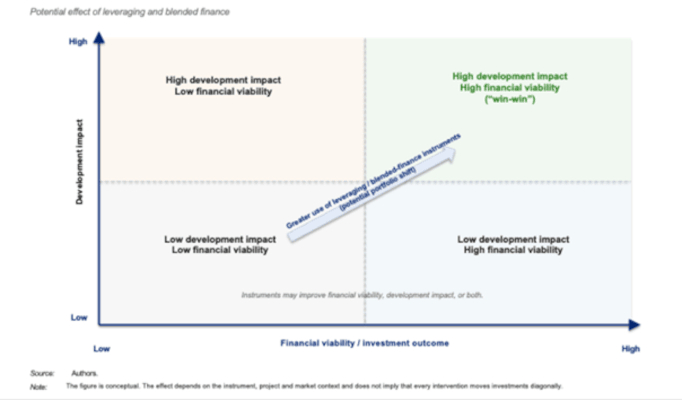
The graph below outlines possible combinations of development impact and the financial viability of lending portfolios. It also illustrates the effect that highly efficient leveraging instruments can have on the portfolios. The potential impact of enhancing the use of these instruments is indicated by the diagonal black arrow. Greater use of well-targeted leveraging instruments can increase both development impact and financial viability. It can move the portfolio upwards and to the right simultaneously: upwards because the MDB’s resources generate more investment with potentially broader market effects, and rightwards because risk is diversified or transferred, capital is recycled, and transaction and intermediation costs can fall. This comparison should hold the MDB’s available public resources and overall risk-bearing capacity constant; otherwise, an apparent improvement may simply reflect the commitment of more resources or the assumption of greater public risk.
But higher leverage does not mean better development outcomes
However, it is important to recognise that this is a potential effect, not a guaranteed one. Reported financing volumes alone do not demonstrate greater development impact. A high leverage ratio does not necessarily indicate superior performance; it could imply investment in easier markets, weak additionality, or understated public risk. Conversely, a lower ratio may suggest greater additionality, for example in a fragile market or pioneering sector. Therefore, the pursuit of leverage should not be regarded as an objective in itself. When making any changes to policies, the following factors must be considered: the amount of private finance mobilised per dollar of MDB resources; the nature of the public risk assumed; additionality; development impact; and longer-term catalytic effects.
Furthermore, the use of concessional funds through blended finance instruments can be costly and may undermine the debt sustainability of partner countries and the financial headroom of development agencies. DFIs apply the ‚minimum concessionality principle‘, but this principle requires further specification. If interpreted too generously, there is a risk of creating leverage without sufficient development impact. Conversely, greater focus should be given to improving policy frameworks, particularly through policy-based lending and relevant technical assistance.
Winning the leverage battle without losing the development war
Consequently, shareholders in favour of increasing private-sector mobilisation should demand greater transparency regarding mobilisation-related data, particularly with regard to the market impact of projects and portfolios. They should consider metrics that encompass development impact and broader catalytic effects, rather than just leverage ratios. Our paper provides specific recommendations in this regard:
- sharpen and develop lending instruments to increase leverage;
- ensure that enhanced leveraging does not undermine the development objective,
- further enhance collaboration amongst MDBs and with the OECD in order to improve data transparency,
- systematically integrating private sector mobilisation into their business model.