How can countries make the 2030 Agenda “spillover-aware” across borders, sectors and value chains?
©IDOS
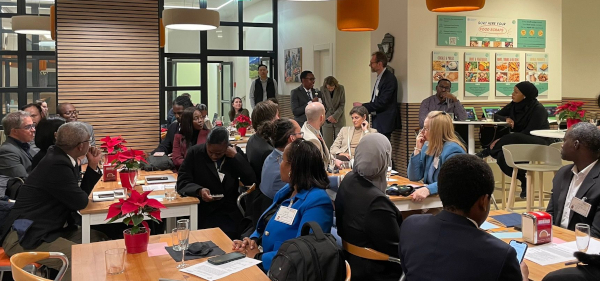
That question shaped SDSN Germany’s side event, “Aligning National Action with Global Sustainable Development: A Peer Learning Workshop on ‘Spillover Effects’”, held on 17 December 2025 at FAO Headquarters in Rome alongside the First Global Workshop for 2026 Voluntary National Reviews (VNRs).
Spillover effects, defined as the cross-border impacts of national policies, production and consumption patterns, remain difficult to measure and too often sit outside SDG reporting. In this peer-learning exchange, participants from more than 20 countries discussed how to better integrate spillovers into strategies, governance arrangements and VNR processes.
Country perspectives from Brazil, Rwanda, Senegal, and Switzerland, were followed by a table discussion on challenges, data measurement and partnership needs.
Key takeaways:
- Spillovers are not an “add-on”: they are central to policy coherence, SDG interlinkages, and credible VNR reporting.
- The bottlenecks are practical: data availability, institutional responsibilities, and turning indicators into actionable policy and governance.
- Promising approaches are emerging: countries are combining quantitative indicators with qualitative assessment and emphasising frank reflection on cross-border impacts.
SDSN Germany thanks all participants for the open and constructive exchange, and colleagues from UN DESA and FAO for their engagement.

Schreibe einen Kommentar