IDOS researcher Dr Annabelle Houdret stresses the crucial relevance of gender aspects in water governance.
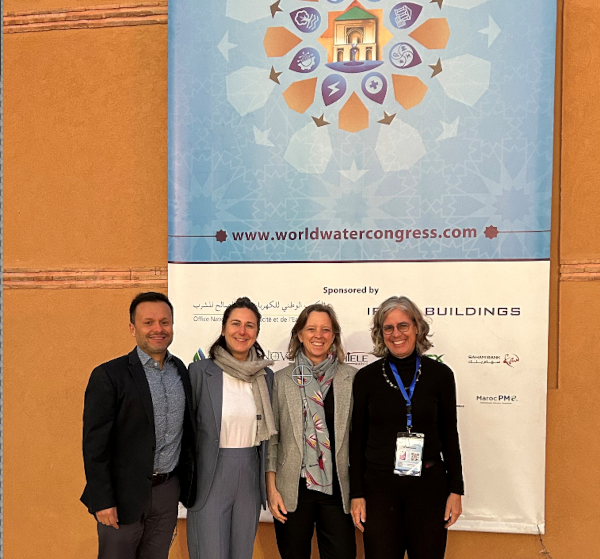
At the invitation of the International Water Resources Association (IWRA) and the Moroccan Ministry of Infrastructure and Water, around 1,500 participants gathered for the International Water Congress from 1 to 5 December 2025. As the last major international meeting before the High-Level Preparatory Meeting (HLPF) for the 2026 UN Water Conference scheduled for January, the congress was of great importance for the exchange of ideas. The IDOS water team contributed with several inputs.
Dr Annabelle Houdret organised the special session “Morocco at a critical juncture: expert debate on opportunities for improved water governance”. In view of important transformations caused by severe water scarcity in Morocco, the debate focused on how related gender aspects can be strengthened and governance challenges addressed. Ms Touria ElAfti, advisor to the Moroccan Minister of Infrastructure and Water, explained how the country has, among other things, significantly increased the recruitment of female professionals in the sector, and what challenges remain in implementing the strategy to institutionalise gender equality in the water sector. Ms Raja Aouijil, a civil society representative from the Tafilalt oasis region, who herself was able to acquire agricultural land for women through a land rights reform, gave an impressive account of the need for further support. Dr Annabelle Houdret (IDOS) explained which four measures can be particularly effective, based on the policy brief Water crisis and rural women: insights from Moroccan oases, which she co-authored with three other authors. In the second part of the panel discussion, Prof. Samira Idlallène from Cadi Ayyad University in Marrakesh-Safi explained how the extensive infrastructure measures Morocco is taking to tackle the water crisis also pose challenges for governance. She pointed to insufficient research into the ecological and social consequences that the so-called “water highways” for water transfer between regions and the numerous desalination plants will have. Ms Radia Benabderrazik from the same university emphasised in her presentation that traditional, often informal water rights in particular could be negatively affected by these projects.
Prof. Ines Dombrowksy held a presentation where she identified mechanisms for governing the Water-Energy-Food- Ecosystem (WEFE) nexus across four cases in lower and middle income countries. She pointed out that in all cases hierarchical decision-making and regulatory instruments prevail and the existing permit systems are not able to ensure sustainable water abstraction and equitable water allocation across different water-using sectors. Main reasons are lack of information, lack of capacity and, most importantly, political economy factors.
The special session ‘Water and biodiversity protection through environmental justice: exploring nature-based solutions for water security’, organised by Dr Jean-Carlo Rodriguez (IDOS), head of the BIO-JUST project, explained how nature-based solutions can undermine environmental justice. Case studies from Europe and Latin America showed how such solutions can lead to multiple injustices: disadvantages of those affected in the distribution of costs and benefits, their lack of involvement in processes, insufficient recognition of their traditional practices and rights, and intergenerational injustice. The cases showed that when they focus solely on water provision rather than cooperative management, nature-based solutions mainly create water security for privileged groups. Marginalised groups, on the other hand, often face environmental injustices due to existing power imbalances.


Schreibe einen Kommentar