
IDOS researcher Dr Niklas Wagner took part in COP30 in Brazil and reflects on his (partial) observations.
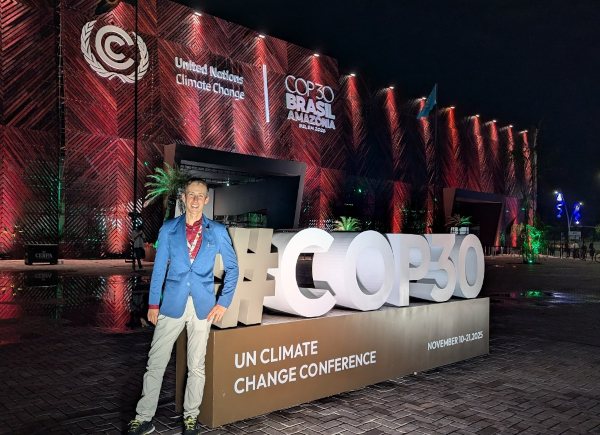
COP30 often felt less like a conference and more like an entire Amazonian city transformed into a vast arena of climate diplomacy, political negotiation, and societal debate. 29 agenda items discussed in the formal negotiations, 286 pavilions with hundreds of side-events in the Blue and Green Zone, and an uncountable number of parallel activities stretching across the wider city including the fantastic Peoples Summit and the March on Saturday. Capturing the full breadth of these interactions is impossible from any single vantage point. What follows is therefore a necessarily partial reflection, shaped by the encounters, observations, and research moments I experienced during my time in Belém.
This COP for me was anchored by different groups of people. My host family welcomed me into their home with warmth and kindness, grounding me during two intense weeks and reminding me every day of the local reality of climate governance far beyond the formal spaces.
Professionally, my COP30 centred on research the Global Stocktake (GST). More than 20 interview partners, representing all major negotiation groups, offered generous, reflective insights into the follow-up of the first Global Stocktake — insights that form a core part of our ongoing research.
Beyond my research, I conducted various side-events together with the German Institute of Development and Sustainability (IDOS) which shaped many of my reflections, linking institutional design questions to broader political debates. Further, discussions with my IDOS colleagues — Aparajita Banerjee, Darius Saviour Ankamah, Marcel Artioli —shaped my thinking . The cross-constituency GST Working Group brought diverse observer perspectives into the discussions, while conversations with friends from the Bonn Climate Camp ensured that justice-oriented perspectives and critique remained central.
Insightful not only for my students at the Rheinische Friedrich-Wilhelms-Universität Bonn but as well for me where the inputs on of Caterina Bittendorf on her experience as youth delegate in the gender negotiations, Eqram Mustaqeem on his perspective working as advisor for the Third World Network on Adaptation and Romie Niedermayer on the progress of UN Reforms.
Finally, this COP was shaped by being part of the CLIMACOP collaborative ethnography group with colleagues from the University of Hamburg and several institutions in Paris, including Stefan C. Aykut, Léa Lebeaupin-Salamon, Anna Fünfgeld, Eduardo Gonçalves Gresse, David Dumoulin and Lea Kammler. The joint reflections on different areas of COP helped me to make sense of many of the things I observed.
And yet, a necessary acknowledgement: none of us — and almost no one at COP — belongs to the communities most vulnerable to the climate crisis. Many of us benefit economically from attending. For a sharp critique of COPs and the culture of “toxic positivity ”about COP see here: With that positionality in mind, here are some reflections — inevitably incomplete.
Climate Consequences and Geopolitics: a Divide Within the Minority World
Increasingly I observe how the reality of climate consequences enter the negotiation halls. Parties and non-Party stakeholders alike spoke not only of policies and pathways, but about the loss of land, lives, heritage, ecosystems, food security, and dignity. These interventions increasingly came from Majority World Parties — especially those in the Alliance of Small Island States (AOSIS) and the Least Developed Countries (LDCs) — whose societies already face irreversible impacts.
A foundational element for understanding these negotiations is the centrality of historic responsibility with this context shaping negotiations ever since: who contributed most to the climate crisis, who must act first, and who suffers most. The failure of Annex I countries to reduce emissions in line with the Kyoto Protocol, and last year’s failure to deliver finance under the New Collective Quantified Goal (NCQG), left a residue of disappointment and eroded trust among historically differentiated groups.
This dynamic was intensified by the absence of the United States. Aside from a short visit by California Governor Gavin Newsom, the US was largely absent — both physically in the negotiation spaces and rhetorically in interventions. This silence stood in contrast even to Donald Trump’s first presidency, when subnational actors mobilised around the “We Are Still In” pavilion. The absence of the United States contributes to a divide within the Minority World (the Global North), with the European Union attempting to hold up mitigation ambition externally while facing increasingly critical domestic attitudes toward climate policy — exemplified by the EU’s last-minute Nationally Determined Contribution (NDC).
At the same time, the Majority World (Global South) is not monolithic. The long-standing image of a unified “G77 and China” bloc no longer captures the realities inside the negotiation rooms. While AOSIS and LDC countries confront existential threats, several countries within the Like-Minded Developing Countries (LMDCs) group emphasise economic development, energy security, or geopolitical considerations over ambitious mitigation. These differing priorities shape how principles such as Common But Differentiated Responsibilities (CBDR) and equity are interpreted and deployed.
Paris Agreement Follow-Up: Global Stocktake and Ambition Cycle
The COP30 cover decision does not explicitly include language on fossil fuels. Yet it directly refers to the outcomes of the first Global Stocktake (Decision 1/CMA.5), which does mention “transitioning away from fossil fuels in a just, orderly and equitable manner.” Thus, although not repeated in the cover decision itself, fossil fuels remain embedded within the Paris Agreement’s ambition cycle.
How Parties intend to follow up on GST outcomes — both internationally in agenda items outside the GST process and domestically in their Nationally Determined Contributions (NDCs) — is a key focus of our SNIS research project. Early insights suggest a complex pattern. The synthesis report indicates that 88% of submitted NDCs report being informed by the GST. We learnt that the African Union is planning guidelines to support the integration of GST recommendations into development policy. Many negotiators referenced specific GST paragraphs to bolster arguments for increased ambition. Others refrained from invoking the GST, perceiving it as too mitigation-centred — illustrating the political tensions surrounding GST follow-up.
Institutionally, COP30 adopted three decisions after years of negotiations. The long-awaited UAE Dialogue was finally agreed upon — a mechanism intended to track the implementation of GST outcomes, with particular emphasis on finance. The adoption of 59 indicators for the Global Goal on Adaptation (GGA) signals significant changes to how adaptation will be assessed and incorporated in future GST cycles. The cover decision also emphasises the importance of best available science and the role of the Intergovernmental Panel on Climate Change (IPCC), while explicitly inviting “comprehensive and representative scientific inputs from developing countries” within the procedural refinement decision, pointing toward evolving debates about expertise and knowledge legitimisation under the Paris Agreement.
Other Issues Reshaping the Landscape of Climate Governance
One of the most significant outcomes of COP30 was the adoption of the Belém Action Mechanism (BAM) for Just Transition. Many civil society actors — Indigenous organisations, labour unions, and social justice groups — welcomed BAM as a rare decision in which human rights, Indigenous rights, and workers’ rights were explicitly recognised as integral to transition planning. Although the mechanism’s operationalisation remains to be defined, BAM marks a shift and toward more socially grounded, justice-oriented transition approaches.
Another increasingly important theme was the intersection of trade and climate policy, especially discussions around the European Union’s Carbon Border Adjustment Mechanism (CBAM). CBAM places a carbon price on certain imports to prevent carbon leakage and align imported goods with the EU’s Emissions Trading System. Many Majority World countries regard CBAM as a disguised trade barrier that shifts mitigation burdens onto producers rather than consumers, challenges the principle of CBDR, and risks constraining industrial development. The European Union, in contrast, frames CBAM as necessary to protect the integrity of domestic climate policies. The divergence of these narratives indicates that trade will become an even more central — and contentious — arena in future climate negotiations.
The Brazilian Presidency also left a strong mark on COP30. Drawing on the concept of mutirão — collective mobilisation — Brazil led the process with determination and visibility. Importantly, this leadership must be understood in the context of domestic politics and upcoming elections, during which social movements and Indigenous organisations play a key role. COP30 saw strong Indigenous and civil society participation, both inside the Blue Zone and throughout Belém. After years in which such participation was restricted, it was remarkable and very good to see this level of engagement again.
Conclusion: Paris at a Crossroads in a More Complex World
COP30 revealed a deep paradox. The world is becoming more complex, with diverse interests both within and between the Majority World and the Minority World. Trust is fragile. Domestic political considerations shape negotiation positions. Geopolitical alliances shift more quickly than they did even a decade ago. And yet, Belém demonstrated again that the multilateral climate regime remains indispensable. There is no alternative forum where countries so unequal in responsibility, capacity, and vulnerability can deliberate over the greatest justice challenge of our century.
But having a forum is not enough.The Paris Agreement stands at a crossroads. Its future will depend on whether Parties can approach one another differently — with greater trust, political courage, and willingness to act decisively together.

Schreibe einen Kommentar