The Horizon 2020-funded project PRODIGEES (Promoting Research on Digitalisation in Emerging Powers and Europe Towards Sustainable Development) has successfully concluded after five and a half years of impactful international cooperation. The project explored how digitalisation impacts sustainable development across different continents.
Co-funded by the European Commission through its Marie Skłodowska-Curie Actions (MSCA) Research and Innovation Staff Exchange (RISE) programme, PRODIGEES brought together ten leading research institutes, think tanks, and universities across Europe, Latin America, Africa, and Asia to investigate how digitalisation can serve as a catalyst for and a challenge to sustainable development in governance, society, the economy, and the environment.
From January 2020 to June 2025, PRODIGEES implemented 74 research secondments, representing 149 person-months of transnational staff exchanges. The consortium’s work tackled a diverse range of critical topics — from artificial intelligence ethics and platform regulation to digitalisation of public infrastructure, climate technologies, and inclusive digital economies. The project produced an impressive 64 publications and policy briefs (with at least 12 forthcoming), 65 videos and online media, and over 140 lectures, seminars, and workshops. These outputs not only contributed to academic debates but also shaped policy dialogues through platforms such as the G20’s Think20 (T20), UN forums, the Network of Technology Assessment (NTA), the International Studies Association (ISA), the Global Young Academy (GYA), and more.
PRODIGEES was jointly coordinated by the German Institute of Development and Sustainability (IDOS) and Instituto Mora (MORA) Mexico. The wider consortium included the Austrian Academy of Sciences – Institute of Technology Assessment (OEAW-ITA) Austria, Centre for Strategic and International Studies (CSIS) Indonesia, Fundação Getúlio Vargas (FGV) Brazil, Istituto Affari Internazionali (IAI) Italy, Luiss Guido Carli University (LUISS) Italy, Research and Information System for Developing Countries (RIS) India, Stellenbosch University (SU) South Africa, and the University of Hamburg (UHAM) Germany. The collaboration was developed within and implemented in collaboration with the Managing Global Governance (MGG) Network, supported by Germany’s Federal Ministry for Economic Cooperation and Development (BMZ), and the Ministry of Culture and Science of North-Rhine Westphalia strengthening connections between Europe and global powers.
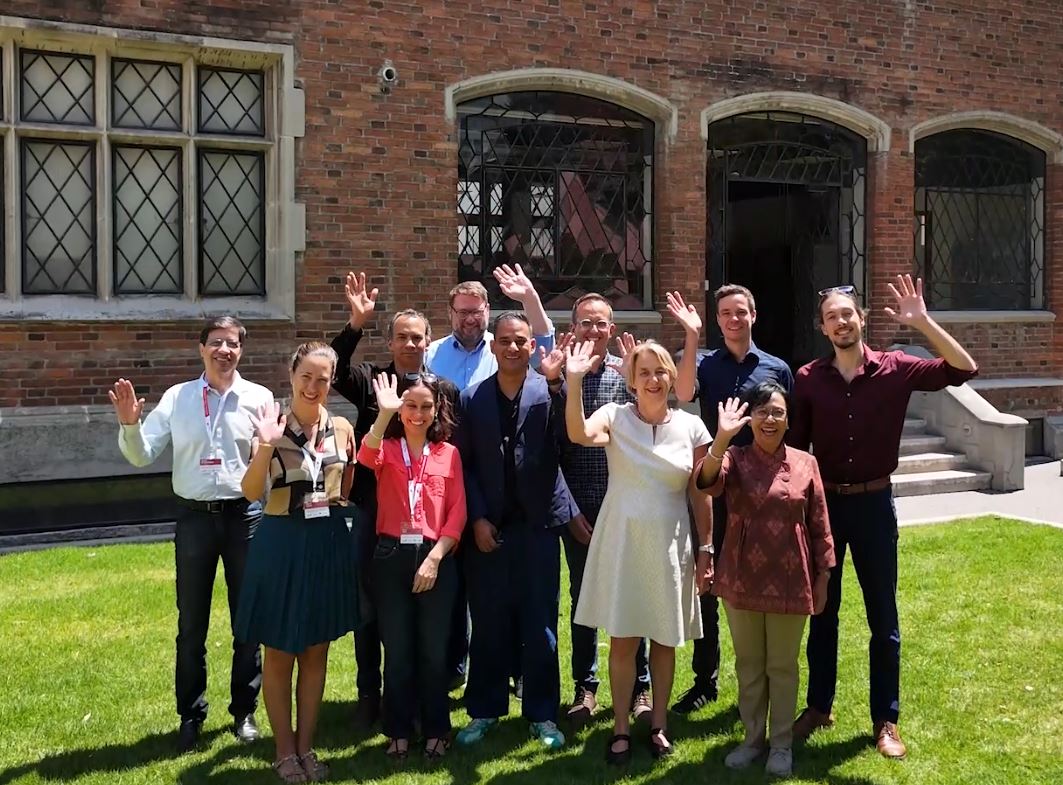
Network-wide events, including the innovative Transnational Open Access Trainings (TOAT), Authors’ Workshops, Policy Labs, and a well-received Final Conference at Instituto Mora in Mexico City, highlighted PRODIGEES’ commitment to inclusive, cross-sectoral dialogue. The project also established strong governance structures, including an active Steering Committee, represented by members of each partner institute, and an External Scientific Advisory Board, with contributions by Prof. Willem Fourie, founder of Stellenbosch University’s Policy Innovation Lab, and Arun Sharma, Senior Digital Development Specialist at the World Bank. These structures ensured accountability, quality, and strategic foresight throughout the project’s lifetime.
Key researchers across the network made notable contributions: Prof. Ingrid Schneider (University of Hamburg) advanced critical research on platform regulation and digital geopolitics; Dr Anita Breuer (IDOS) focused on information integrity and democratic resilience; and numerous others enriched the project’s interdisciplinary outputs. PRODIGEES leaves behind a robust legacy — with plans underway for a forthcoming open-access book and further collaborations on the digitalisation-sustainability nexus. All PRODIGEES products are available for view and download in the “PRODIGEES Research Community” repository on the open access platform, Zenodo. 

Schreibe einen Kommentar