Club governance formats were meant to work around blockages and challenges in the multilateral system. In a system under pressure, these have become more important. Simultaneously, they become embattled themselves in a political climate that has become more ruthless. Just after its presidence, South Africa has declared it would ”pause” its engagement in the G20 for 2026 after intense bullying by the US President. Yet, the existence of the G20 is based on the recognition that (financial) crisis of global scale require close cooperation among countries across the globe, going beyond the G7. That fact remains valid.
The G20 is a collection of key countries that have to engage with each other – and that Europe has to engage with – to push for solutions for global challenges. Yet, polarisations are making G20 presidencies increasingly challenging. How did the last four “Southern” presidencies – Indonesia, India, Brazil and South Africa – navigate the increasingly choppy waters? And which elements can we distil from deliberations as communalities?
G20 Presidencies 2022 to 2025: marked by crisis and decreasing trust in the international system
Over the last four years, globalisation and global cooperation have taken various blows: We saw a struggling economic order, with vulnerable global value chains and aggravated national debt crisis in several low-income countries, as a repercussion of the COVID-19 pandemic. Further, the outbreaks and escalations of armed conflicts – not least so Russia’s full-scale invasion of Ukraine in 2022 – put the world order and its key principles under massive pressure. Since January 2025, with the second Trump administration, we also see aggressive tariff policies, withdrawal from multilateral engagements and further questioning the current order based on international law. Much trust has been lost in the international system and cooperation has become more complicated.
Many international actors, for years, have been calling for fundamental reforms to the current global governance system, which was shaped after the Second World War and has not been updated to the current global setting. For instance, the international financial system makes it difficult for countries to consolidate their budgets when facing debt crisis. Questions persist whether the system is still fit for purpose. Consequently, systemic crisis shaped the G20 Presidencies between 2022 and 2025, who still aimed at communalities across presidencies.
Indonesian, Indian, Brazilian, and South African leadership aspired to raise issues relevant to low and middle-income countries. Indonesia, despite Russia’s escalating war against Ukraine, kept the group intact and despite strong frictions facilitated a joint (!) G20 Leader’s Declaration. India managed the admission of the African Union (AU) to the G20 by 2023, making for a better representation of African countries– and thus lived up to a recommendation repeatedly brought forward by Think20 (T20) experts since 2017. Building on the AU’s inclusion, Brazil focused on representation of think tanks beyond G20 countries, especially from Africa, in 2024, and initiated the Global Alliance Against Hunger and Poverty. South Africa, as the first G20 Presidency “on African soil”, promoted “Solidarity, Equality, Sustainability” as this year’s G20 theme, in an attempt to set positive principles, countering crisis. South Africa’s leading think tanks for the T20 process chose the theme “consolidate and sustain”.
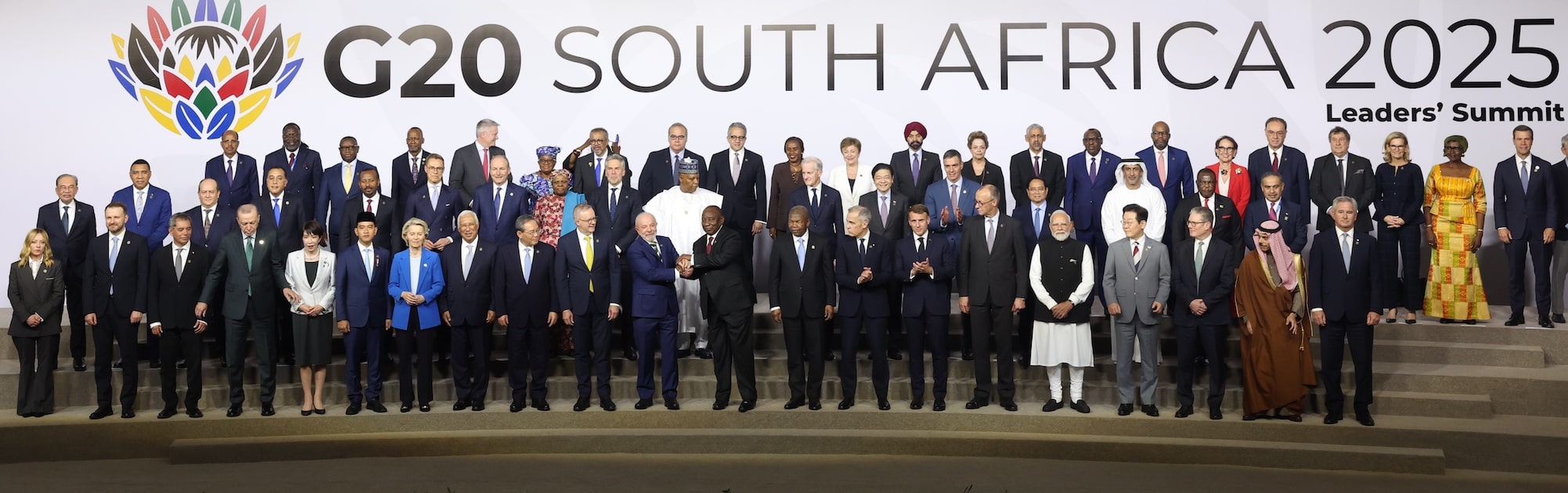
The absence of several heads of state – among them those of China, Russia, and the US, with the latter continuing to challenge South Africa’s role based on false allegations – hampered the G20 Summit in Johannesburg. Yet, the G20 is more than a heads of state club as activities around it are also indicative of debates. The T20, for instance, comprises policy-oriented think tanks from across the globe – and provides evidence-based policy advice.
T20 – think tanks and proposals to reform global institutions
With the four consecutive “Southern” presidencies, “Southern” think tanks led the T20, too. In the communiqués that condense the work of each T20 process, recommendations throughout all four processes call for the leaders of the G20 to ensure and enhance cooperation on reforms of (1) global governance structures and (2) the multilateral trading system.
- Modernising the international order
Published in the direct aftermath of COVID-19, the Indonesian T20 Communiqué called for a general modernisation of the international order to account for the interests of developing countries, and to be able to address “global problems as climate change and future pandemics”. The Indian T20 process specified this call suggesting the establishment of an expert group by the G20 to develop concrete proposals for global governance reform, a “roadmap for ‘Multilateralism 2.0’”.
The recommendation, inter alia (and not surprisingly), explicitly refers to a reform of the UN Security Council, which experts in the Brazilian T20 process took up. Both countries have ambitions for a permanent seat at that table. Building on the recommendation of establishing an expert group, the Brazilian T20 Communiqué formulates the idea of establishing a permanent task force on UN reform within the G20 Sherpa Track.
- Ensure cooperation in the multilateral financial and trading system
The general call for more representation for low- and middle -income countries goes along with specific recommendations for the reform of multilateral procedures at the IMF and WTO. The Indonesian T20 Communiqué called for a “new Bretton Woods”. The recommendations especially highlight the importance of a change in the quotas of IMF special drawing rights (SDR) in favour ofl ow-income countries, who are currently only allocated 3.2% of the USD 650 billion that the IMF allocated in total in SDR in 2021. Underlining the call for a reform of the IMF quota system, the Brazilian T20 process also published an Implementation Roadmap to reform the G20 Common Framework for Debt Relief that links its outcome to the recent G20 Leaders’ Summit of South Africa.
Recommendations to reform the multilateral trading system and the international financial architecture formulated in the T20 processes under the Indonesian, Indian, Brazilian and South African G20 Presidencies call for structural adjustments to develop more fair and cooperative processes. India, for instance, proposed that the G20 “tasks” the WTO with coordinating an agreement to reform trade rules, with G20 meetings as regular reporting occasions. The High-Level Recommendations published during the South Africa T20 Midterm Conference recommends strengthening the WTO secretariat. These calls can be read as commitments to existing multilateral institutions and processes.
Urgency in building on policy proposals
The four T20 processes under the G20 Presidencies between 2022 and 2025 reaffirmed that reforms are needed in the multilateral system. Questions remain about rising powers’ increasing global responsibilities, and how they are exercised, e.g. with regard to G20 countries’ role in the international financial system. Recommendations by experts from leading research organisations consider it crucial to make the multilateral global governance system fairer and more fit to address global challenges.
The G20 South Africa Leaders’ Declaration, adopted at the Johannesburg Summit on 22 and 23 November, makes reference to enhancing the international financial architecture as well as to the reform process of the United Nations, UN80. The text also refers to the G20 Call to Action on Global Governance Reform, adopted under the Brazilian G20 Presidency in 2024. The absence of the US government as next chair of the G20 in 2026 at the Summit in Johannesburg leaves little room for optimism that further steps will be taken in these areas in the coming year. And yet, Europe would be wise to continue engaging on the substance elaborated in the T20 process.
The G20 will become more difficult, if not dysfunctional in 2026. From a European perspective, it is all the more important to keep in dialoge with so-called “rising global powers”, and particularly seek partnership of the middle-powers. Building and expanding these alliances is in Europe’s vital interest. Consequently, European actors should actively take up reform proposals that are already on the table. In this line of thinking, it is obviously unwise to exclude African representation from the next G20 meeting, be that South Africa or the often-ignored African Union. Engaging for a legitimate international order is in Europe’s crucial interest in an increasingly multipolar global setting.

