
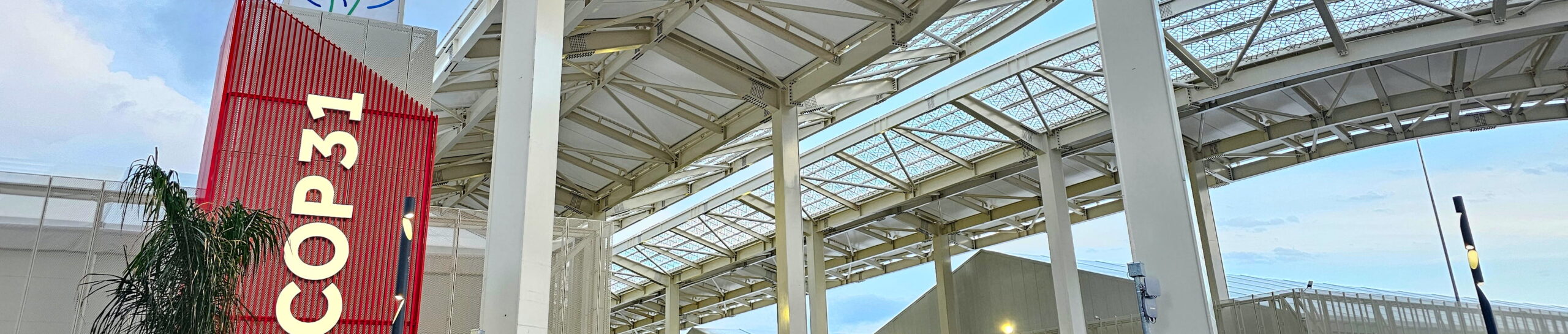
In the second week of the UN climate conference – COP31 – in Antalya, Pacific delegates continue to demonstrate their leadership in global climate policy, pushing for ambitious outcomes. Meanwhile, the EU’s current high-level political focus seems adrift from the urgency of the climate crisis affecting the Pacific region. This has implications for the EU’s global role, both directly in the Pacific region and beyond, and links to the ongoing EU budget discussions.
Core agenda item at this year’s COP negotiations and action agenda is access to finance. Australia, as holding COP31 co-presidency, launched an Access to Finance Statement and Action Plan, while Pacific countries held a pledging event for the Pacific Resilience Facility (PRF), which has emerged from long-standing challenges in accessing international climate finance in the region. Referred to as Small Island Developing States (SIDS) under the United Nations Framework Convention on Climate Change (UNFCCC), Pacific SIDS steward large parts of the Pacific Ocean. 22 Pacific countries and territories represent about 20% of the Exclusive Economic Zones globally – making them the Large Ocean States of the Blue Pacific Continent. Climate change is their greatest challenge.
The Pre-COP31 in Fiji in early October 2026 – a preparatory meeting held before the 31st UN Climate Conference (COP31) in Antalya – sought to build high-level political momentum for Pacific countries in global climate policy. With average annual adaptation finance needs from 2023 to 2035 in the region estimated at USD 2.5 billion, and an annual average funding gap of at least USD 1.6 billion by 2035, climate finance – especially for adaptation – was a core priority on the Pre-COP31 agenda. Pacific countries endorsed the Taku Pakasoa Declaration – a call for unity and action to keep 1.5°C within reach.
COP31: a sobering moment for EU’s international cooperation on climate change?
At the COP31 Antalya Leaders‘ Summit, Ursula von der Leyen highlighted the EU’s emissions targets, support for the 35-by-35 Global Electrification Pledge – 35% of power being electrified by 2035, which is a flagship initiative of the Turkish COP Presidency, and global partnerships for a clean transition. Notably, however, she made no reference to the Large Ocean States, co-hosts of the pre-COP meetings, or to their COP31 priorities, particularly on ocean action, adaptation and access to finance. These areas of international cooperation are largely losing attention in the EU’s political narratives. In her State of the Union address in September 2026 – an annual speech by the President of the European Commission to the European Parliament outlining her political priorities – von der Leyen made little reference to multilateral and bilateral partnerships with the Global South, instead emphasising competitiveness, security, and defence as means toward Europe’s strategic autonomy. Climate-related points focused on domestic ambition, not the EU’s global role.
While the PRF may seem a minor issue from a Brussels perspective, it is illustrative of the EU’s credibility risks. The PRF capitalization so far is a missed opportunity for the EU to demonstrate commitment to improving access to climate finance. The PRF is the first climate and disaster financing facility owned and governed by Pacific states, offering direct access to finance for local level interventions; its capitalisation target of USD 500 million remains roughly USD 300 million short. Although financial pledges have been made by several EU member states (including Germany and France among few other), the European Commission’s pledge was missing; support was instead facilitated by a „Team Europe“ approach with the current EU Council Presidency Ireland announcing EUR 2.65 million in additional funding, on top of its previous pledge of EUR 3 million.
This outcome says much about the wider state of multilateralism. UN climate change funds are struggling to secure fresh finance, and the EU faces challenges of its own: another round of budget negotiations begins just days after COP31 – the next Multiannual Financial Framework (MFF) for 2028–2034, which will define the funding architecture of the EU’s future external action, including on climate.
Will the next 7-year EU budget fall short on climate finance for the Blue Pacific Continent?
Heated debates on the draft MFF budget 2028-2034 during the previous meetings in Brussels centred on budget size, public finance sources, and allocation between competing domestic and geopolitical priorities. Funding for the external action pillar – Global Europe – remained in the background with reduced budget in the new proposal by the Irish Presidency from 17.1 billion EU to EUR 12.9 billion EUR for the Asia and the Pacific funding window. This is an increase from the current regional envelope of 8.48 billion EUR (2021-2027), though in real terms the value of the proposed budget is much lower.
MFF decisions are made with wider considerations in mind, but they will shape the EU’s climate finance provision broadly and beyond funding volumes alone. In the Pacific region, climate finance has been a key pillar of EU-Pacific cooperation under the current budget cycle. Between 2021 and June 2026, the European Commission has approved geographic projects covering 13 Pacific Island Countries and Papua New Guinea worth approximately 461 million EUR, of which 83 per cent targeted climate change adaptation and/or mitigation as significant or principal objectives (own estimates**).
In particular, the proposed budget framework marks a major restructuring of the Global Europe pillar – with implications for the credibility of the EU’s global role that reach much further.
First, the draft budget creates uncertainty about the scale and predictability of climate finance. Currently the EU delivers climate finance mostly through global and geographic programmes under the Neighbourhood, Development and International Cooperation Instrument (NDICI) – Global Europe – whereas the European Fund for Sustainable Development Plus (EFSD+) is the dedicated instrument for finance mobilization at scale through technical assistance, investment grants, and de-risking instruments. The proposed Global Europe instrument will merge NDICI, humanitarian aid, and pre-accession assistance into a single, geographically focused instrument – in other words, funds would flow into one pot, with a flexibility mechanism that reallocates resources. It places a much stronger emphasis on flexibility – and, with it, programmable funding, including climate finance, will become less predictable for partner countries.
Second, the shift from traditional development cooperation toward an investment framework narrows access to adaptation finance. Across the Pacific region, the EU is already repositioning itself – not as a development partner, but as a long-term strategic investor through its Global Gateway strategy and in direct competition with, inter alia, China. The strategy foresees investments in digitalisation, clean energy and climate, transport, health systems, and education and research, signalling the EU’s prioritisation of infrastructure, the private sector, and trade as key areas in which climate considerations could be mainstreamed. This shift comes with an increase in non-grant instruments such as guarantees and blended finance. Yet most Pacific Island Countries have low appetite for debt, and given their diverse economies and national circumstances, this strong focus on large-scale investment projects could limit access to funding suited to local needs and realities, particularly for adaptation measures.
Third, the proposed framework introduces new provisions on who can access and deliver climate finance. It prioritises European actors in delivering EU finance – including through direct grants and procurement, as well as indirect management of projects – which would negatively affect access for regional, national, and local institutions. Under the EU’s „Buy European“ shift, the Commission could award grants directly to EU companies without calls for proposals, and further provisions favour European firms in the name of competitiveness and strategic autonomy. This is in tension with key commitments on climate finance and country ownership under the UNFCCC. A large share of climate finance to Large Ocean States in the Pacific has already been channelled through international intermediaries, particularly EU Member State organisations, multilateral and development finance institutions – a trend that would be reinforced under the current proposals.
The future of the EU as an actor in the Pacific
As powers like China and the US compete for influence in the Pacific – from missile tests and military presence to deep-sea mining interests – the EU has a strategic interest in leveraging its regional cooperation towards a stable world order. In this regard, the EU should offer an alternative model of engagement based on values and principles enabling long-term sustainable development rather than geopolitical competition. Climate diplomacy has clear implications for EU credibility in a key policy area and for the Union’s engagement in a multilateral system under pressure. This matters particularly in the Pacific – the next MFF will ultimately determine whether the EU will meet its commitments under the UN climate change regime, including tripling adaptation finance and improving access.
* Pacific Island Countries: Cook Islands, Federated States of Micronesia, Fiji, Kiribati, Marshall Islands, Naoero, Niue, Palau, Samoa, Solomon Islands, Tonga, Tuvalu, Vanuatu.
** Based on own analysis of the EU’s project portfolio.