
Gender‑responsive and locally grounded water governance proves key to fair and effective development.
Development cooperation needs to be effective, and the water sector highlights that efficiency must serve equity to foster development. Across several events and publications, and together with external experts, the IDOS water team demonstrated how inclusive water governance — built on gender mainstreaming and local actors and knowledge — supports development across sectors and communities.
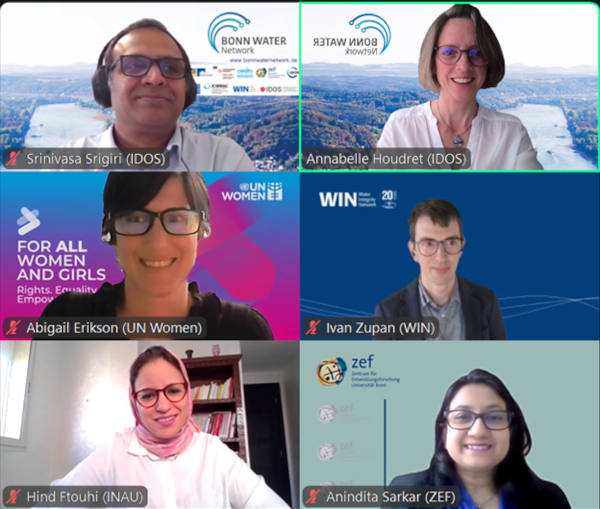
In line with the UN World Water Day 2026 theme Where water flows, equality grows, a Current Column by Bonn Water Network’s Annabelle Houdret (IDOS) and Anindita Sarkar (ZEF) highlighted that water management has become increasingly feminised in practice — particularly where male out-migration has left women managing the resource. And where women are involved, water systems perform better. Governance systems that exclude women misread local realities and misallocate resources — an observation confirmed in IDOS’ recent policy brief and in the online debate Against the current: how water access affects women and men differently, organised on the occasion of World Water Day 2026 by the Bonn Water Network (available online here). Panellists from UN Women, the Water Integrity Network, the Centre for Development Research, and Morocco’s Institut National d’Aménagement et d’Urbanisme agreed that closing the gender gap in water access requires not just technical investment but a fundamental rethink of who holds power in water governance — and whose knowledge counts. Investing in women’s participation in water governance is a development imperative, not a social nicety.
Effective development cooperation must also build on local actors and their knowledge and capacities, as this enables opportunities to be leveraged across actors and scales. With discussions on a post-2030 agenda taking shape, a recent publication by IDOS and external authors argues for a paradigm shift, drawing lessons from SDG 6. New approaches should move away from homogeneous, technical, infrastructure-based responses and toward pluralistic, power-informed approaches that recognise the diversity of needs, knowledge, and experiences around water.

Schreibe einen Kommentar