From 26 to 29 August, the general conference of the European Consortium for Political Research (ECPR) brought together scholars to discuss cutting-edge political research from around Europe. It took place at the Aristotle University of Thessaloniki, Greece. IDOS researchers contributed to the conference with insights on current research projects.
The influence of sustainability institutions in Germany and Europe
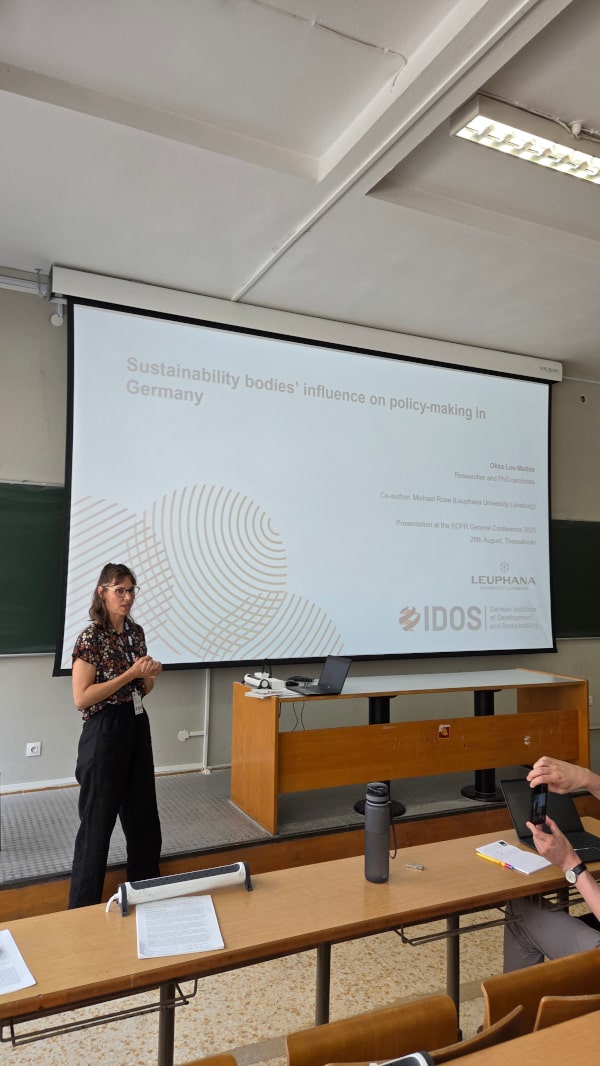
IDOS researcher Okka Lou Mathis, together with Dr Michael Rose from Leuphana University Lüneburg, organised a double-panel titled “The Polity of Sustainability”. In the panel, they focussed on preconditions, institutions and bodies promoting a political shift towards sustainability. The discussions brought attention to the often-ignored colonial roots and dependencies of the environmental state. They also explored the ambiguous reactions of policymakers to climate policy proposals from democratic innovations like citizens’ assemblies. Okka Lou Mathis presented a case study on sustainability bodies in Germany. She highlighted good examples but also pointed to the limits of these institutions’ effective political integration and their substantial impact on wider policy-making. The research contributes to the Klimalog project’s goal of identifying drivers and barriers to implementing the Paris Climate Agreement alongside the Agenda 2030 for Sustainable Development.Chances and challenges for reforming the social contract in Columbia
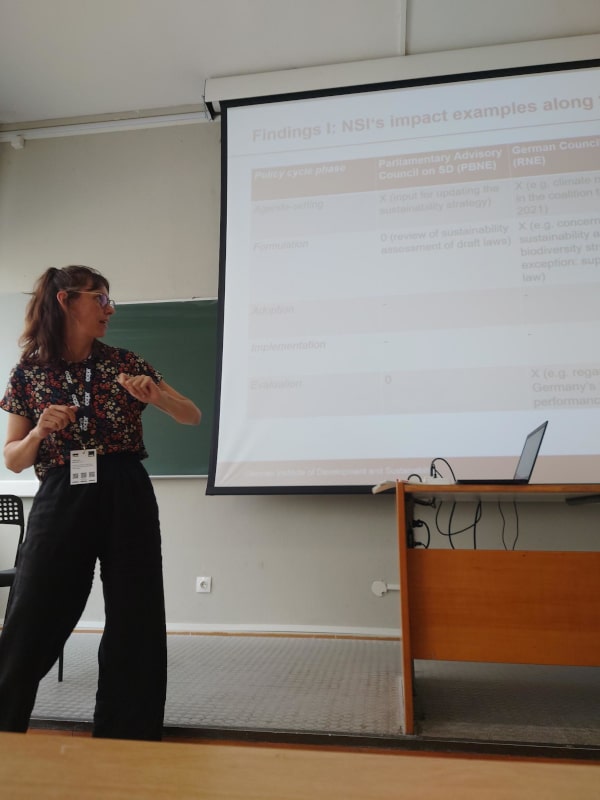
IDOS researcher Mauricio Böhl Gutierrez presented his work on the opportunities and challenges of reforming the social contract in Colombia. A growing body of literature highlights the potential of a renewed social contract to address global sustainability and inequality crises. Building on this debate, Mauricio Böhl Gutierrez offers an empirical study of negotiations with key stakeholders on phasing out fossil fuel subsidies and their positions regarding a renewed agreement for this aspect of Colombia’s social contract. His findings show that the transition toward a new social contract in Colombia faces significant challenges, most importantly the lack of a broad and non-partisan policy vision that all stakeholders support. While participants expressed support for the transition in principle, they also voiced scepticism about the government’s capacity to deliver the necessary changes. The Colombian case offers lessons for other countries: reform efforts are more likely to succeed if they build on existing policy programmes rather than relying solely on new, partisan initiatives.
Improved integration of climate protection and biodiversity conservation through geodata
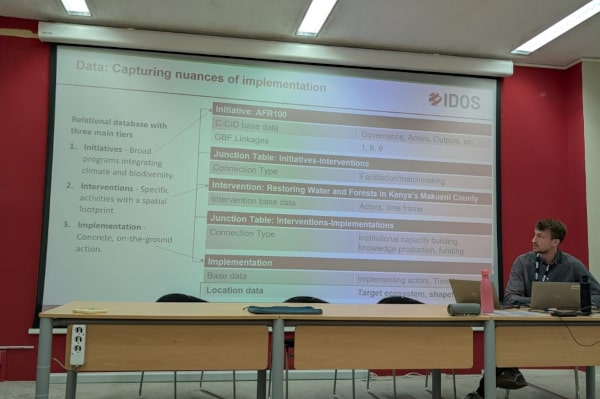
IDOS researcher Paul Hagenström presented research on spatialising action data to understand and advance climate and biodiversity integration in a panel session organised by IDOS associated researcher Dr Sander Chan. Against the background of the BioCAM4 project, the presentation highlighted the urgent need to better align voluntary climate action with biodiversity goals. The main argument of the presentation was that spatial data plays a key role in improving both accountability and credibility of cooperative initiatives at the intersection between climate and nature. Paul Hagenström argued that without explicit information on where actions are implemented, important subnational processes remain invisible, limiting the ability to link interventions to outcomes and weakening monitoring and evaluation efforts.
At the conference, IDOS researchers also took the opportunity to broaden their networks by connecting with the ECPR Standing Groups on Environmental Politics as well as Energy Politics, Policy and Governance.

Schreibe einen Kommentar