The report, presented on 8 October, highlights the need for reform and recommends specific measures to policymakers.
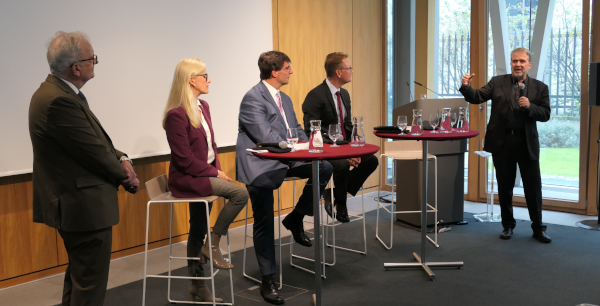
©FiFo_Köln_Tom_McKenzie
Tax expenditures account for a significant share of government spending in Germany. In 2026, they amount to 76.5 billion euros, which corresponds to approximately 1.7 percent of the gross domestic product. With the new Tax Expenditures Country Report Germany – presented on 8 October 2026 at the Representation of the State of North Rhine-Westphalia in Berlin – authors Dr Michael Thöne (Research Institute for Public Finance at the University of Cologne, FiFo Köln) and Dr Christian von Haldenwang (German Institute of Development and Sustainability, IDOS) examine the German practice regarding transparency and governance. The report is part of the „Tax Expenditures Country Reports“ (TECRs) series published by the Council on Economic Policies (CEP) and IDOS, which currently comprises twelve such country studies.
In Germany, tax expenditures are currently the subject of intense political debate. Yet, as the country report reveals, it is hardly possible to gain a reliable overview of the full range of these measures. The federal government’s official subsidy report is incomplete, as the criteria used to define tax expenditures are significantly more restrictive than those typically applied internationally. Furthermore, even the measures covered fail to provide a complete picture: for 43 percent of them, there are no cost estimates available at all.
Dr Marcus Optendrenk, Minister of Finance for the State of North Rhine-Westphalia, states: „Anyone wishing to reform tax expenditures should bundle various measures into reform packages, ensuring that the burden is distributed more broadly and equitably. A “lawnmower” approach – which cuts useful and questionable measures alike – would be the very antithesis of sound, reliable fiscal policy.“
Against this backdrop, the new report recommends several key measures. First, existing ambiguities regarding the reference tax system must be resolved. This should also ensure that tax expenditures are no longer viewed solely in the context of economic objectives, but that social and other policy goals are also taken into account. In line with international standards, reports on tax expenditures should be submitted to and approved by parliament as an integral part of the annual budget. Finally, clear evaluation requirements with broad coverage and regular intervals should be established and subsequently implemented in practice.
„Our report clearly highlights the knowledge gaps and ambiguities present in current reporting on tax expenditures in Germany. Yet, there is already sufficient information available to start reforming existing measures that have proven ineffective or even harmful,“ concludes Dr Christian von Haldenwang (IDOS), co-author of the report and co-director of the Tax Expenditures Lab.
Dr Michael Thöne, Director of FiFo Cologne, also emphasizes that tax expenditures should be at the heart of the current debate on fiscal and tax policy: „The federal government is squabbling over a tax on sugary drinks—a measure that would generate a mere 1 billion euros annually. Meanwhile, we could mobilize twelve times that amount by trimming back outdated tax privileges and eliminating tax subsidies that have been shown to be ineffective. The recent ‚fuel discount‘ – applied indiscriminately to everyone – should serve as the final example of a subsidy policy that we can no longer afford.“
