AMR strategies in three countries reveal a common pattern: environmental actors lack authority, resources and mandate to shape policy.
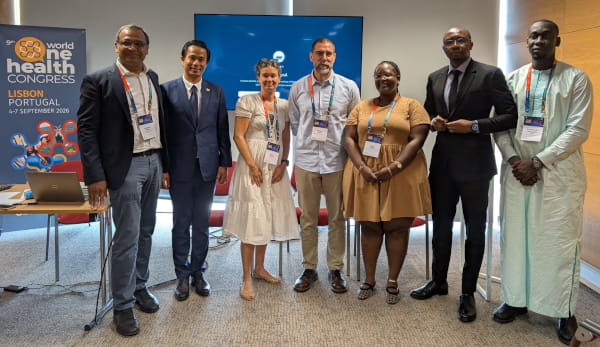
At the 9th World One Health Congress in Lisbon (4 – 7 September 2026), IDOS co-convened a science-policy session examining institutional and governance entry points for embedding the environmental dimension into the national antimicrobial resistance (AMR) mitigation strategies.
The session brought governance research from three countries into dialogue with policy practitioners. A keynote by Jacqueline Alvarez (AMR Multi-Partner Trust Fund) framed the global governance landscape, followed by research inputs on Senegal, Cambodia, and Tanzania. Dr Srinivasa Srigiri (IDOS) presented findings from a polycentric governance analysis of Cambodia’s AMR strategy. Across all three cases, a shared pattern emerged: while One Health coordination structures exist, environmental actors lack the authority, resources, and regulatory mandate to shape AMR policy. In Cambodia, environmental integration risks being deferred when activities follow partner priorities rather than a nationally owned plan. In Senegal, AMR governance remains focused on antibiotic use, overlooking environmental and structural drivers. In Tanzania, a low-cost composting intervention showed that environmental AMR can be operationalised when linked to national standards and financing mechanisms.
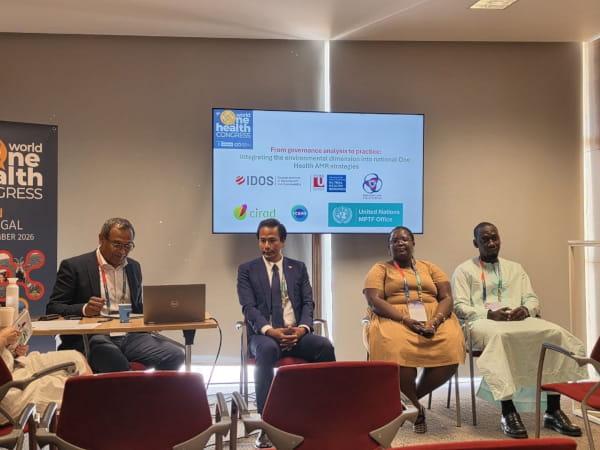
A panel discussion, moderated by Srinivasa Srigiri, brought together AMR governance experts from Cambodia, Senegal, and Rwanda. Panellists emphasised that representation alone is insufficient. Environmental actors need decision-making power, not just a seat at the table. Funding structures themselves were identified as a driver of asymmetric progress across sectors.
