International experts discussed perspectives and opportunities for cooperation beyond the 2030 Agenda.
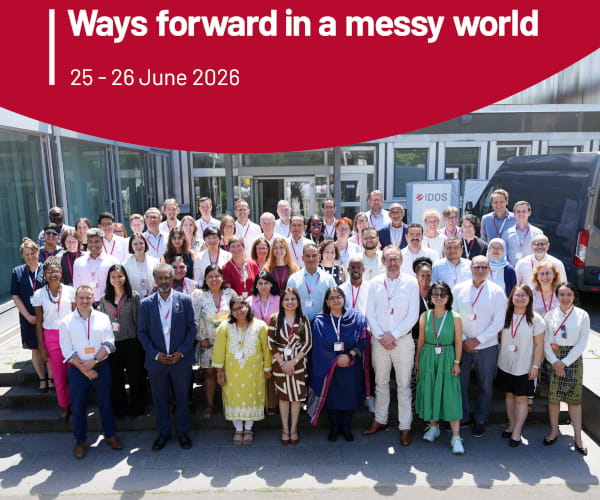
With only four years remaining until the deadline for the UN’s Agenda 2030, the latest assessments reveal a stark reality: the world is far from achieving these ambitious targets. Meanwhile, multilateralism is facing unprecedented challenges. Against this background, IDOS organised a conference titled “Sustainability cooperation beyond 2030 – Ways forward in a messy world” on 25 and 26 June 2026.
The conference built a bridge to discussions at the Hamburg Sustainability Conference on 29-30 June 2026 and to formal international discussions scheduled to start at the Sustainable Development Goal Summit in September 2027. Its objective was to assess the importance and impact of shared global goals, draw lessons from the implementation of Agenda 2030, and explore the partnerships and forms of cooperation required to establish a beyond-2030 framework.
Developing such a framework requires perspectives and expertise from various sectors, disciplines, and world regions. To achieve this, IDOS brought together more than 70 experts from diverse academic disciplines and countries. Many participants are long-standing partners and/or alumni from the networks Managing Global Governance (MGG), Shaping Futures and beyond. Designed as an interactive event, the conference fostered in-depth dialogue and exchange among experts on sustainability cooperation in an era marked by volatility and uncertainty.
The conference opened with welcoming remarks by Prof Dr Anna-Katharina Hornidge (Director of IDOS), followed by a keynote address from Csaba Kőrösi (President of the 77th United Nations General Assembly). Prof Dr Archna Negi (Jawaharlal Nehru University) and Dr Fabio Veras Soares (Institute of Applied Economic Research) provided additional insights and reflections on the achievements and shortcomings of Agenda 2030. The conference was moderated by Dr Sven Grimm, Dr Chris Büscher, Dr Wulf Reiners, Dr Tatjana Reiber, Eva Lynders, Matthias Kachelmann, and Vy Dang.
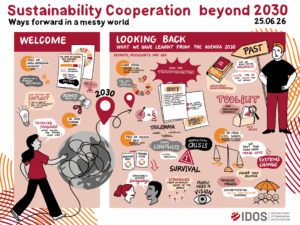
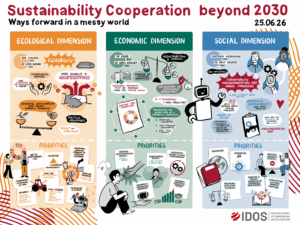
During the first day of the conference, participants explored emerging opportunities and challenges that are likely to shape a beyond-2030 sustainability framework. Discussions highlighted issues that were not central to Agenda 2030 but will be crucial in the future, particularly digital transformation and artificial intelligence. Participants also identified shared priorities across the three core dimensions of sustainability – economic, ecological, and social – with governance as a cross-cutting dimension.
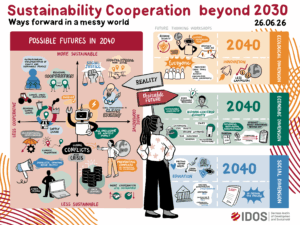
On the second day, discussions shifted to futures in 2040. Through futures-thinking exercises, participants explored different possible futures for 2040 and assessed their implications for the priorities identified on Day 1. They jointly developed visions and profiles of desirable futures that inspire action and chart pathways towards sustainability cooperation. Discussions also focused on how to build momentum for 2027 (and beyond) and highlighted the partnerships and forms of cooperation that hold the greatest promise for governing the global commons in a rapidly changing world.
The event was funded by the Federal Ministry for Economic Cooperation and Development (BMZ) and the Ministry of Culture and Science (MKW) of the State of North-Rhine Westphalia.

Schreibe einen Kommentar