
Syria is caught between emergency and stabilisation. Reconstruction can only succeed if reforms move forward in parallel across key sectors.
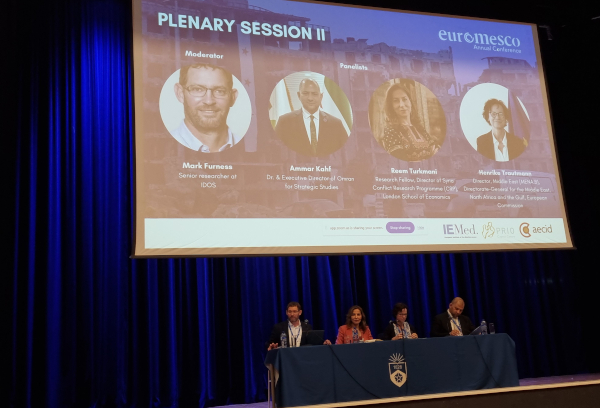
Syria’s reconstruction and the role of donors were at the centre of the panel discussion organised by the IDOS MENA team at the Annual Conference 2026 of the Euro-Mediterranean Study Commission in Cyprus, 4–6 June. The speakers examined how international cooperation can be structured in fragile settings, where reconstruction goes beyond technical and financial challenges. Moderated by Dr Mark Furness (IDOS), the panel brought together Dr Ammar Kahf (Omran Center for Strategic Studies), Dr Reem Turkmani (LSE), Henrike Trautmann (European Commission, DG MENA) and Farah Al Shami (Arab Reform Initiative).
The discussion showed that Syria is not yet in a post-conflict reconstruction phase, but between emergency and stabilisation. Encouraging signals include renewed EU cooperation, sanctions relief, regional investment and mostly restored electricity supply. Yet recovery remains below citizens‘ expectations, transitional justice is slow, and reconstruction risks becoming externally driven without a strong internal agenda. Funding is not the main bottleneck — and sequencing support is unrealistic, as state-building, justice, economic recovery and social protection must advance in parallel.
The moment was described as a historical opportunity for Europe, the diaspora and a much-expanded civil society. At the same time, concerns were raised about centralising tendencies of the transitional authorities and about European engagement that remains too state-centric and ad hoc. Calls were made for a clearer EU strategy with benchmarks at national and local levels, placing women and Syrian expertise at the centre, prioritising security sector reform and mobilising the diaspora.
The EU’s emerging approach rests on technical assistance, support for transitional justice and civil society, and eventually investment. Time pressure is high: Syrians need to be convinced that Europe’s interest lies in rebuilding the country, not in returning refugees. Drawing on Lebanon’s experience, the panel warned against sidelining social protection and allowing elite capture.

Schreibe einen Kommentar