
To mark Desertification and Drought Day 2026, the INTERFACES team at IDOS convened a panel on rangeland restoration, highlighting the importance of recognising and respecting community knowledge.
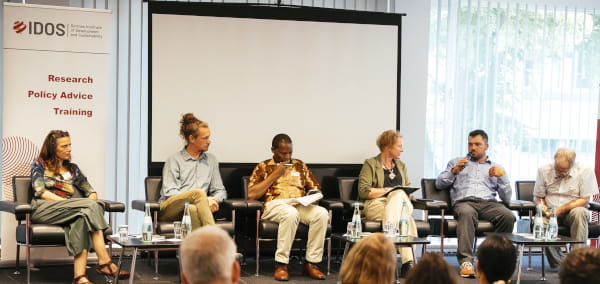
Rangelands cover more than half the world’s land surface, yet they remain among the most misunderstood and undervalued ecosystems on earth. On 17 June, the INTERFACES team at IDOS, together with Let’s Plant! e.V. and GIZ Livesys, brought together scientists, policymakers and practitioners in Bonn for a Science-Policy-Practitioners’ Dialogue. The discussion focused on why desertification and drought continue to advance and what measures are needed to halt this trend.
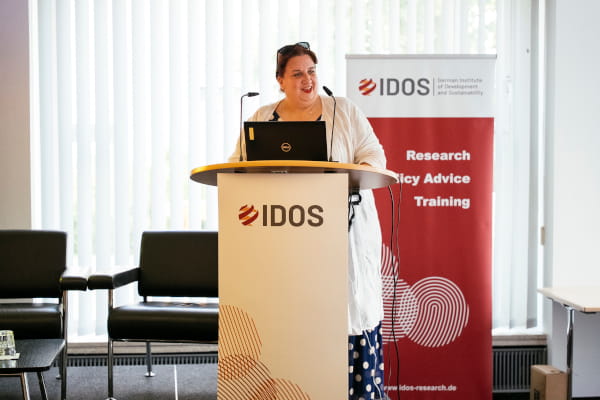
Following welcoming remarks from IDOS Director Prof. Anna-Katharina Hornidge and BMZ Senior Policy Advisor Jan Brix, keynote speaker Louise Baker of the UNCCD set a hopeful but urgent tone: pastoralists, including women and youth, can be the „architects of their own future“, but only if the knowledge, investment and political will exist to support them. A Rangeland Flagship Initiative to be launched at UNCCD COP17 in August 2026 aims to provide exactly that compass for the next decade.
What followed was a conversation that moved fluidly between continents and lived experiences. Prof. Brigitte Kaufmann, a researcher on African pastoralism, and Johannes Bois, a local German shepherd, found striking common ground: pastoralism is a family enterprise, and the knowledge it rests on is passed from parent to child, embedded in daily tasks that outsiders rarely see or value. Women in particular, as Kaufmann, Bois and Bernard Kimoro — a Kenyan policy maker heading the Climate Change and Livestock Sustainability Section at the State Department for Livestock Development — all noted, carry indispensable roles from managing young animals, milk and fodder, to organising community activities. In all discussed circumstances, pastoralism fulfils important ecosystem services, notably for biodiversity. These roles and services, however, remain largely invisible in academic research and policy alike. As Kaufmann put it, studies need to be done with pastoralists, not on them.
Anthony Denayer of Vétérinaires Sans Frontières Belgium grounded this in practice: by supporting local institutions in Uganda to engage with a mining company on equal terms, communities were able to assert their land rights. Denayer’s broader point that lasting change comes from helping communities formalise what they already know, found an echo in Kimoro’s account of Kenya’s experience: locally-led committee structures, he noted, consistently prove more effective than top-down intervention. The same logic applies to restoration. Kaufmann’s InfoRange project, in co-design with the local communities started using drone imaging to track invasive species in Kenya and Namibia that were originally introduced for erosion control but now overwhelm the local ecosystems, a costly lesson in what happens when interventions bypasses community knowledge. Bois gave the challenge a European face: as herding rights come under pressure in the state of North Rhine-Westphalia, traditional knowledge risks disappearing before it can be recognised for what it is.
A key take-away message from the evening was that rangelands can only be restored if the people who steward them—and the knowledge they hold—are recognised and respected first.
The activities of the accompanying project INTERFACES and the four regional projects, COINS, DecLaRe, InfoRange and Minodu are funded by the Federal Ministry of Research, Technology and Space (BMFTR) as part of the platform strategy Research for Sustainability (FONA). Further information on the projects can be found on our website and on the FONA-Website.

Schreibe einen Kommentar