A practitioner dialogue explored how translating between diverse views of „nature“ can strengthen cooperation across the Rio Conventions.
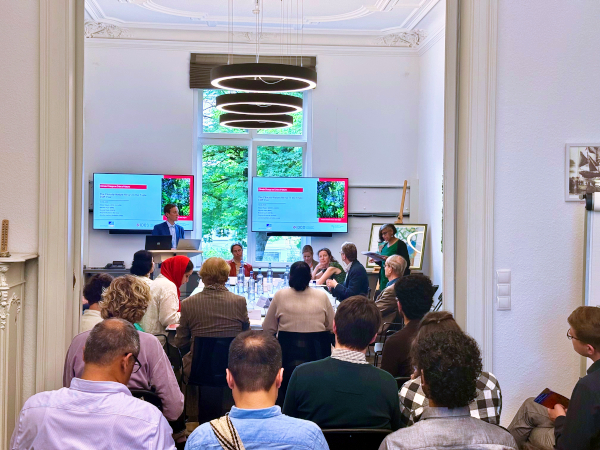
Co-organised by IDOS on 12 June 2026, the dialogue explored how the Rio Conventions understand „nature“ differently—and what that means for achieving synergies in the Triple COP year.
Moderated by IDOS researcher Niklas Wagner, the panel brought together Claudia Hiepe (German Ministry for Economic Cooperation & Development), Melanie Coath (RSPB), and Jennifer Lenhart (Ambition Loop) to examine a central paradox: the same word „nature“ circulates across the UNFCCC, CBD, and UNCCD, yet each encodes fundamentally different meanings. The UNFCCC frames nature primarily as carbon; the CBD as biological diversity; the UNCCD as land for survival.
The panel was opened by referencing indigenous scholar Ailton Krenak’s insight that the nature/culture divide is itself a Western, colonial separation. The session then turned to practitioners‘ experiences: what structural changes would help bridge institutional fragmentation? Whose knowledge gets to count when climate, land, and biodiversity agendas intersect? How do indigenous knowledge systems, scientific expertise, and policy mandates actually interact in practice?
Rather than abstract calls for integration, the discussion grounded synergy in practitioners‘ daily work across these divided spaces, suggesting that real progress requires translating between fundamentally different ontologies of nature.

Schreibe einen Kommentar