The workshop brought partners from various countries together to share knowledge and strengthen their collaboration on climate and biodiversity governance.
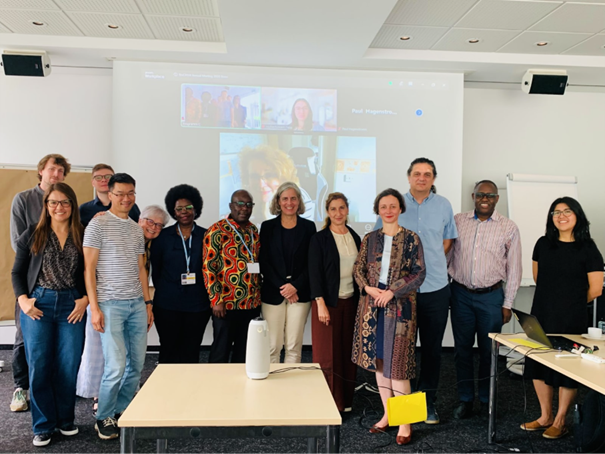
On 15-17 June, IDOS hosted the second in-person project workshop of the BioCAM4 research project, which focuses on better alignment of climate and biodiversity action on global and local levels. Bringing together partners from seven countries, the gathering included two outward-facing events, a book and a database launch as well as three intensive days of team workshops.
Climate change and biodiversity loss are two deeply intertwined crises, yet they frequently remain addressed separately. Having kicked off in 2024, the BioCAM4 project is now in the middle of activities, bridging global level mapping methodologies with local level deep dives in Central America and East Africa.
On June 15, the workshop started with a dedicated workshop day for the case studies, bringing together partner organisations from the Africa Research and Impact Network (ARIN), Greater Virunga Transboundary Collaboration (GVTC), Centro Agronómico Tropical de Investigación y Enseñanza (CATIE), York University and IDOS for focused discussions on deep dive studies in Rwanda, Kenya, and Guatemala. In the evening, in a collaboration with the partnering projects ACHIEVE and CAMDA, BioCAM4 and IDOS hosted an outward-facing event, bringing together representatives from COP 30 and 31, UNFCCC, as well as several non-state organisations. The evening included a discussion on the integrity of transnational climate action as well as the launch of the CoAct Database. Following this, workshop days 2 and 3 brought the main project workshop, an official BioCAM4 side event at SB64, and the launch of the book „Reclaiming Knowledge“ by BioCAM4 partner organisation ARIN.
Throughout the workshop, participants emphasised the benefits of South-North, and especially South-South learning and cooperation, as well as the need for global climate and biodiversity governance and research in touch with local realities and landscapes. Motivated by this second project workshop, BioCAM4 will continue to contribute to this goal, going into the second half of project activities.

Schreibe einen Kommentar