NRW Science Dialogue II highlights understanding of mandates and approaches to assessing impact.
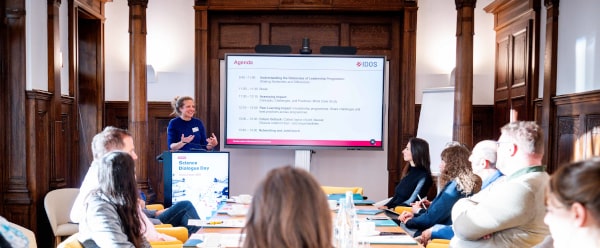
On 8 December 2025, the second edition of the NRW Science Dialogue took place at the Academy of International Affairs (AIA) in Bonn. Under the title „NRW Science Dialogue II – Empowering Leadership Programmes: Understanding Rationales and Assessing Impact”, the meeting brought together leadership programmes across NRW. The event was organised by the Managing Global Governance (MGG) Programme of the German Institute of Development and Sustainability (IDOS), kindly hosted by AIA, and opened by the AIA Director, Dr Mayssoun Zein Al Din.
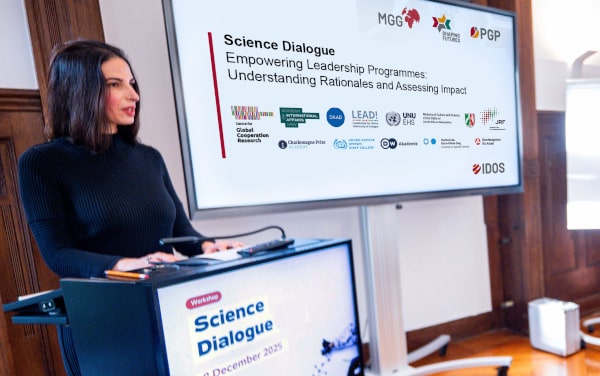
The NRW Science Dialogue is a collaborative format initiated by the MGG Programme to strengthen exchange and cooperation among leadership academies and training programmes in North Rhine-Westphalia (NRW) that are committed to sustainable development and international cooperation. Following the first Dialogue dealing with Strategies for Diversity and Inclusion held at IDOS in 2024, the second edition continued the joint learning process by focusing on two core themes: (1) understanding the conceptual rationales and evolving mandates of leadership programmes, and (2) exploring approaches to assessing their impact.
The NRW Science Dialogue format brings together directors and coordinators of leadership programmes across NRW that prepare professionals and emerging leaders for global challenges. Participating institutions included: the Academy of International Affairs (AIA), the Charlemagne Prize Academy, leadership programmes at the University of Cologne and the German Academic Exchange Service (DAAD), the Deutsche Welle Akademie, leadership programmes by the United Nations (UN) and IDOS programmes including the Managing Global Governance (MGG) Academy, Shaping Futures: African-European Network on Development and Sustainability Academy (SF), and the Postgraduate Programme for Sustainability Cooperation (PGP).
This diverse group reflects the broader ecosystem of leadership and capacity-development initiatives that have been developed across NRW in response to complex geopolitical, ecological, and social transformations. The Science Dialogue provides these institutions with a dedicated platform for structured reflection, peer learning, and mutual support.
The exchange in 2025 explored the conceptual foundations of leadership initiatives, their strategic aims, and their cooperation philosophies. A central part of the day focused on impact assessment and theories of change – a topic of growing relevance as leadership programmes seek to demonstrate how they contribute to individual, organisational, and systemic transformation. As part of this session, insights from the recently published IDOS Discussion Paper on the impact of global governance networks were presented to illustrate pathways to change and enabling conditions that support collaboration and innovation, taking the example of the MGG Network.
The Science Dialogue concluded with a joint discussion on opportunities for further cooperation, shared research interests, and follow-up activities. Participants identified avenues for deepening peer learning, strengthening coordination across institutions, and jointly advancing methodologies for assessing the impact of leadership development in times of uncertainty.
The workshop was facilitated by Dr Johanna Vogel and Dr Wulf Reiners (IDOS, MGG Programme) and warmly hosted by the Academy of International Affairs (AIA).

Schreibe einen Kommentar