
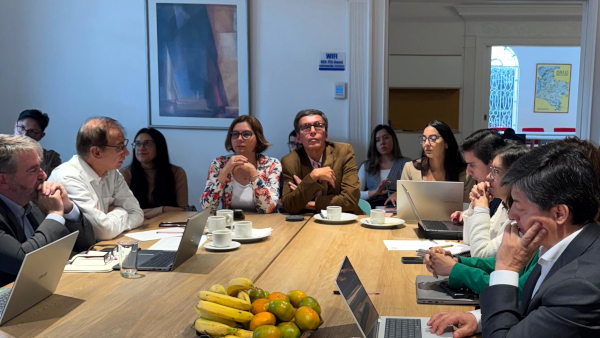
The Colombian TECR was presented at a Forum on Tax Expenditures, organised by the Friedrich Ebert Foundation in Colombia (FESCOL) in partnership with the Fiscal Observatory of Pontificia Universidad Javeriana and IDOS on 22 October in Bogotá, Colombia.
In their presentation, the authors of the report, Profs Mauricio Salazar and Liliana Heredia from the Fiscal Observatory, highlighted that Colombia makes extensive use of tax expenditures without having introduced a solid evaluation framework that would combine ex-ante assessments with ex-post cost-benefit analyses. In fact, as shown by the TECR, revenue forgone from tax expenditures amounted to 7.8 percent of GDP in 2022, of which 5.6 percent correspond to VAT-related measures alone. This poses serious strains on the government’s budget.
Vice-Minister Leonardo Pazos from the Colombian Ministry of Finance welcomed the report as an important contribution to the ongoing debate on the rationalisation of tax expenditures in that country. He also emphasised the need to strengthen the linkages between tax expenditures and development planning.
Javier Ávila Mahecha from the Colombian Revenue Authority (DIAN) commented on the governance of tax expenditures, calling for a better cooperation between public entities, including the planning authority (DNP), the statistics department (DANE) and the comptroller’s office. He also suggested that putting a cap on certain tax incentives could contribute to improving the fiscal sustainability and medium-term management of tax expenditures.
IDOS‘ Dr Christian von Haldenwang put the Colombian TECR in a broader context of international efforts to improve the transparency and effectiveness of tax expenditures. The Colombian report is part of a series of country reports that started in 2024. So far, seven such reports have been published, with another six reports currently in the pipeline.
In addition, tax expenditures are increasingly discussed in international fora, such as the 4th International Conference on Financing for Development that took place in Seville in June this year. Harmonising the way how countries and jurisdictions define tax expenditures and the underlying benchmark tax system, and how they report on the tax expenditures they use, is an ambitious goal and a key step towards tax expenditure rationalisation.
Further information on the Global Tax Expenditures Database (GTED), the Global Tax Expenditures Transparency Index (GTETI) and related activities can be found on the website of the Tax Expenditures Lab, a joint initiative of IDOS with the Council on Economic Policies (CEP).

Schreibe einen Kommentar